

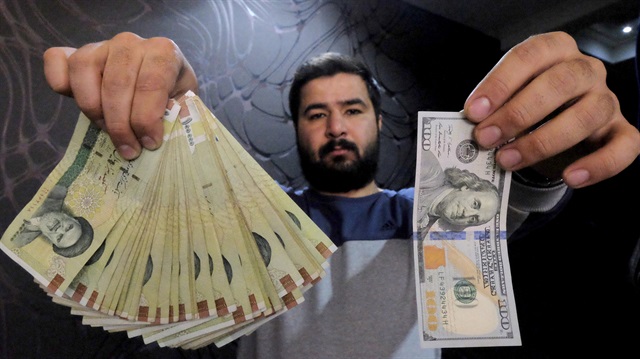
File photo
The Iranian rial hit a record low against the U.S. dollar on the unofficial market on Monday, amidst a deterioration in the economic situation and the reimposition of sanctions by the United States.
The dollar was being offered for as much as 128,000 rials, according to foreign exchange website Bonbast.com, which tracks the unofficial market.
The currency has been volatile for months because of a weak economy, financial difficulties at local banks and heavy demand for dollars among Iranians who fear the pullout of Washington from a landmark 2015 nuclear deal and renewed U.S. sanctions against Tehran could shrink the country's exports of oil and other goods.
The UK's top share index rose on Monday, starting September on a stronger note as a weaker pound and a bounce across commodity stocks helped British equities outperform continental peers. The blue chip FTSE 100 index was up 0.8 percent at 7,493.04 points by 0857 GMT, while mid caps edged 0.2 percent higher.A rise in oil stocks contributed more than 13 points to the FTSE 100, the biggest sectoral boost to the index.Shares in Royal Dutch Shell and BP were up 1.5 percent and 1.2 percent respectively as the price of oil rose, supported by concerns that falling Iranian output will tighten markets once U.S. sanctions hit in November.A firmer copper price also buoyed UK mining stocks, with Glencore, BHP Billiton and Anglo American up as much as 1.4 percent.Other major stock markets across Europe were subdued on Monday, however, as investors fretted about an escalation in the trade war between the United States and China, which also weighed on Asian markets overnight."Investors still have mixed outlooks regarding the global trade situation as well as the turmoil in emerging markets caused by the recent Turkish Lira crisis and this means fewer traders are going long on stocks right now," Pierre Veyret, technical analyst at ActivTrades, said.A weaker pound was another factor keeping the FTSE in positive territory. A fresh round of Brexit-related headlines dented demand for the currency, as critics at home and abroad ramped up their opposition to Prime Minister Theresa May's plans for leaving the European Union.A depressed pound lifted the FTSE 100's big, dollar-earning constituents on the day.However, worries over Brexit kept investors cautious on UK equities."The UK is a defensive, high-dividend yielding market which might have a problem if bond yields move sustainably higher, and if global equities advance, as we expect," equity strategists at J.P. Morgan said in a note. They are underweight UK equities."We look for a stronger GBP, which will weigh on the performance of FTSE 100."Veterinary firm Dechra Pharmaceuticals was the biggest faller among mid cap stocks, its shares tumbling 15 percent and on track for their biggest one-day loss since January 2003.Dechra Pharma dropped after it said it would implement a plan to navigate a hard Brexit, adding that the measure may result in 2 million pounds ($2.6 million) of additional expense.Analysts at Investec said that while Dechra's preliminary results were ahead of their expectations, they were introducing some caution into their forecasts to reflect the potential impact of accounting standard changes, sanctions on Iran and a hard Brexit. BoE and UK finance ministry discussing extending Carney's time as governorUK factories feel pinch from global economy as export orders fall
Weak pound, higher commodity stocks boost Britain's FTSE 100
Israel's defence minister signalled on Monday it could attack suspected Iranian military assets in Iraq, as it has done by carrying out scores of air strikes in civil war-torn Syria."We are certainly monitoring everything that is happening in Syria, and regarding Iranian threats we are not limiting ourselves just to Syrian territory. This also needs to be clear," Avigdor Lieberman told a conference in Jerusalem.Asked if this included Iraq, where sources told Reuters that Iran has given ballistic missiles to Shi’ite proxies, Lieberman responded: "I am saying that we will contend with any Iranian threat, and it doesn't matter from where it comes ... Israel's freedom is total. We retain this freedom of action." 
Israel signals it could target Iranian military assets in Iraq
Iranian Foreign Minister Mohammad Javad Zarif traveled to Damascus on Monday for talks with Syrian officials, the Tasnim news agency reported.Iranian forces have backed Syrian President Bashar al-Assad in the country’s civil war.Last week, Iran's defence minister traveled to Damascus and signed an agreement for defence cooperation between the two countries with his Syrian counterpart.Iranian President Hassan Rouhani is scheduled to meet Russian President Vladimir Putin and Turkish President Recep Tayyip Erdoğan in Iran, Iran's foreign ministry spokesman Bahram Qassemi said Monday, according to Fars News.Turkish warships at the ready in East Med as Idlib battle looms"I'm optimistic that this meeting will be successful and productive for the region, the people of Syria and the fight against terrorism," Qassemi said.Fars News said the leaders would meet on Friday.The meeting comes as Syrian government forces are preparing a phased offensive in the northwestern province of Idlib and surrounding areas, the last big opposition enclave."Iran, as a supporter of the Syrian government, is present and will continue its advisory help as long as the Syrian government wants," Qassemi said, according to Fars News.391 civilians killed in Syria in August: NGOUS sees assault on Idlib as escalation of Syria conflict: Pompeo
Iran foreign minister arrives in Damascus for talks with Syrian officials