

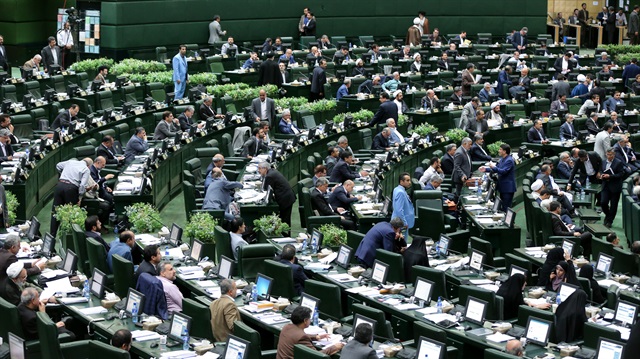
File photo
Iran's parliament sacked the minister of economic affairs and finance on Sunday, state media said, amid a sharp fall in the rial currency and a deterioration in the economic situation.
The Iranian economy is dogged by high unemployment and the rial has lost half its value since April. The United States reimposed some sanctions in early August and a second set targeting Iran's oil industry is due to take effect in November.
The head of the elite Revolutionary Guards said Iran faced "unique" challenges and the foreign minister accused the United States of waging "psychological war" on his country.
The Iranian parliament backed the removal from office of Masoud Karbasian, minister of finance and economic affairs, by 137 votes to 121 against, state media said.
The sacking was the latest in a continuing shakeup of top economic personnel. In early August Iranian lawmakers voted out the minister of labour and last month President Hassan Rouhani replaced the head of the central bank.
The U.S. sanctions, reimposed after President Donald Trump pulled the United States out of a 2015 international deal aimed at curbing Tehran's nuclear programme, have exacerbated an already difficult economic situation in Iran.
"(America's) focus is on a psychological war against Iran and its business partners," Foreign Minister Mohammad Javad Zarif said on Sunday, according to the Tasnim news agency.
"From the time that Trump announced the withdrawal from the nuclear deal, America has not been able to reach its goals," Zarif added, according to the Iranian Students' News Agency (ISNA).
The European Union agreed 18 million euros ($20.6 mln) in aid for Iran on Thursday, including for the private sector, to help offset the impact of U.S. sanctions and salvage a 2015 deal that saw Tehran limit its nuclear ambitions.The announcement is part of the bloc's high-profile efforts to support the nuclear accord that President Donald Trump abandoned in May. It is part of a wider package of 50 million euros earmarked for Iran in the EU budget.The EU is working to maintain trade with Iran, which has threatened to stop complying with the nuclear agreement if it fails to see the economic benefits of relief from sanctions.The bloc's foreign policy chief Federica Mogherini said in a statement the bloc was committed to cooperation with Iran."This new package will widen economic and sectoral relations in areas that are of direct benefit to our citizens," she said.The bloc will spend 8 million euros on the Islamic Republic's private sector, including assistance for small and medium-sized enterprises and Iran's Trade Promotion Organisation.A further 8 million euros will go to environmental projects and 2 million euros to fighting harm caused by drugs. ($1 = 0.8744 euros) Iran sanctions are 'unjust and harmful': UN expertUK to help modify Iran’s Arak heavy-water nuke reactorIran's Revolutionary Guard says will raise defensive capabilities
EU agrees 18 mln euro development aid for Iran
"Complicated and sensitive" situation
Other parties to the 2015 accord - China, Russia, Germany, Britain and France - are trying to salvage the deal, which lifted some economic sanctions against Iran in return for curbs on Tehran's nuclear programme. But their companies now face the risk of U.S. penalties if they do business with Iran.
Washington also wants Tehran to end its support for militant groups in Syria and Iraq.
Protests linked to the tough economic situation in Iran began last December, spreading to more than 80 cities and towns and resulting in 25 deaths.
Sporadic protests, led by truck drivers, farmers and merchants in Tehran’s bazaar, have continued regularly since then and have occasionally resulted in violent confrontations with security forces.
The head of Iran's elite Revolutionary Guards, Major General Ali Jafari said on Sunday Iran was facing a "unique, complicated and sensitive" situation, with both external and internal threats to its security, Tasnim reported.
The U.S. withdrawal from the nuclear deal has undermined Rouhani, a relative pragmatist, and emboldened his hardline opponents who always opposed any compromises with Washington.
Zarif appeared to offer guarded criticism of Rouhani's opponents.
"There are some in the country who, instead of laying the groundwork for using the opportunities presented by the nuclear deal, chose a political fight," Zarif said, according to ISNA. "And this political fight led to despair and disappointment."
Iranian Defence Minister Amir Hatami arrived in Syria on Sunday for meetings with "senior defence and military officials" according to the Tasnim news agency.Iranian forces have backed Syrian President Bashar al-Assad in the country's civil war."We hope to have a productive role in the reconstruction of Syria," Hatami said on arrival in Syria, according to Fars News.U.S. National Security Adviser John Bolton said last week that Iran should remove its forces from Syria.Senior Iranian officials have said their military presence in Syria is at the invitation of the Assad government and they have no immediate plans to withdraw.More than 1,000 Iranians, including senior members of the elite Revolutionary Guards, have been killed in Syria since 2012.Ten killed in boiler explosion in IranMashhad hosts conference on Iran/Iraq/Syria cooperationUN invites Iran, Russia, Turkey to talks on Syria next monthMillions in rural Iran lack social securityEU agrees 18 mln euro development aid for Iran
Iran defence minister Amir Hatami arrives in Syria
America is waging a psychological war against Iran and its business partners, Foreign Minister Mohammad Javad Zarif said on Sunday, according to the Tasnim news agency."[America's] focus is on a psychological war against Iran and its business partners," Zarif said.President Donald Trump pulled the United States out of a 2015 nuclear deal between Iran and world powers in May and is reimposing sanctions on Tehran. Other parties to the accord are trying to find ways to save the agreement. UN invites Iran, Russia, Turkey to talks on Syria next monthEU agrees 18 mln euro development aid for IranUS disregard of legal process unacceptable: presidential aide
America is waging 'psychological war' against Iran