

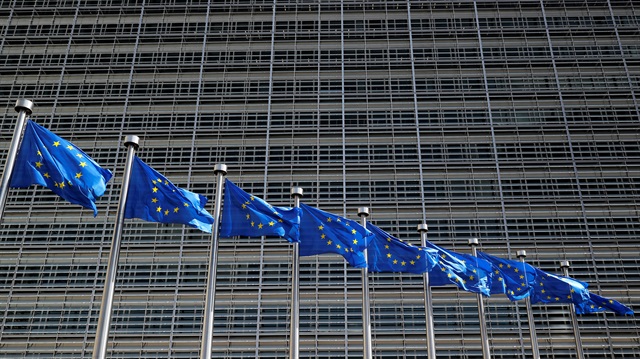
File photo
The European Union agreed 18 million euros ($20.6 mln) in aid for Iran on Thursday, including for the private sector, to help offset the impact of U.S. sanctions and salvage a 2015 deal that saw Tehran limit its nuclear ambitions.
The announcement is part of the bloc's high-profile efforts to support the nuclear accord that President Donald Trump abandoned in May. It is part of a wider package of 50 million euros earmarked for Iran in the EU budget.
The EU is working to maintain trade with Iran, which has threatened to stop complying with the nuclear agreement if it fails to see the economic benefits of relief from sanctions.
The bloc's foreign policy chief Federica Mogherini said in a statement the bloc was committed to cooperation with Iran.
"This new package will widen economic and sectoral relations in areas that are of direct benefit to our citizens," she said.
The bloc will spend 8 million euros on the Islamic Republic's private sector, including assistance for small and medium-sized enterprises and Iran's Trade Promotion Organisation.
A further 8 million euros will go to environmental projects and 2 million euros to fighting harm caused by drugs. ($1 = 0.8744 euros)
United Nations Special Rapporteur Idriss Jazairy slammed on Wednesday the recent U.S. sanctions against Iran, calling them “unjust and harmful”.In a written statement, the special rapporteur on the negative impact of sanctions said: “These unjust and harmful sanctions are destroying the economy and currency of Iran, driving millions of people into poverty and making imported goods unaffordable.”On Aug. 6, the U.S. re-imposed a first round of economic sanctions on Iran, which mainly target the country’s banking sector.The sanctions are intended to hinder Tehran's acquisition of U.S. currency, its precious metals trade, bank transactions denominated in the Iranian rial, activities related to Iran's sovereign debt, and the country’s automotive sector.In his statement, Jazairy questioned whether the United States would provide food and medicines to the millions of Iranians no longer able to afford them.“The current system creates doubt and ambiguity which makes it all but impossible for Iran to import these urgently needed humanitarian goods. This ambiguity causes a ‘chilling effect’ which is likely to lead to silent deaths in hospitals as medicines run out, while the international media fail to notice,” he said.The special rapporteur urged the U.S. to "demonstrate its commitment to allow agricultural commodities, food, medicine, and medical devices into Iran by taking real and concrete steps to ensure that banks, financial institutions and companies can quickly and freely be assured that relevant imports and payments are permitted”“Sanctions must be just, and must not lead to the suffering of innocent people,” Jazairy added.UK to help modify Iran’s Arak heavy-water nuke reactorIran's Revolutionary Guard says will raise defensive capabilitiesBolton reaffirms US not seeking regime change in IranIran cleric says Israel and US will be targeted if Washington attacks
Iran sanctions are 'unjust and harmful': UN expert
The U.K. will help Iran modify its Arak nuclear reactor after the U.S. withdrew from a 2015 nuclear deal between Tehran and world powers earlier this year, Iranian officials announced Wednesday.“The U.K. has replaced the U.S. in a working group tasked with modifying the Arak heavy reactor,” Ali Akbar Salehi, head of Iran’s Atomic Energy Agency, was quoted as saying by Iran’s Mehr News Agency.In mid-2015, Iran signed the landmark nuclear deal with the P5 1 group of nations (the five permanent UN Security Council members plus Germany).The agreement had placed tight restrictions on Iran’s nuclear program in exchange for billions of dollars in sanctions relief.In May of this year, however, U.S. President Donald Trump unilaterally withdrew his country from the agreement, which he had earlier described as the “worst deal ever”.Under the agreement’s terms, U.S. and Chinese experts had been tasked with modifying Iran’s heavy-water Arak reactor with a view to reducing its plutonium yield.Iran's Revolutionary Guard says will raise defensive capabilities
UK to help modify Iran’s Arak heavy-water nuke reactor
Iran's Islamic Revolutionary Guard Corps (IRGC) said on Wednesday it will continue increasing the country's defensive capabilities, and will not surrender to pressure over its missile programme."(Iran’s) missile programme has turned into the main challenge of the enemies of the Iranian nation, especially the United States, the Zionist regime (of Israel) and the Saudi rulers..."Increasing defensive capabilities will remain the main strategy of the armed forces," the IRGC said in a statement carried by the Tasnim news agency.Germany calls for end to US dominance in global financeBolton reaffirms US not seeking regime change in IranIran cleric says Israel and US will be targeted if Washington attacks
Iran's Revolutionary Guard says will raise defensive capabilities