

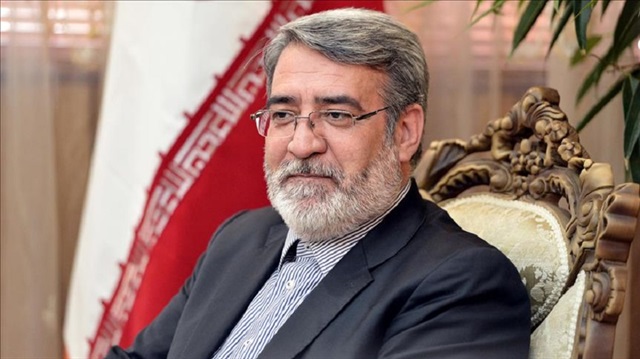
Interior Minister of Iran Abdolreza Rahmani Fazli
Iranian Interior Minister Abdolreza Rahmani Fazli arrived in Baghdad on Wednesday for security talks with Iraqi officials, according to Iraq’s Interior Ministry.
Talks will focus on bilateral security relations between the two countries, the ministry said in a statement.
The Iranian delegation includes Deputy Interior Minister for Security Affairs Hossein Zolfaghari, Border Guard Commander Brigadier General Qasem Rezaei and Interior Ministry media officer Seyed Ramazan Shojaei Kiasari.
On Aug. 2017, Baghdad and Tehran signed a memorandum of understanding for security cooperation.
A first phase of U.S. sanctions banning the sale of dollars, gold and other precious metals to Iran has tangibly impacted the lives of the Iranian people, most notably through soaring commodity prices.Although the government is trying to reign in inflation by adopting a raft of policy measures, prices continue to rise daily, especially in the housing, automotive and imported-goods sectors. Acute shortages of diapers and sanitary napkins have caused particular concern among many Iranians. At a recent meeting with President Hassan Rouhani and members of his cabinet, Supreme Leader Ayatollah Ali Khamenei asserted that Iran’s “enemies” had orchestrated the “diapers crisis” with a view to sowing anger among the Iranian people.Iran rial hits record low around 146,000 against dollarEarlier, Ahmad Jannati, chairman of Iran’s Assembly of Experts, a deliberative body, addressed the crisis during a session of parliament. In an interview with the Iranian Labor News Agency, Seyed Hassan Dokmehchi, head of the Iranian Drugstore Union, said 10 diaper factories had recently closed in Iran due to a lack of raw materials caused by the re-imposition of U.S. sanctions.According to the Tasnim News Agency (affiliated with Iran’s Revolutionary Guards, the price of one pack of 34 diapers recently jumped from 500,000 Iranian rials (slightly less than $5) to a current 850,000 rials (over $8). In November, a second phase of U.S. sanctions banning the purchase of Iranian oil and gas is expected to come into effect.Will Trump's trade war spur the dollar’s decline?Observers fear that this will lead to further price hikes for many basic commodities, including foodstuffs and medicine, the brunt of which will be borne by Iranian citizens.In mid-2015, Iran signed a landmark nuclear deal with the P5 1 group of nations (the five permanent UN Security Council members plus Germany).The agreement placed tight restrictions on Iran's nuclear program in exchange for billions of dollars in sanctions relief.In May of this year, however, U.S. President Donald Trump unilaterally withdrew his country from the agreement in a move heavily criticized by the deal's European signatories.Washington then re-imposed sanctions on Iran, which primarily target the country’s banking sector.
Iranian citizens feel sting of US sanctions
Iran rial extended its slide on Wednesday, hitting a record low around 150,000 against the dollar, according to foreign-exchange websites, as the country's economic fortunes ebb after the United States re-imposed sanctions.The dollar was being offered for 150,000 rials, compared with about 138,000 rials on Tuesday, according to website Bonbast.com, which tracks the unofficial market. The website bazar360.com also quoted 150,000. Mesghal.online gave an exchange rate of 152,530.The rial has lost more than two-thirds of its value this year because of a weak economy, financial difficulties at local banks and heavy demand for dollars among Iranians. Many fear the Washington's pulling out of a 2015 nuclear deal and renewed U.S. sanctions will cut into Iran’s exports of oil and other goods.A set of U.S. sanctions targeting Iran’s oil industry is due to take effect in November.Iranian rial hits record low at 128,000 to the dollarLast week, Iran’s parliament sacked the minister of economic affairs and finance, the latest in a continuing shakeup of top economic personnel. In early August, Iranian lawmakers voted out the minister of labour and in July President Hassan Rouhani replaced the head of the central bank.Protests linked to the tough economic situation erupted last December, spreading to more than 80 cities and towns and resulting in 25 deaths.Sporadic protests, led by truck drivers, farmers and merchants in Tehran’s bazaar, have continued since then and have occasionally resulted in violent confrontations with security forces.
Iran rial hits record low around 146,000 against dollar