

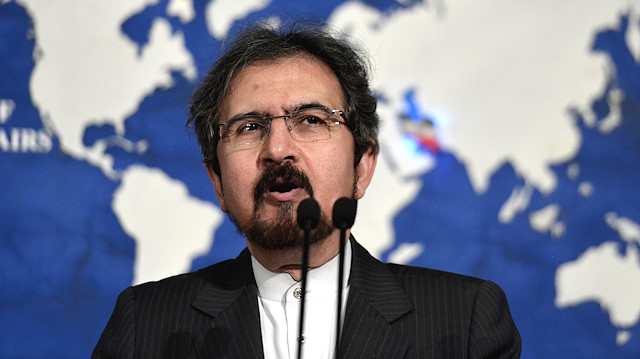
Bahram Qasemi
Iran is still hopeful that Europe can save a 2015 nuclear deal between Tehran and six major powers despite the withdrawal of the United States, Iranian Foreign Ministry spokesman Bahram Qasemi said on Monday.
"There are some ambiguities on implementation of EU's mechanism to protect trade with Iran from America's sanctions ... But we remain hopeful that the Europeans can save the deal," Qasemi told a weekly news conference, broadcast live on state TV.
Other signatories of the deal have been trying to salvage it since May, when U.S. President Donald Trump abandoned the accord. The United States also restored sanctions targeting Iran's oil, banking and transportation sectors earlier this month.
Iraq and Iran are seeking to bolster the volume of their trade exchange, Iraqi President Barham Salih said Saturday.“We have close relations with Iran and we are keen on developing them,” Salih told a press conference following his talks with Iranian President Hassan Rouhani in the capital Tehran.“It’s time to establish a regional system that serves peoples of the region,” he said.“We want Iraq to be an area for conciliation between the region’s countries, not an area for conflict,” he said, in reference to the current tension between the U.S. and Iran.Salih’s visit to Iran is the first by the Iraqi president since he assumed office last month.Rouhani, for his part, said his talks with the Iraqi leader tackled energy cooperation between the two countries.“We also discussed the extension of a rail line between the Iranian city of Shalamjah and Basra in southern Iraq,” he said.“We seek to increase the volume of the trade exchange with Iraq to $20 billion annually,” Rouhani said.The remarks by the Iraqi and Iranian leaders come against recent sanctions imposed by the U.S. against Iran.The U.S. has issued Iraq a 45-day waiver from U.S. sanctions on Iran for natural gas and electricity imports, the U.S. Embassy in Baghdad announced last week.Iraq, which is struggling with electricity outages and insufficient power generation, is reliant on its neighbor for natural gas imports for its power stations.The second wave of renewed U.S. sanctions on OPEC's third largest exporter officially started Nov. 5, targeting Iran's energy, shipbuilding, shipping and financial sectors.The Donald Trump administration also granted China, Greece, India, Turkey, Italy, Japan, South Korea and Taiwan a 180-day waiver for Iranian oil imports.Iraq restarts some Kirkuk oil flows after year-long haltYPG is 'Syrian offshoot' of PKK terror group: US envoyIraqi president arrives in Jordan for official visitTurkey neutralizes four PKK terrorists in northern Iraq
Iraq, Iran seek to boost trade ties despite sanctions
Iran and Iraq could raise their annual bilateral trade to $20 billion from the current level of $12 billion, President Hassan Rouhani said on Saturday, amid concerns in Tehran over the economic impact of renewed U.S. sanctions.Rouhani's remarks, made after a meeting with visiting Iraqi President Barham Salih, came about two weeks after the United States restored sanctions targeting Iran’s key oil industry as well as its banking and transportation sectors."... through bilateral efforts, we can raise this figure (for bilateral trade) to $20 billion in the near future," Rouhani said in comments broadcast live on Iranian state television."We held talks on trade in electricity, gas, petroleum products and activities ... in the field of oil exploration and extraction," Rouhani said.Iraq restarts some Kirkuk oil flows after year-long haltIraqi officials told Reuters last week that Iraq had agreed to trade Iraqi food items in return for Iranian gas and energy supplies.Baghdad is seeking U.S. approval to allow it to import Iranian gas for its power stations. Iraqi officials say they needs more time to find an alternative source than a 45-day waiver granted to it by the United States."It will be important to create free trade zones at our shared border and to connect the two countries' railways," Salih said."We will not forget your support for the Iraqi people in the fight against (Iraqi dictator) Saddam (Hussein). Neither do we forget Iran's stand in the recent fight against terrorism," added Salih.YPG is 'Syrian offshoot' of PKK terror group: US envoyIran wields wide influence in Iraq, its smaller Arab neighbour, where its Revolutionary Guards played a key role in training and arming the mainly Shi’ite militias that helped defeat Daesh.Iraq imports a wide range of goods from Iran, including food, agricultural products, home appliances, air conditioners and spare car parts. The goods element of Iranian imports to Iraq was worth about $6 billion in the 12 months ending March 2018, or about 15 percent of Iraq’s total imports for 2017.Energy contracts also contribute to the total volume of bilateral trade.Iraqi central bank officials said in August that their country’s economy was closely linked to non-Arab Iran, which is engaged in several proxy wars with Saudi Arabia in the region.Iraqi president arrives in Jordan for official visitUS comes to Talabani’s rescue as Barzani attempts coup after KRG referendum
Rouhani sees Iran, Iraq expanding trade despite US sanctions