

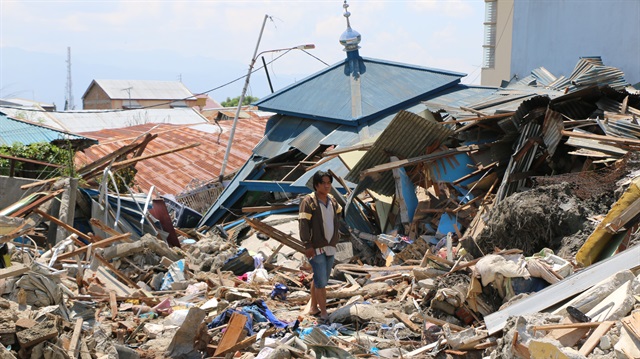
Most of the dead have been from the small city of Palu
Indonesian President Joko Widodo ordered more rescuers to be sent in to find victims of a devastating earthquake and tsunami on Tuesday as the official death toll rose above 1,200 and looting raised fears of growing lawlessness.
Most of the dead have been from the small city of Palu, 1,500 km (930 miles) northeast of Jakarta, but some remote areas have been cut off since Friday's 7.5 magnitude quake triggered tsunami waves, leading to fears the toll could soar.
"There are some main priorities that we must tackle and the first is to evacuate, find and save victims who've not yet been found," Widodo told a government meeting to coordinate disaster recovery efforts on the west coast of Sulawesi island.
He said he had ordered the national search and rescue agency to send more police and soldiers into the affected districts, some cut off by destroyed roads, landslides and downed bridges.
The official death toll surged to 1,234, the national disaster agency said.
The Red Cross said the situation was "nightmarish" and reports from its workers venturing into one cut-off area, Donggala, a region of 300,000 people north of Palu and close to the epicentre, indicated it had been hit "extremely hard".
Four badly hit districts have a combined population of about 1.4 million.
Indonesia's geophysics agency lifted a tsunami warning 34 minutes after it was first issued following a major earthquake that sent huge waves crashing into the northeastern coast of Sulawesi island, killing hundreds and leaving thousands more homeless.The 7.5 magnitude quake and tsunami, which hit the city of Palu about 1,500 km (940 miles) from Jakarta and further along the coastline, killed at least 384 people. Officials said on Saturday the death toll was likely to rise.Hundreds of people had gathered for a festival on the beach in Palu on Friday when waves as high as six metres (18 feet) smashed onshore at dusk, sweeping many to their death.Video: Massive waves crash on shore as tsunami hits Indonesian island of SulawesiThe geophysics agency (BMKG) faced criticism on Saturday on social media, with many questioning if the tsunami warning was lifted too soon.The agency said it followed standard operating procedure and made the call to "end" the warning based on data available from the closest tidal sensor, around 200 km (125 miles) from Palu."We have no observation data at Palu. So we had to use the data we had and make a call based on that," said Rahmat Triyono, head of the earthquakes and tsunami centre at BMKG.He said the closest tide gauge, which measures changes in sea level, only recorded an "insignificant", six-centimetre (2.5 inches) wave and did not account for the giant waves near Palu.Video: At least 384 killed in Indonesian quake, tsunam"If we had a tide gauge or proper data in Palu, of course it would have been better. This is something we must evaluate for the future," said Triyono.It was not clear whether the tsunami, which officials say hammered Palu and the surrounding area at extremely high speeds measuring in the hundreds of kilometres per hour, occurred before or after the warning had been lifted."Based on the videos circulating on social media, we estimate the tsunami happened before the warning officially ended," Triyono said.Indonesia sits on the Pacific Ring of Fire and is regularly hit by earthquakes. The most devastating came on Boxing Day in 2004, when a magnitude 9.5 quake triggered a massive tsunami that killed around 226,000 people along the shorelines of the Indian Ocean, including over 126,000 in Indonesia.Indonesia: State of emergency in wake of quake, tsunamiThe scenic town of Palu sits at the mouth of a narrow bay in northeastern Sulawesi and is home to around 380,000 people. It was hit by a tsunami in 1927 and 1968, according to Indonesia's national disaster mitigation agency (BNPB).Baptiste Gombert, a geophysics researcher at University of Oxford, said it was "surprising" the quake had generated a tsunami.Friday's quake was recorded as a "strike-slip" event where neighbouring tectonic plates move horizontally against each other, rather than vertically, which is what usually generates a tsunami."There is some speculation that there was a landslide under the sea which displaced a lot of water and caused the tsunami," he said, adding the narrow bay may have concentrated the force of the waves as they moved toward the shore.Turkish aid agency sends team to quake-hit IndonesiaSutopo Purwo Nugroho, spokesman for the disaster agency, told reporters his team had been "preparing to send public warnings that were easy to understand" when the tsunami warning was "suddenly ended".The communications ministry said repeated warnings were sent out to residents via text message, but Nugroho said the quake had brought down the area's power and communications lines and there were no sirens along the coast.Indonesians took to social media to question the BMKG's move to lift the tsunami warning and a failure to release information in a timely manner."So upset.. the warning was lifted.. although a tsunami happened..." said one Twitter user @zanoguccy in a direct message to BMKG.Death toll jumps to 384 after tsunami, quake in Indonesia
Indonesia tsunami sensors missed huge waves: official
Indonesia declared a state of emergency Saturday for Sulawesi Island in the wake of a powerful earthquake and resulting tsunami.At least 384 people died after Friday's 7.7-magnitude earthquake and tsunami, said Sutopo Purwo Nugroho, spokesman for Indonesia’s disaster management agency (BNPB).According to local news outlets, the state of emergency was declared to mobilize all state units for aid and recovery efforts.The tsunami, towering up to three meters high, hit Palu, capital of the Central Sulawesi province, and the northeast of the nearby Donggala Regency.Turkish aid agency sends team to quake-hit IndonesiaAfter its 500-meter airstrip was damaged, Palu’s airport was closed to flights, excepting certain cargo planes. Indonesian President Joko Widodo ordered troops to the region to support search and rescue efforts.A hospital ship with medical equipment and nearly 100 specialist doctors is also being sent, said Indonesian officials.Local media said some 540 people were injured.Death toll jumps to 384 after tsunami, quake in IndonesiaThree more earthquakes with magnitudes 6.3, 6.9, and 7 hit the eastern island of Lombok in the last two months, killing a total of 563 people.Indonesia lies within the Pacific Ocean’s "Ring of Fire" where tectonic plates collide and cause frequent seismic and volcanic activity.On Dec. 26, 2004, a magnitude 9.1 earthquake struck the eastern coast of Sumatra, triggering a tsunami that killed around 230,000 people as it tore along the coasts of Sri Lanka, India, Malaysia, Indonesia, and Thailand.Video: At least 384 killed in Indonesian quake, tsunami 
Indonesia: State of emergency in wake of quake, tsunami
In Palu, tsunami waves as high as six metres (20 feet) smashed into the beachfront, while hotels and shopping malls collapsed in ruins and some neighbourhoods were swallowed up by ground liquefaction.
Among those killed were 34 children at a Christian bible study camp, a Red Cross official said.
The government has ordered aid supplies to be airlifted in but there's little sign of help on Palu's shattered streets and survivors appeared increasingly desperate.
A Reuters news team saw a shop cleared by about 100 people, shouting, scrambling and fighting each other for items including clothes, toiletries, blankets and water.
Many people grabbed diapers while one man clutched a rice cooker as he headed for the door. Non-essential goods were scattered on the floor amid shards of broken glass.
At least 20 police were at the scene but did not intervene. The government has played down fears of looting saying disaster victims could take essential goods and shops would be compensated later.
Indonesia is all too familiar with earthquakes and tsunamis. A quake in 2004 triggered a tsunami across the Indian Ocean that killed 226,000 people in 13 countries, including more than 120,000 in Indonesia.
It has said it would accept offers of international aid, having shunned outside help earlier this year when an earthquake struck the island of Lombok.
Indonesia will accept international help for disaster response and relief after a major earthquake and tsunami hit Sulawesi island, killing at least 832 people, the head of the Indonesian investment board said on Twitter on Monday.President Joko Widodo agreed to accept international help on Sunday night, Thomas Lembong said. Lembong said he would coordinate private sector help from around the world.Authorities scrambled to get food, aid and equipment into Sulawesi on Monday as the death toll appeared certain to rise, three days after the 7.5 magnitude quake and tsunami hit the island.Countries such as Thailand and Australia have already offered to help. Video: Search and rescue continues, after Indonesia quake and tsunami kills hundreds
Indonesia to accept international help after devastating quake and tsunami
Indonesian authorities scrambled on Monday to get aid and rescue equipment into quake-hit Sulawesi island and prepared to bury some of the dead, while shaken survivors streamed away from their ruined homes in search of food and shelter.The confirmed death toll of 1,203 looked certain to rise as rescuers reached devastated outlying communities hit on Friday by a 7.5 magnitude earthquake and subsequent tsunami waves as high as six metres (20 feet).Accounts filtering out of remote areas brought news of devastation, including the deaths of 34 children at a Christian study camp.Dozens of people were reported to be trapped in the rubble of several hotels and a mall in the small city of Palu, 1,500 km (930 miles) northeast of Jakarta, with hundreds more were feared buried in landslides that engulfed villages.Erdoğan: Turkey ready to help Indonesia heal its woundsPresident Joko Widodo told reporters getting those people out was a priority."The evacuation is not finished yet, there are many places where the evacuation couldn't be done because of the absence of heavy equipment, but last night equipment started to arrive," Widodo said."We'll send as much food supplies as possible today with Hercules planes, directly from Jakarta," he said, referring to C-130 military transport aircraft.The disaster agency said later more heavy equipment and personnel were needed to recover bodies.One woman was recovered alive from ruins overnight in the Palu neighbourhood of Balaroa, where houses were swallowed up when the earthquake caused soil liquefaction, the national rescue agency said.Rescuers search for survivors of Indonesian quake, tsunamiMost of the confirmed deaths were in Palu, a city of about 380,000 people, where authorities were preparing a mass grave to bury the dead as soon as they were identified.However, nearly three days after the quake, the extent of the disaster was not known with authorities bracing for the toll to climb - perhaps into the thousands - as connections with remote areas up and down the coast are restored.Of particular concern is Donggala, a region of 300,000 people north of Palu and close to the epicentre of the quake, and two other districts, which had been cut off from communications.The four districts have a combined population of about 1.4 million.Indonesia tsunami sensors missed huge waves: officialAid worker Lian Gogali, who had reached Donggala district by motorcycle, said hundreds of people facing a lack of food and medicine were trying to get out but evacuation teams had yet to arrive and roads were blocked."It's devastating," she told Reuters by text.Indonesian Red Cross spokeswoman Aulia Arriani said the situation in another of the affected districts, Sigi, was dire."My volunteers found 34 bodies buried under tsunami debris ... missing children who had been doing a bible camp," she said.Sulawesi is one of the earthquake-prone archipelago nation's five main islands and sits astride fault lines. Numerous aftershocks have rattled the region.Indonesia: State of emergency in wake of quake, tsunamiFUEL AND RICEPictures showed expanses of splintered wood, washed-up cars and trees mashed together, with rooftops and roads split asunder. Access to many areas is being hampered by damaged roads, landslides and collapsed bridges.A Reuters witness said queues at petrol stations on the approaches to Palu stretched for kilometres. Convoys carrying food, water and fuel awaited police escorts to prevent pilfering before heading towards the city while a stream of residents headed out.The state energy company said it was airlifting in 4,000 litres of fuel, while Indonesia's logistics agency said it would send hundreds of tonnes of rice.The government has allocated 560 billion rupiah ($37.58 million) for disaster recovery.Military aircraft were sent to bring people out of Palu, where crowds of people clutching bags and boxes were waiting at the airport, military official Bambang Sudewo told Metro TV.Video: Indonesia rushes aid to Sulawesi as death toll from quake climbsIt was hoped up to 1,500 people could be taken out every day, with children, women and the injured the priority, he said. Media footage showed chaotic scenes with officers struggling to keep order.Indonesia, which is on the seismically active Pacific Ring of Fire, is all too familiar with earthquakes and tsunamis. A quake in 2004 triggered a tsunami across the Indian Ocean that killed 226,000 people in 13 countries, including more than 120,000 in Indonesia.Questions are sure to be asked why warning systems set up after that disaster appear to have failed on Friday, and why more people in coastal areas had not moved to higher ground after a big quake, even in the absence of an official warning.Sutopo Purwo Nugroho, spokesman for the National Disaster Mitigation Agency, told reporters on Sunday none of Indonesia's tsunami buoys, one device used to detect waves, had been operating since 2012. He blamed a lack of funds.The meteorological and geophysics agency BMKG issued a tsunami warning after the quake but lifted it 34 minutes later, drawing criticism it had been too hasty.However, officials estimated the waves had hit while the warning was in force.The head of Indonesia's investment board said Widodo had agreed to accept international help and he would coordinate private sector assistance from around the world.
Indonesia rushes aid to Sulawesi as death toll from quake, tsunami passes 1,203
'Buried Fast'
Rescuers in Palu held out hope they could still save lives.
"We suspect there are still some survivors trapped inside," the head of one rescue team, Agus Haryono, told Reuters at the collapsed seven-storey Hotel Roa Roa.
About 50 people were believed to have been caught inside the hotel when it was brought down. About nine bodies have been recovered from the ruins and three rescued alive.
Haryono pored over the hotel's blueprints, searching for possible pockets and a way through to them. A faint smell of decomposition hung in the air.
Power has yet to be restored and aftershocks have rattled jangled nerves.
A particular horror in several areas in and around Palu was liquefaction, which happens when soil shaken by an earthquake behaves like a liquid.
About 1,700 houses in one neighbourhood were swallowed up, with hundreds of people believed buried, the national disaster agency said.
Before-and-after satellite pictures show a largely built-up neighbourhood just south of Palu's airport seemingly wiped clean of all signs of life by liquefaction.
Elsewhere, on the outskirts of Palu, lorries brought 54 bodies to a mass grave dug in sandy soil.
Most of the bodies had not been claimed, a policeman said, but some relatives turned up to pay respects to loved ones at the 50-metre (165 ft) trench, where the smell of decomposition was overpowering.
"It's OK if he's buried in the mass grave, it's better to have him buried fast," said Rosmawati Binti Yahya, 52, whose husband was among those placed in the grave, before heading off to look for her missing daughter.
More than 65,000 homes were damaged and more than 60,000 people have been displaced and are in need of emergency help, while thousands have been streaming out of stricken areas.
Commercial airlines have struggled to restore operations at Palu's damaged airport but military aircraft have taken some survivors out.
But thousands of people have been thronging the airport hoping for any flight out, and authorities have said a navy vessel capable of taking 1,000 people at a time would be deployed to help with the evacuation.
Sulawesi is one of the archipelago nation's five main islands.
Turkey is the first country in the world to respond a plea from the Indonesian government to provide humanitarian and emergency support to the quake-hit island of Sulawesi.In a Monday interview, Dandy Koswaraputra, the head of Anadolu Agency’s Indonesian Service based in the capital Jakarta, said that the Turkish Red Crescent and Istanbul-based Humanitarian Relief Foundation (IHH) were the first responders to the victims of Friday’s quake and resulting tsunami.The death toll from the 7.7-magnitude earthquake and tsunami on the island of Sulawesi has risen to 1,203, the country's disaster management agency said on Sunday.Indonesia says it needs more heavy equipment, rescuers in quake zoneThe IHH said in a statement that the group sent a five-person team as soon as the devastating earthquake struck and also launched a fundraising campaign for the quake victims.The Turkish Red Crescent also sent two specialized personnel to the region who started to work with the Indonesian Red Cross right away. The Turkish agency will appeal to Turkish nationals to help the Indonesian victims.Koswaraputra said the toll of casualties and damage could rise further as “some of the affected areas have not been reached yet by rescue teams due to infrastructure and communication concerns.”Indonesia to accept international help after devastating quake and tsunamiIndonesian President Joko Widodo visited Palu, Sulawesi’s capital, one of the cities hardest hit, to inspect the extent of the disaster and ongoing relief efforts. Widodo asked military and police commanders to deploy troops to help rescue teams and to secure everything there.Historic tragedyQuake-hit areas have reported some looting of basic needs from small markets due to the lack of security and food, according to Koswaraputra.“About 16,000 people are living in shelters without food, water, or sanitary supplies,” he said.Indonesia rushes aid to Sulawesi as death toll from quake, tsunami passes 1,203Prison breaks are also being reported in the region. “As many as 1,425 prisoners fled jail after burning down their detention buildings,” said the Anadolu Agency’s Indonesia bureau chief.The disaster in Central Sulawesi could be Indonesia’s second-largest tragedy, following the 2004 Aceh tsunami that killed more than 170,000 people, said Koswaraputra.He urged the Jakarta government to declare a state of emergency in the quake-hit areas and seek more international help to deal with the situation.“What the survivors need now are water, food, clothes, sanitary supplies, tents, medicine, doctors, and security,” he said.Koswaraputra said despite the poor infrastructure and communication woes, Anadolu Agency is providing its subscribers and readers with the latest quake updates with news stories, pictures, and videos from ground zero of the disaster.A team of Anadolu Agency journalists, cameramen, and photographers have already reached the scene to cover the disaster and aid efforts.Meanwhile, Turkish President Recep Tayyip Erdogan said his country is ready to provide all kind of support to Indonesia.“Turkey is prepared to do everything in its power to help Indonesia heal its wounds,” Erdogan said Sunday on Twitter.
Turkey first to reach Indonesian quake, tsunami victims
Indonesia's disaster agency said more heavy equipment and rescue personnel were needed to help recover bodies after Friday's quake and tsunami disaster.The agency had reported 844 confirmed dead by Monday, most of them in the city of Palu, but the toll was expected to rise with many areas yet to be reached by rescuers.Video: Death toll from Indonesia quake, tsunami reaches 1,203Police were providing escorts for aid convoys to prevent supplies being intercepted.Indonesia to accept international help after devastating quake and tsunamiIndonesia rushes aid to Sulawesi as death toll from quake, tsunami passes 840
Indonesia says it needs more heavy equipment, rescuers in quake zone