

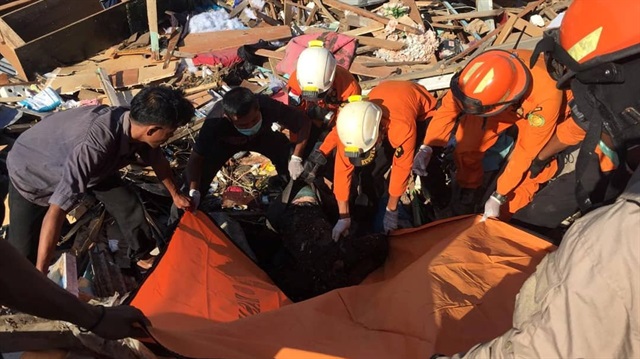
A body is recovered by Humas Basarnas in Palu, Indonesia September 30, 2018 in this picture obtained from social media.
Indonesia's disaster agency said more heavy equipment and rescue personnel were needed to help recover bodies after Friday's quake and tsunami disaster.
The agency had reported 844 confirmed dead by Monday, most of them in the city of Palu, but the toll was expected to rise with many areas yet to be reached by rescuers.
Various shots from Palu city after a 7.7 magnitude earthquake and tsunami in central Sulawesi, indonesia on September 28, 2018. The death toll from Friday's 7.7-magnitude earthquake and tsunami on the Indonesian island of Sulawesi has risen to 1,203, the country's disaster management agency said on Sunday.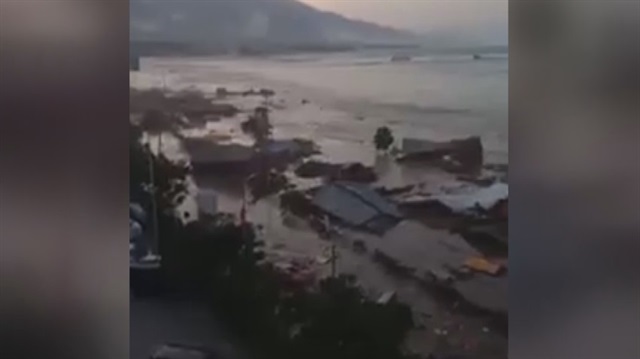
Death toll from Indonesia quake, tsunami reaches 1,203
Police were providing escorts for aid convoys to prevent supplies being intercepted.
Indonesia will accept international help for disaster response and relief after a major earthquake and tsunami hit Sulawesi island, killing at least 832 people, the head of the Indonesian investment board said on Twitter on Monday.President Joko Widodo agreed to accept international help on Sunday night, Thomas Lembong said. Lembong said he would coordinate private sector help from around the world.Authorities scrambled to get food, aid and equipment into Sulawesi on Monday as the death toll appeared certain to rise, three days after the 7.5 magnitude quake and tsunami hit the island.Countries such as Thailand and Australia have already offered to help. Video: Search and rescue continues, after Indonesia quake and tsunami kills hundreds
Indonesia to accept international help after devastating quake and tsunami
Indonesian authorities scrambled on Monday to get aid and rescue equipment into quake-hit Sulawesi island and prepared to bury some of the dead, while shaken survivors streamed away from their ruined homes in search of food and shelter.The confirmed death toll of 1,203 looked certain to rise as rescuers reached devastated outlying communities hit on Friday by a 7.5 magnitude earthquake and subsequent tsunami waves as high as six metres (20 feet).Accounts filtering out of remote areas brought news of devastation, including the deaths of 34 children at a Christian study camp.Dozens of people were reported to be trapped in the rubble of several hotels and a mall in the small city of Palu, 1,500 km (930 miles) northeast of Jakarta, with hundreds more were feared buried in landslides that engulfed villages.Erdoğan: Turkey ready to help Indonesia heal its woundsPresident Joko Widodo told reporters getting those people out was a priority."The evacuation is not finished yet, there are many places where the evacuation couldn't be done because of the absence of heavy equipment, but last night equipment started to arrive," Widodo said."We'll send as much food supplies as possible today with Hercules planes, directly from Jakarta," he said, referring to C-130 military transport aircraft.The disaster agency said later more heavy equipment and personnel were needed to recover bodies.One woman was recovered alive from ruins overnight in the Palu neighbourhood of Balaroa, where houses were swallowed up when the earthquake caused soil liquefaction, the national rescue agency said.Rescuers search for survivors of Indonesian quake, tsunamiMost of the confirmed deaths were in Palu, a city of about 380,000 people, where authorities were preparing a mass grave to bury the dead as soon as they were identified.However, nearly three days after the quake, the extent of the disaster was not known with authorities bracing for the toll to climb - perhaps into the thousands - as connections with remote areas up and down the coast are restored.Of particular concern is Donggala, a region of 300,000 people north of Palu and close to the epicentre of the quake, and two other districts, which had been cut off from communications.The four districts have a combined population of about 1.4 million.Indonesia tsunami sensors missed huge waves: officialAid worker Lian Gogali, who had reached Donggala district by motorcycle, said hundreds of people facing a lack of food and medicine were trying to get out but evacuation teams had yet to arrive and roads were blocked."It's devastating," she told Reuters by text.Indonesian Red Cross spokeswoman Aulia Arriani said the situation in another of the affected districts, Sigi, was dire."My volunteers found 34 bodies buried under tsunami debris ... missing children who had been doing a bible camp," she said.Sulawesi is one of the earthquake-prone archipelago nation's five main islands and sits astride fault lines. Numerous aftershocks have rattled the region.Indonesia: State of emergency in wake of quake, tsunamiFUEL AND RICEPictures showed expanses of splintered wood, washed-up cars and trees mashed together, with rooftops and roads split asunder. Access to many areas is being hampered by damaged roads, landslides and collapsed bridges.A Reuters witness said queues at petrol stations on the approaches to Palu stretched for kilometres. Convoys carrying food, water and fuel awaited police escorts to prevent pilfering before heading towards the city while a stream of residents headed out.The state energy company said it was airlifting in 4,000 litres of fuel, while Indonesia's logistics agency said it would send hundreds of tonnes of rice.The government has allocated 560 billion rupiah ($37.58 million) for disaster recovery.Military aircraft were sent to bring people out of Palu, where crowds of people clutching bags and boxes were waiting at the airport, military official Bambang Sudewo told Metro TV.Video: Indonesia rushes aid to Sulawesi as death toll from quake climbsIt was hoped up to 1,500 people could be taken out every day, with children, women and the injured the priority, he said. Media footage showed chaotic scenes with officers struggling to keep order.Indonesia, which is on the seismically active Pacific Ring of Fire, is all too familiar with earthquakes and tsunamis. A quake in 2004 triggered a tsunami across the Indian Ocean that killed 226,000 people in 13 countries, including more than 120,000 in Indonesia.Questions are sure to be asked why warning systems set up after that disaster appear to have failed on Friday, and why more people in coastal areas had not moved to higher ground after a big quake, even in the absence of an official warning.Sutopo Purwo Nugroho, spokesman for the National Disaster Mitigation Agency, told reporters on Sunday none of Indonesia's tsunami buoys, one device used to detect waves, had been operating since 2012. He blamed a lack of funds.The meteorological and geophysics agency BMKG issued a tsunami warning after the quake but lifted it 34 minutes later, drawing criticism it had been too hasty.However, officials estimated the waves had hit while the warning was in force.The head of Indonesia's investment board said Widodo had agreed to accept international help and he would coordinate private sector assistance from around the world.
Indonesia rushes aid to Sulawesi as death toll from quake, tsunami passes 1,203