

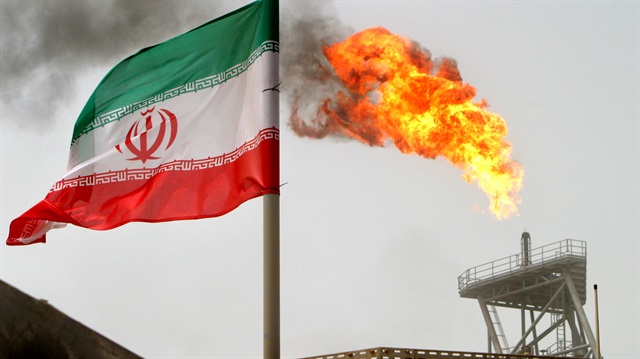
FILE PHOTO: A gas flare on an oil production platform in the Soroush oil fields is seen alongside an Iranian flag in the Persian Gulf, Iran.
Indian refiners cut imports of Iranian oil last month as they started weaning their plants off crude from the country to avoid sanctions by the United States that are set to take effect in November.
India's monthly oil imports from Iran declined to 592,800 barrels per day (bpd) in June, down 16 percent from May, according to data from industry and shipping sources.
The United States in May said it would reimpose the sanctions after withdrawing from a 2015 agreement with Iran, Russia, China, France, Germany, and Britain, where Tehran agreed to curb its nuclear activities in return for the lifting of earlier sanctions.
China is clearly angry about Washington's hard line on trade, but has controlled coverage of the row in its media, limiting open commentary and banning attacks on U.S. President Donald Trump, several sources with knowledge of the matter said.Beijing has issued unusually strict rules limiting coverage of the trade war because of worries that unrestrained reporting could spark instability or roil its already jittery financial markets, according to sources within Chinese state media."When exposing and criticising American words and actions, be careful not to link it to Trump and instead to aim it at the U.S. government," said a memo based on a set of directives issued verbally by government officials that was circulated to reporters at a state-run news outlet and seen by Reuters.China says will hit back after US proposes fresh tariffs on $200 bln in goodsMedia outlets must help "stabilise the economy, growth, employment, stabilise foreign trade, investment, finance, stabilise the stock market, the foreign exchange market, the housing market, and basically stabilise the peoples' thinking, hearts and expectations", it said.A person who works at a leading Chinese news website said the rules issued last week were "the most strict yet".The website was told to post only stories about the trade conflict by state news agency Xinhua, rather than publishing its own. It was also ordered to keep the topic out of the top few headlines and closely manage comments about it, according to the source.US readies $200 billion in additional Chinese tariffsThe website's smartphone app was no longer permitted to send push notifications on the subject to users, and the website was forbidden from setting up special pages about the dispute.Like other Chinese media workers who spoke with Reuters for this story, the source declined to be identified by name due to the sensitivity of the topic and because he was not authorised to speak publicly about it.Editors at several leading state-media outlets, including the China Daily, the Global Times and Xinhua, were not made available after Reuters requested interviews. The information office of the State Council, or cabinet, did not immediately comment on the state's efforts to censor news of the trade row.It was not immediately known if Beijing's attitude would change after the United States threatened further import duties on Chinese goods on Tuesday in a sharp escalation of the conflict between the world's two biggest economies.To be sure, there have been vitriolic editorials in key Chinese newspapers as the trade tensions have simmered.In recent weeks, state media have criticised U.S. behaviour as reckless, hegemonic, delusional, and accused the Trump administration of harbouring "blood lust" and behaving like a "gang of hoodlums".REVEALING CARDSBut the attacks have been general - there has been little mention of Trump, for instance - and few details on how China will be affected.Two sources at separate state-run news organisations said they had been instructed not to mention the impact of the trade war on Chinese companies in their coverage.At one large state news organisation, a fourth source said journalists had been instructed to report on Chinese company news with caution because some were already feeling the effects of the trade spat.Reporters at the news outlet, a key government mouthpiece, were directed not to stir up negative emotions or "reveal the cards" of Chinese importers, the source said.In disputes with South Korea and Japan in recent years, Beijing has taken a more aggressive stance and at times encouraged public anger.In 2012, state media tacitly supported anti-Japan protests during a spat over disputed islands, and last year the Communist Youth League helped target South Korean brands on social media amid a row over Seoul's decision to allow the United States to install an advanced missile defence system on the Korean peninsula.But the power imbalance in the China-U.S. trade dispute and the potential for real economic discomfort have led the control-obsessed leadership to adopt a softer approach, analysts said."They know the seriousness of the situation and the possible consequences, and they don't want the media coverage to bring any kind of extra damage," said Li Xigen, a professor in the department of Media and Communications at City University of Hong Kong."Later, as the situation gets worse, if the people are actually affected with their jobs, with prices ... that may become real anger, and if the media do anything to stir up that kind of anger it will cause some kind of very bad consequences."The trade war does not appear to be a hot item on China's tightly-controlled social media. Media sources said authorities were censoring anything found objectionable, minimising the prospect that any outcry on social media platforms could spur a backlash against U.S. brands.Wang Jiangyu, a trade expert at the National University of Singapore, said attacking U.S. firms could backfire."China might need to restrict the market access of American companies. But to purge American companies that are already operating in China might be a very bad idea. Those companies generate jobs and revenue for China. Most Apple products are made in China," he said."To do something to harm American firms that are already operating in China would be very stupid."
Keep calm, don't inflame trade row with US: China to its state media
The government of India, Iran's top oil client after China, asked refiners last month to prepare for drastic reductions or even zero Iranian oil imports.
The first set of sanctions will take effect on Aug. 6 and the rest, notably in the petroleum sector, following a 180-day "wind-down period" ending on Nov. 4.
U.S. officials said in June they would push countries to reduce their Iranian oil imports to zero. The Indian refiners will want to comply with the limits to maintain their access to the U.S. financial system.
"Trump administration will push for zero crude, condensate and products exports from Iran," said Sri Paravaikkarasu, Head of East of Suez Oil at energy consultancy FGE. "The zero tolerance policy and the pace with which it is moving no doubt concerns Iran’s current crude buyers."
Germany is not a prisoner of Russian policy, German Defence Minister Ursula von der Leyen said on Wednesday, reacting to U.S. President Donald Trump's accusation that Germany is "totally controlled" by Moscow."We have a lot of issues with Russia without any doubt," von der Leyen told a side event at the NATO summit, moments after Trump spoke at meeting in central Brussels."On the other hand, you should keep the communication line between countries or alliances and opponents without any question," she said when asked about about Trump's accusation, speaking in English.Trump lashes Germany over gas pipeline deal, calls it Russia's 'captive'
'We have issues with Russia,' Germany tells Trump
Overall, India's oil imports in June rose 10.1 percent from a year ago to 4.82 million bpd, the data showed. Overall purchases climbed on a higher intake of crude from Mexico, the United States and Azerbaijan. Imports from other Middle East suppliers also increased.
Lower purchases by private refiners dragged down India's June imports from Iran although state refiners stepped up purchases.
Sources told Reuters last month that private refiners Nayara Energy and Reliance Industries Ltd plan to halt Iranian oil imports. The two firms significantly cut their imports from Iran in June.
HPCL-Mittal Energy Ltd continued to skip Iran oil imports for a second month in June, the data showed.
State refiners, accounting for about 60 percent of India's nearly 5 million bpd of refining capacity, lifted 10 percent more Iranian volumes in June compared to May, at about 454,000 bpd, the data from the sources showed. The sources declined to be identified since they are not authorized to speak to the media.
On a yearly basis, India's imports from Iran were 19.5 percent higher, the data showed.
Indian state refiners had cut Iranian oil imports in the 2017/18 financial year because of a dispute over the development rights for an Iranian natural gas field.
However, the state refiners raised their imports in the current fiscal year starting in April after Iran offered free shipping and an extended credit period of 60 days.
For the first six months of 2018, India's Iranian oil imports increased by 8.4 percent to 585,000 bpd.
In April to June 2018, the first quarter of this fiscal year, India's oil imports from Iran rose by about 24 percent from the previous quarter to about 647,000 bpd, the data showed.
Imports by state refiners during the period more than doubled to about 413,400 bpd from 191,700 bpd, the data showed.
Indian refiners will likely gain more clarity on how much the United States would like them to cut after a meeting with U.S. officials scheduled for July 16 to 17, said an official with a state-run refiner who declined to be named due to the sensitivity of the matter.