

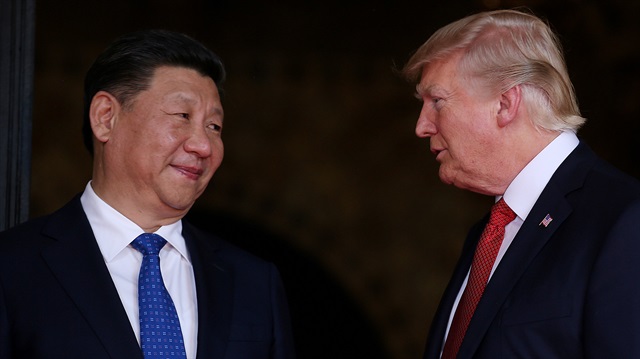
US President Donald Trump and Chinese President Xi Jinping
China is clearly angry about Washington's hard line on trade, but has controlled coverage of the row in its media, limiting open commentary and banning attacks on U.S. President Donald Trump, several sources with knowledge of the matter said.
Beijing has issued unusually strict rules limiting coverage of the trade war because of worries that unrestrained reporting could spark instability or roil its already jittery financial markets, according to sources within Chinese state media.
"When exposing and criticising American words and actions, be careful not to link it to Trump and instead to aim it at the U.S. government," said a memo based on a set of directives issued verbally by government officials that was circulated to reporters at a state-run news outlet and seen by Reuters.
China accused the United States of bullying and warned it would hit back after the Trump administration raised the stakes in their trade dispute, threatening 10 percent tariffs on $200 billion of Chinese goods.China's commerce ministry said on Wednesday it was "shocked" and would complain to the World Trade Organisation, but did not immediately say how it would retaliate. In a statement, it called the U.S. actions "completely unacceptable".The foreign ministry described Washington's threats as "typical bullying" and said China needed to counter-attack to protect its interests."This is a fight between unilateralism and multilateralism, protectionism and free trade, might and rules," foreign ministry spokeswoman Hua Chunying told a regular briefing on Wednesday.US readies $200 billion in additional Chinese tariffsBeijing has said it would hit back against Washington's escalating tariff measures, including through "qualitative measures," a threat that U.S. businesses in China fear could mean anything from stepped-up inspections to delays in investment approvals and even consumer boycotts.China could also limit visits to the United States by Chinese tourists, a business state media said is worth $115 billion, or shed some of its U.S. Treasury holdings, Iris Pang, Greater China economist at ING in Hong Kong, wrote in a note.The $200 billion far exceeds the total value of goods China imports from the United States, which means Beijing may need to think of creative ways to respond to such U.S. measures.On Tuesday, U.S. officials issued a list of thousands of Chinese imports the Trump administration wants to hit with the new tariffs, including hundreds of food products as well as tobacco, chemicals, coal, steel and aluminium, prompting criticism from some U.S. industry groups.It also includes consumer goods ranging from car tires, furniture, wood products, handbags and suitcases, to dog and cat food, baseball gloves, carpets, doors, bicycles, skis, golf bags, toilet paper and beauty products."For over a year, the Trump administration has patiently urged China to stop its unfair practices, open its market, and engage in true market competition," U.S. Trade Representative Robert Lighthizer said in announcing the proposed tariffs."Rather than address our legitimate concerns, China has begun to retaliate against U.S. products ... There is no justification for such action," he said in a statement.Last week, Washington imposed 25 percent tariffs on $34 billion of Chinese imports, and Beijing responded immediately with matching tariffs on the same amount of U.S. exports to China. Each side is planning tariffs on a further $16 billion in goods that would bring the totals to $50 billion.MARKETS RATTLEDInvestors fear an escalating Sino-U.S. trade war could hit global growth and damage sentiment.On Wednesday, the MSCI's broadest index of Asia-Pacific shares outside Japan was down about 1 percent, while the main indexes in Hong Kong and Shanghai recovered somewhat after falling more than 2 percent.S&P 500 and Dow futures dropped around 1 percent, pointing to a weak opening on Wall Street later on Wednesday.The onshore yuan tracked its offshore counterpart lower with traders closely watching the key 6.7 per dollar level as pressure mounted on the currency.U.S. President Donald Trump has said he may ultimately impose tariffs on more than $500 billion worth of Chinese goods - roughly the total amount of U.S. imports from China last year.The new list published on Tuesday targets many more consumer goods than those covered under the tariffs imposed last week, raising the direct threat to consumers and retail firms and increasing the stakes for lawmakers in Trump's Republican party facing elections in November.The list is subject to a two-month public comment period before taking effect.'TARIFFS ARE TAXES'Some U.S. business groups and lawmakers from Trump's own Republican Party were critical of the escalating tariffs.Senate Finance Committee Chairman Orrin Hatch said the announcement "appears reckless and is not a targeted approach."The U.S. Chamber of Commerce has supported Trump's domestic tax cuts and efforts to reduce regulation of businesses, but does not back Trump's aggressive tariff policies."Tariffs are taxes, plain and simple. Imposing taxes on another $200 billion worth of products will raise the costs of every day goods for American families, farmers, ranchers, workers, and job creators. It will also result in retaliatory tariffs, further hurting American workers," a Chamber spokeswoman said.Louis Kuijs, Hong Kong-based Head of Asia Economics at Oxford Economics, said while he expects China to strongly condemn the U.S. moves, its policy response is likely to be limited for now."In part because they have only limited ammunition and in part because it's still early in the process on the U.S. side," Kuijs said.Trump has been following through on pledges he made during his presidential campaign to get tough on China, which he accuses of unfair trade practices including theft of intellectual property and forced technology transfer that have led to a $375 billion U.S. trade deficit with China.China's exports have mushroomed since it joined the World Trade Organisation in 2001, making it the world's second-largest economy and prompting widening criticism in recent years from trading partners that it has unfairly used global trade rules to its advantage.As its dispute with Washington deepened, Beijing has been calling on other countries to support global free trade and has talked up efforts to ease investment rules. During a visit to Germany this week by Chinese Premier Li Keqiang, the countries signed business deals worth more than $23 billion."China stands in line with the international community on the correct side of history to together protect the rules of the multilateral trade order," foreign ministry spokeswoman Hua said on Wednesday.
China says will hit back after US proposes fresh tariffs on $200 bln in goods
Media outlets must help "stabilise the economy, growth, employment, stabilise foreign trade, investment, finance, stabilise the stock market, the foreign exchange market, the housing market, and basically stabilise the peoples' thinking, hearts and expectations", it said.
A person who works at a leading Chinese news website said the rules issued last week were "the most strict yet".
The website was told to post only stories about the trade conflict by state news agency Xinhua, rather than publishing its own. It was also ordered to keep the topic out of the top few headlines and closely manage comments about it, according to the source.
The U.S. on Tuesday announced it is readying 10 percent tariffs on an additional $200 billion worth of Chinese goods as Washington and Beijing escalate their growing trade war.U.S. Trade Representative Robert Lighthizer released the list of wide-ranging goods that could be penalized following a public hearing and comment period. The Chinese goods include meat, ornamental fresh and saltwater fish, a host of seafood including eel and bigeye tuna, burglar and fire alarms, fruits and vegetables, baseball gloves and rubber-based products.Last Friday, the U.S. imposed 25 percent tariffs on $34 billion worth of Chinese goods to which China quickly retaliated with an equivalent amount of penalties on American goods.Lighthizer called China's retaliatory levies "without any international legal basis or justification", stressing Washington took action to correct China's "abusive trading practices with regard to intellectual property and innovation"."China has been engaging in industrial policy which has resulted in the transfer and theft of intellectual property and technology to the detriment of our economy and the future of our workers and businesses," he said in a statement.President Donald Trump threatened China with escalating economic penalties last month if Beijing does not acquiesce to his demand to narrow the U.S.-China trade imbalance and halt other "unfair practices", threatening the additional $200 billion in tariffs announced Tuesday if China did not change course and change its trade practices.The latest wave of tariffs will reportedly go into effect sometime after the end of August.Lawmakers have increasingly voiced concern over Trump's protectionist economic policies, and Tuesday's actions drew quick concern on Capitol Hill.Republican Senate Finance Committee Chairman Orrin Hatch said the announcement "appears reckless and is not a targeted approach"."We cannot turn a blind eye to China’s mercantilist trade practices, but this action falls short of a strategy that will give the administration negotiating leverage with China while maintaining the long-term health and prosperity of the American economy," he said in a statement.
US readies $200 billion in additional Chinese tariffs
The website's smartphone app was no longer permitted to send push notifications on the subject to users, and the website was forbidden from setting up special pages about the dispute.
Like other Chinese media workers who spoke with Reuters for this story, the source declined to be identified by name due to the sensitivity of the topic and because he was not authorised to speak publicly about it.
Editors at several leading state-media outlets, including the China Daily, the Global Times and Xinhua, were not made available after Reuters requested interviews. The information office of the State Council, or cabinet, did not immediately comment on the state's efforts to censor news of the trade row.
It was not immediately known if Beijing's attitude would change after the United States threatened further import duties on Chinese goods on Tuesday in a sharp escalation of the conflict between the world's two biggest economies.
To be sure, there have been vitriolic editorials in key Chinese newspapers as the trade tensions have simmered.
In recent weeks, state media have criticised U.S. behaviour as reckless, hegemonic, delusional, and accused the Trump administration of harbouring "blood lust" and behaving like a "gang of hoodlums".
REVEALING CARDS
But the attacks have been general - there has been little mention of Trump, for instance - and few details on how China will be affected.
Two sources at separate state-run news organisations said they had been instructed not to mention the impact of the trade war on Chinese companies in their coverage.
At one large state news organisation, a fourth source said journalists had been instructed to report on Chinese company news with caution because some were already feeling the effects of the trade spat.
Reporters at the news outlet, a key government mouthpiece, were directed not to stir up negative emotions or "reveal the cards" of Chinese importers, the source said.
In disputes with South Korea and Japan in recent years, Beijing has taken a more aggressive stance and at times encouraged public anger.
In 2012, state media tacitly supported anti-Japan protests during a spat over disputed islands, and last year the Communist Youth League helped target South Korean brands on social media amid a row over Seoul's decision to allow the United States to install an advanced missile defence system on the Korean peninsula.
But the power imbalance in the China-U.S. trade dispute and the potential for real economic discomfort have led the control-obsessed leadership to adopt a softer approach, analysts said.
"They know the seriousness of the situation and the possible consequences, and they don't want the media coverage to bring any kind of extra damage," said Li Xigen, a professor in the department of Media and Communications at City University of Hong Kong.
"Later, as the situation gets worse, if the people are actually affected with their jobs, with prices ... that may become real anger, and if the media do anything to stir up that kind of anger it will cause some kind of very bad consequences."
The trade war does not appear to be a hot item on China's tightly-controlled social media. Media sources said authorities were censoring anything found objectionable, minimising the prospect that any outcry on social media platforms could spur a backlash against U.S. brands.
Wang Jiangyu, a trade expert at the National University of Singapore, said attacking U.S. firms could backfire.
"China might need to restrict the market access of American companies. But to purge American companies that are already operating in China might be a very bad idea. Those companies generate jobs and revenue for China. Most Apple products are made in China," he said.
"To do something to harm American firms that are already operating in China would be very stupid."