

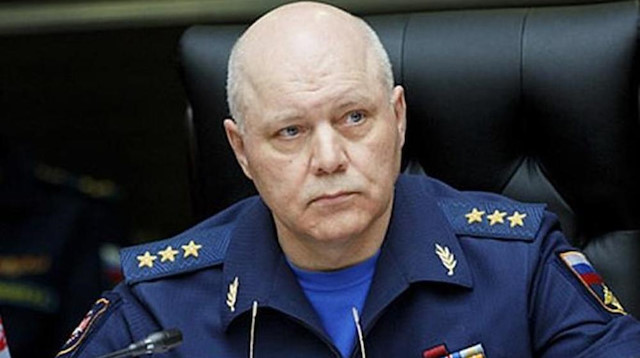
Igor Korobov
The head of Russia's GRU military intelligence agency that the West has blamed for a string of brazen attacks died on Wednesday after "a serious and long illness," the Russian defence ministry said.
State news agency TASS cited the ministry as saying Igor Korobov, 62, who ran the spy agency since 2016, had been made a Hero of Russia for his service in the post, the highest state award.
Britain has accused the GRU of attempting to poison former Russian spy Sergei Skripal and his daughter with a nerve agent in the city of Salisbury, the Netherlands has accused it of trying to hack the global chemical weapons watchdog, and U.S. intelligence agencies say it tried to hack the 2016 presidential election.
Russia denies all those allegations.
Russian Foreign Ministry called new U.S. sanctions against two Russian companies and an individual "clumsy" and "routine".In a statement published on its official website, the ministry said Russia supplied oil to the regime forces because they fought against terrorism."Trying to put pressure on Russia, Washington repeatedly demonstrates its inability to force our country to change its independent line on the world stage," it said.Iran decries latest round of US sanctionsU.S. politicians have to emerge from the illusion of omnipotence and realise the impossibility to influence Russia by the means of sanctions, it said.On Tuesday, the U.S. Treasury published a new sanction list which includes six individuals and three companies for assistance in the supply of oil to the Syrian government. The restrictions affected two Russian enterprises of Global Vision Group and Promsyreimport and the deputy director general Andrey Dogayev of the second company. In addition, restrictions were put on two Iranians, one Lebanese, one Syrian and one Iraqi, as well as a company registered in Iran.
Moscow slams new US sanctions
Speculation about Korobov's fate had been growing since an unconfirmed Russian media report that he had been summoned by President Vladimir Putin after the Skripal affair and severely criticised for the operation which left the Skripals alive and the GRU a target of mockery in the Western media.
Korobov was absent from a ceremony in Moscow this month where Putin and other senior officials celebrated the centenary of the GRU, with the Russian leader praising its skill and "unique abilities."
Operatives of the agency, widely known by its old acronym of GRU, set an example for a future generation of military spies, said Putin, himself a former intelligence officer, citing their readiness to sacrifice everything "for the motherland".
The Kremlin said on Wednesday that clear outside pressure had been exerted on a vote to elect a new head of Interpol, but that it did not see any factors that would render the election illegitimate, Russian news agencies reported.International police body Interpol elected Kim Jong-yang of South Korea as its president for a two-year term on Wednesday, beating a Russian national whose candidacy raised concerns in the West about the risk of Kremlin interference.The Kremlin regretted that Russia's candidate did not win, spokesman Dmitry Peskov was quoted as saying by Interfax news agency. 
Kremlin says there was clear pressure on Interpol vote
SOVIET VETERAN
Korobov's death paves the way for Putin to appoint a successor to head an agency that intelligence experts say has stepped up its covert missions as tension mounts between Russia and the West, which has imposed sanctions on Moscow over its annexation of Ukraine's Crimea.
Asked last month if there would be a shake-up at the defence ministry in the aftermath of the Skripal affair, the Kremlin said the low quality of the allegations levelled at GRU did not justify such changes.
The United States included Korobov's name on a March sanctions blacklist of people believed to have helped "undermine cyber security on behalf of the Russian government".
The United States has moved to disrupt an Iranian-Russian network that sent millions of barrels of oil to Syria and hundreds of millions of dollars to indirectly fund Hamas and Hezbollah.The complicated arrangement, described by the U.S. Treasury in a statement on Tuesday, involved a Syrian citizen using his Russia-based company to ship Iranian oil to Syria with the aid of a Russian state-owned company.Syria then helped transfer hundreds of millions of dollars in cash to Hezbollah, which functions as a political party that is part of the Lebanese government and as a militia, as well as to Hamas, the Palestinian group that rules the Gaza Strip.Since 2014, vessels carrying Iranian oil have switched off transponders to conceal deliveries to Syria, the Treasury Department said, adding it, the State Department and the U.S. Coast Guard had issued an advisory to the maritime community about the sanctions risks of shipping oil to Syria's government.US sends medical aid to PKK terrorists in Iraq’s QandilThe alleged arrangement shows how Russia has sought to undercut U.S. policy toward Syria, where Washington and Moscow back opposite sides of a civil war that began in 2011, as well as toward Iran, which the United States wants to curb its nuclear and missile programs and support for militant proxies."Today we are acting against a complex scheme Iran and Russia have used to bolster the (Syrian President Bashar al-) Assad regime and generate funds for Iranian malign activity," U.S. Treasury Secretary Steven Mnuchin said in a statement announcing sanctions on those it said were tied to the network."Central Bank of Iran officials continue to exploit the international financial system," he added.Richard Nephew, a sanctions expert at Columbia University, said: "The arrangement exposes Russia's efforts to support Assad for their own interests, which has the function of thwarting the U.S. desire to no longer have Assad in power."Israel vows to continue staging operations in SyriaThose targeted include Syrian Mohammad Amer Alchwiki and his Russia-based company Global Vision Group, which were central to the delivery of Iranian oil to Syria and the transfer of funds to the Islamic Revolutionary Guard Corps' Quds Force's "lethal proxies", the Treasury Department said in a statement.Other targets include Syrian national Hajji Abd Al-Nasir, Lebanon national Muhammad Qasim Al-Bazzal and Russian national Andrey Dogaev, as well as Iranian nationals Rasoul Sajjad and Hossein Yaghoubi Miab, the statement said.Sajjad and Yaghoubi, Central Bank of Iran officials, worked to facilitate Alchwiki's transfers, it said.Others sanctioned include state-owned Russian company Promsyrioimport, a subsidiary of the Russian Ministry of Energy, which the U.S. Treasury said had facilitated shipments of Iranian oil to Syria, as well as Mir Business Bank and Iran-based Tadbir Kish Medical and Pharmaceutical Company.Russia will continue supplying oil to Syria in line with its agreement with Damascus despite pressure from the United States, RIA news agency quoted Oleg Morozov, a member of the Russian Federation Council, as saying late on Tuesday."The political defeat in Syria apparently prompts the United States to return to the idea of regime change in Damascus. Therefore, economic pressure through oil supply shutdown becomes a tool of the new economic war with Bashar Assad and indirectly with Moscow and Iran," he said.According to Morozov, Russia acts and will act "absolutely legally"."We have an agreement with Syria and therefore it's up to us to decide what we supply and to whom. This will be our answer, (it is) much more effective than counter sanctions," he added.The Russian Energy Ministry, to which Promsyrioimport belongs, declined immediate comment.The Treasury's "designation" of the individuals and entities effectively cuts them off from the global financial system by blocking any of their assets under U.S. jurisdiction and in effect warning non-U.S. institutions against dealing with them.The United States is at odds with Britain, France and Germany as well as with Russia and China over U.S. President Donald Trump's May 8 decision to abandon the 2015 Iran nuclear deal, negotiated with the other world powers during Democratic President Barack Obama's administration.That agreement removed many U.S. and other economic sanctions from Iran in return for Tehran's commitment to curtail its nuclear program.Trump restored U.S. sanctions on Nov. 5 and has threatened more action to stop its "outlaw" policies.Iran, in turn, called Trump's actions economic warfare and vowed to defy the sanctions. European powers that continue to back the nuclear deal said they opposed the reapplication of sanctions. 
US targets Iran-Russia network over oil sent to Syria
Korobov was a Soviet military veteran who served in the air force and, according to his official biography, began working for the GRU in 1985.
The GRU, founded as the registration directorate in 1918 after the Bolshevik revolution, is one of Russia's three main intelligence agencies, alongside the domestic Federal Security Service and the SVR Foreign Intelligence Service.