

File photo
The United States has moved to disrupt an Iranian-Russian network that sent millions of barrels of oil to Syria and hundreds of millions of dollars to indirectly fund Hamas and Hezbollah.
The complicated arrangement, described by the U.S. Treasury in a statement on Tuesday, involved a Syrian citizen using his Russia-based company to ship Iranian oil to Syria with the aid of a Russian state-owned company.
Syria then helped transfer hundreds of millions of dollars in cash to Hezbollah, which functions as a political party that is part of the Lebanese government and as a militia, as well as to Hamas, the Palestinian group that rules the Gaza Strip.
Since 2014, vessels carrying Iranian oil have switched off transponders to conceal deliveries to Syria, the Treasury Department said, adding it, the State Department and the U.S. Coast Guard had issued an advisory to the maritime community about the sanctions risks of shipping oil to Syria's government.
The United States dispatched medical aid to the Kurdistan Workers’ Party (PKK) terror organization via Iraq’s Sulaimaniyah International Airport. Cargo planes landed at the airport and the aid was transported to Erbil before it was distributed to the PKK and its Syrian offshoot, the Democratic Union Party (PYD).Some of the aid was provided to terrorists stationed in Iraq’s Qandil, while another portion was sent to the PKK/PYD in Syria’s north.Northern Iraq’s Qandil Mountains have been a haven for PKK terrorists over the past few decades. Considered as the main base of the PKK, which control checkpoints and entrances to the mountains, the structuring in the area is used for cover and concealment by terrorists.UAE, Saudi Arabia dispatch troops to east of the Euphrates in SyriaApart from the medical aid that was stashed in thousands of boxes, mine detectors and light arms were also provided by the U.S. to the terror group.Military sources say that the U.S. has been sending necessities and medical aid as well as heavy arms to Qandil for quite some time, in addition to the 5,000 trucks of arms it sent to PYD in Syria under the pretext of fighting Daesh.Turkey reacts cautiously to US putting bounty on PKKThe U.S. has continued to aid the terror group despite placing a bounty on three key PKK terrorists in early November.Under the Rewards for Justice program, people who give information on the identification or location of PKK terrorists Murat Karayilan, Cemil Bayik, and Duran Kalkan are eligible for rewards of $3-5 million.Hundreds of US troops deploy to PKK-occupied areas on Turkey-Syria borderThe move was a "positive but belated" step, Turkish national defense minister said.The PKK is listed as a terrorist organization by Turkey, the European Union and the United States. The PKK has been conducting armed violence in the southeastern part of Turkey since 1984. More than 40,000 people, mostly civilians, have been killed in the three-decade long conflict.The U.S. and the coalition have largely ignored the PYD/YPG links to the PKK, which the U.S., EU, and Turkey list as a terrorist group.Suspected PKK terrorist arrested in southeastern TurkeyTurkish DefMin discusses Syria's Idlib with Russian counterpartSyrians continue to return to hometowns cleared of terrorists by Turkey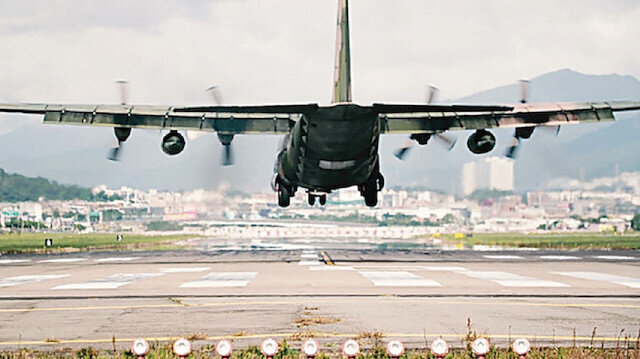
US sends medical aid to PKK terrorists in Iraq’s Qandil
The alleged arrangement shows how Russia has sought to undercut U.S. policy toward Syria, where Washington and Moscow back opposite sides of a civil war that began in 2011, as well as toward Iran, which the United States wants to curb its nuclear and missile programs and support for militant proxies.
"Today we are acting against a complex scheme Iran and Russia have used to bolster the (Syrian President Bashar al-) Assad regime and generate funds for Iranian malign activity," U.S. Treasury Secretary Steven Mnuchin said in a statement announcing sanctions on those it said were tied to the network.
"Central Bank of Iran officials continue to exploit the international financial system," he added.
Richard Nephew, a sanctions expert at Columbia University, said: "The arrangement exposes Russia's efforts to support Assad for their own interests, which has the function of thwarting the U.S. desire to no longer have Assad in power."
Israeli Army Chief-of-Staff Gadi Eizenkot on Tuesday vowed to continue working against what he described as Iranian attempts to establish a permanent military presence in Syria. “Iran’s capabilities in Syria are far from what it had hoped to achieve,” Eizenkot said while touring the Israeli-occupied Golan Heights.“This is due to ongoing Israeli actions,” he added, going on to assert that the Israeli military would “continue its efforts to thwart Iranian ambitions [in Syria], while safeguarding security in the north [i.e., the Golan region]”. In recent months, Israel has carried out a number of military operations inside Syrian territory targeting Syrian and Iranian military sites.
Israel vows to continue staging operations in Syria
Those targeted include Syrian Mohammad Amer Alchwiki and his Russia-based company Global Vision Group, which were central to the delivery of Iranian oil to Syria and the transfer of funds to the Islamic Revolutionary Guard Corps' Quds Force's "lethal proxies", the Treasury Department said in a statement.
Other targets include Syrian national Hajji Abd Al-Nasir, Lebanon national Muhammad Qasim Al-Bazzal and Russian national Andrey Dogaev, as well as Iranian nationals Rasoul Sajjad and Hossein Yaghoubi Miab, the statement said.
Sajjad and Yaghoubi, Central Bank of Iran officials, worked to facilitate Alchwiki's transfers, it said.
Others sanctioned include state-owned Russian company Promsyrioimport, a subsidiary of the Russian Ministry of Energy, which the U.S. Treasury said had facilitated shipments of Iranian oil to Syria, as well as Mir Business Bank and Iran-based Tadbir Kish Medical and Pharmaceutical Company.
Russia will continue supplying oil to Syria in line with its agreement with Damascus despite pressure from the United States, RIA news agency quoted Oleg Morozov, a member of the Russian Federation Council, as saying late on Tuesday.
"The political defeat in Syria apparently prompts the United States to return to the idea of regime change in Damascus. Therefore, economic pressure through oil supply shutdown becomes a tool of the new economic war with Bashar Assad and indirectly with Moscow and Iran," he said.
According to Morozov, Russia acts and will act "absolutely legally".
"We have an agreement with Syria and therefore it's up to us to decide what we supply and to whom. This will be our answer, (it is) much more effective than counter sanctions," he added.
The Russian Energy Ministry, to which Promsyrioimport belongs, declined immediate comment.
The Treasury's "designation" of the individuals and entities effectively cuts them off from the global financial system by blocking any of their assets under U.S. jurisdiction and in effect warning non-U.S. institutions against dealing with them.
The United States is at odds with Britain, France and Germany as well as with Russia and China over U.S. President Donald Trump's May 8 decision to abandon the 2015 Iran nuclear deal, negotiated with the other world powers during Democratic President Barack Obama's administration.
That agreement removed many U.S. and other economic sanctions from Iran in return for Tehran's commitment to curtail its nuclear program.
Trump restored U.S. sanctions on Nov. 5 and has threatened more action to stop its "outlaw" policies.
Iran, in turn, called Trump's actions economic warfare and vowed to defy the sanctions. European powers that continue to back the nuclear deal said they opposed the reapplication of sanctions.