

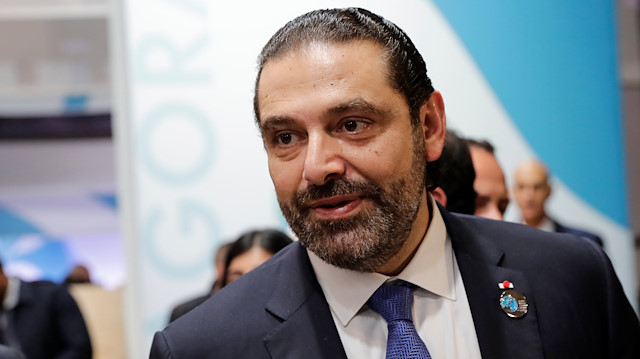
Saad Hariri
Lebanese Prime Minister-designate Saad Hariri, who was detained by Saudi Crown Prince Mohammed bin Salman, is turning a blind eye to enmity against Turkey.
Ever since Lebanon held parliamentary polls on May 6, Hariri has struggled to form a new government. The process has faced repeated delays amid mutual recriminations between the country’s main political forces and demands by certain parties for more representation.
The existing temporary government fosters an enmity against Turkey, head of the Lebanese Turkish Society and elected member of the City Council of Tripoli Dr. Khaled Tadmori said.
“The ministers appointed by Lebanese Prime Minister Saad Hariri try every method to prevent Turkish goods from entering the country. Hariri watches quietly,” Prof. Tadmori said.
A second team that arrived in Istanbul to help cover-up the murder of Saudi journalist Jamal Khashoggi was dispatched by Muhammed Dahlan, UAE Crown Prince Muhammed bin Zayed’s chief hitman in the region, according to newly obtained information about the aftermath of the chilling murder.Khashoggi, a frequent contributor to The Washington Post, was killed on Oct. 2 inside the Consulate of Saudi Arabia in Istanbul.A “cover-up” was put together Dahlan, who is of Palestinian origin, played an active role in assembling a “cover-up team” of four tasked with erasing all traces of the gruesome murder, according to an informed source who spoke to Yeni Şafak daily on the condition of anonymity.The same team dispatched by Dahlan to Istanbul is said to have been behind the assassination of senior Hamas member Mahmood al-Mabhih in 2010, according to Yeni Şafak security sources.Mohammed Dahlan, the former security chief for the Palestinian Authority who is also known as the “hitman” of the Middle East, was the main mediator between the UAE government and an assassination squad in Yemen.Khashoggi’s body may have been smuggled out in suitcases: Turkey’s DefMinThe team, which arrived in Istanbul where they three spent nights, from Lebanon a day before the murder on Oct. 1, had entered the Saudi consulate building on the day of the Khashoggi murder, according to surveillance footage obtained by Turkish officials.According to reports, Turkish investigators found traces of "hydrofluoric acid and other chemicals" inside a well at the Saudi consul general's home in Istanbul, suggesting Khashoggi’s body was dissolved in acid and other chemicals.After weeks of denying any involvement in the crime, Saudi Arabia later admitted that Khashoggi had been killed inside the consulate but claimed the Saudi royal family had no prior knowledge of any plot to murder the journalist.Khashoggi’s body injected with clotting agent to ‘leave no blood trace’CIA believes Saudi crown prince ordered journalist's killingOn Thursday, Saudi Arabia’s chief prosecutor’s office announced it had charged 11 out of 21 suspects in relation to the murder, seeking the death penalty for five of the suspects.The CIA believes Saudi Crown Prince Mohammed bin Salman ordered the killing of Khashoggi, sources familiar with the matter said on Friday, complicating President Donald Trump's efforts to preserve ties with a key U.S. ally.The sources said the CIA had briefed other parts of the U.S. government, including Congress, on its assessment, which contradicts Saudi government assertions that Prince Mohammed was not involved.
Dahlan ‘cover-up team’ from Lebanon helps hide traces of Khashoggi murder
Lebanon will be delivered to the Saudis
Prof. Tadmori added that Lebanese Foreign Minister Genral Bassil blocked the beneficial work Turkey wanted to carry out in Lebanon.
“TİKA [Turkish aid association] wants to open an office in Tripoli, but it is denied permission. The Yunus Emre Cultural Center wants to open a language center in Tripoli but it is also denied permission,” he said.
“By stoking anti-Iran sentiment, they want to deliver Lebanon to Saudi Arabia,” Prof. Tadmori added.
Lebanese officials last November said that Riyadh had forced its long-time ally Hariri to quit and put him under house arrest because it had lost patience with his political accommodation with the Iran-backed Lebanese Shi’ite Muslim group Hezbollah.
Following French intervention, Hariri came back to Beirut and withdrew his resignation, drawing a line under the crisis that had raised fears for Lebanon’s stability and thrust it to the forefront of Riyadh’s regional tussle with Iran.
Hariri became prime minister in 2016 in a political deal that made Hezbollah ally Michel Aoun head of state.
“It is clear that the Lebanese file has changed in Saudi Arabia. They were saying to Saad al-Hariri that because you have a deal with Michel Aoun ... and part of Hezbollah in the government, you must resign,” a source close to Hariri said.
“They have reviewed their calculations with regards to their policy towards Lebanon, and their view that Saad al-Hariri must wage a military war against Hezbollah, or will otherwise be persona non grata,” the source added.
Lebanese Prime Minister-designate Saad al-Hariri said on Tuesday the process of forming a new government had hit a big obstacle and blamed Iran-backed Hezbollah for the stalemate.Hezbollah, a heavily armed group, has been pressing its demand for one Sunni lawmaker allied to it to get a cabinet portfolio, something Hariri refused. No gov’t in Lebanon without Sunni MPs: Hezbollah chiefHezbollah says will respond to any Israeli attack on LebanonLebanon's Aoun vows to find solution over government impasse
Lebanon's Hariri blames Hezbollah for obstructing government formation
Explicit animosity
Caretaker Economy and Trade Minister Raed Khoury announced in June that Lebanon banned the imports of biscuits and detergents from Turkey. The ban constituted a drop of $30 million in trade.
While reducing trade volume with Turkey, Lebanon signed a trade deal with Saudi Arabia and France that allows the free entry of their products into the country, Dr. Tadmori said.
History of hate
Speaking in an interview on MTV Lebanon in March 2017, Lebanese Tourism Minister Avadis Kadanian, who is also the deputy chairman of Tashnag, a small Armenian party, said that as an individual he does not like Turkey and would rather not welcome any Turks to Lebanon.
"I would not promote anything related to Turkey, none of their products, or establish relations with them. I cannot prevent Turks from coming to Lebanon and I do not want to welcome them at an airport," Kadanian said.
Hezbollah Secretary-General Hassan Nasrallah has called on Lebanese Prime Minister-designate Saad Hariri to cede a seat in the new cabinet to a Sunni ally or renegotiate the government formation.“Hezbollah is proud of independent Sunni deputies or deputies of the March 8 camp,” Nasrallah said in a televised speech late Saturday.“We want them to be represented in the government,” he stressed.Hariri has struggled to form a new government in Lebanon following the May 6 parliamentary election.Hezbollah insists on the representation of six Sunni opposition MPs in the new government, while Hariri argued that the six deputies had run in the polls under the umbrella of political blocs that already got their quota in the cabinet.Nasrallah said he was told by Hariri that no ministers from the March 8 camp would be represented in the government.“We told him that we will not send the names of Hezbollah ministers,” he said. “We do not compliment… we were clear from the first day.”Following the May polls, President Michel Aoun tasked Hariri with drawing up a new cabinet lineup.The process, however, has faced repeated delays amid mutual recriminations between the country’s main political forces and demands by some parties for greater representation.According to Lebanon’s constitution, the prime minister-designate does not have a deadline for drawing up a new government.Under the 1989 Taif Accord (which ended Lebanon’s 15-year civil war), government posts are shared between the country’s main ethno-religious groupings, with six cabinet portfolios reserved for Sunni Muslims, six for Shia Muslims, and three for Druze.Hezbollah says will respond to any Israeli attack on LebanonLebanon's Aoun vows to find solution over government impasseHamas blames US for violence at Lebanon refugee camps
No gov’t in Lebanon without Sunni MPs: Hezbollah chief
Lebanese President Michel Aoun said on Saturday that a solution would be found to a political row that has blocked the formation of a new national unity government for more than six months since a general election in May.The country is in dire need of a government able to implement economic reforms that the International Monetary Fund (IMF) says are necessary.The last sticking point surrounds Sunni Muslim representation in the country's cabinet where the 30 seats must be allocated along sectarian lines.The powerful Shi'ite Muslim group Hezbollah says one of its Sunni allies must be represented in the government to reflect the gains they made in the election.Hamas blames US for violence at Lebanon refugee campsBut Prime Minister-designate Saad al-Hariri, who is Lebanon's main Sunni politician and enjoys Western backing, has ruled out allocating any of his cabinet seats to them.The Hezbollah-allied Sunnis are also known for their close ties to the Syrian government of President Bashar al-Assad.Aoun said no effort would be spared to resolve the problem."The matter requires bravery and patience to reach the end, but we will find the solution because waiting is a waste of time," a statement from the presidency cited Aoun as saying in a meeting with the head of the Melkite Greek Catholic Church.Returning refugees killed in Syria: Lebanese ministerA statement from Hezbollah on Saturday said the group's leader, Sayyed Hassan Nasrallah, had met with Aoun's son-in-law and close advisor Gebran Bassil to discuss the formation of a government and efforts "to resolve the complications".Bassil heads the Free Patriotic Movement, the party established by Aoun.Druze leader Walid Jumblatt on Friday voiced fears for Lebanon's currency if the deadlock continues.While politicians have often warned of the risk of an economic crisis in Lebanon, public expressions of concern for the currency are rare. Lebanon is experiencing stagnant economic growth and has the world's third largest public debt to GDP ratio.Central bank governor Riad Salameh has repeatedly said the Lebanese pound, pegged at 1,507.5 to the dollar for two decades, is stable and not at risk, helped by the central bank's high foreign currency reserves.
Lebanon's Aoun vows to find solution over government impasse