

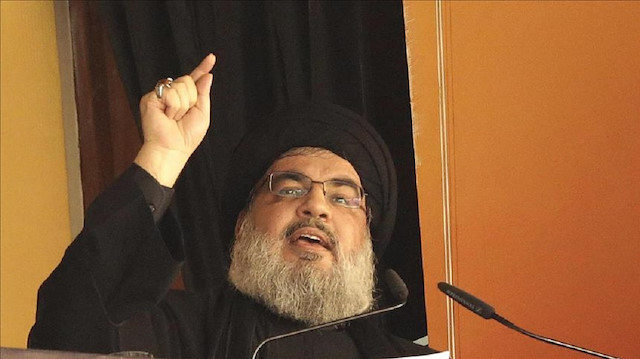
Hezbollah Secretary-General Hassan Nasrallah has called on Lebanese Prime Minister-designate Saad Hariri to cede a seat in the new cabinet to a Sunni ally or renegotiate the government formation.
Hezbollah Secretary-General Hassan Nasrallah has called on Lebanese Prime Minister-designate Saad Hariri to cede a seat in the new cabinet to a Sunni ally or renegotiate the government formation.
“Hezbollah is proud of independent Sunni deputies or deputies of the March 8 camp,” Nasrallah said in a televised speech late Saturday.
“We want them to be represented in the government,” he stressed.
Hariri has struggled to form a new government in Lebanon following the May 6 parliamentary election.
Hezbollah insists on the representation of six Sunni opposition MPs in the new government, while Hariri argued that the six deputies had run in the polls under the umbrella of political blocs that already got their quota in the cabinet.
Nasrallah said he was told by Hariri that no ministers from the March 8 camp would be represented in the government.
“We told him that we will not send the names of Hezbollah ministers,” he said. “We do not compliment… we were clear from the first day.”
Following the May polls, President Michel Aoun tasked Hariri with drawing up a new cabinet lineup.
The process, however, has faced repeated delays amid mutual recriminations between the country’s main political forces and demands by some parties for greater representation.
According to Lebanon’s constitution, the prime minister-designate does not have a deadline for drawing up a new government.
Under the 1989 Taif Accord (which ended Lebanon’s 15-year civil war), government posts are shared between the country’s main ethno-religious groupings, with six cabinet portfolios reserved for Sunni Muslims, six for Shia Muslims, and three for Druze.
The Iran-backed group Hezbollah will respond to any Israeli attack on Lebanon, its leader Sayyed Hassan Nasrallah said on Saturday. "Any attack will definitely and certainly be responded to," he said in a televised speech. Lebanon's Aoun vows to find solution over government impasse
Hezbollah says will respond to any Israeli attack on Lebanon
Lebanese President Michel Aoun said on Saturday that a solution would be found to a political row that has blocked the formation of a new national unity government for more than six months since a general election in May.The country is in dire need of a government able to implement economic reforms that the International Monetary Fund (IMF) says are necessary.The last sticking point surrounds Sunni Muslim representation in the country's cabinet where the 30 seats must be allocated along sectarian lines.The powerful Shi'ite Muslim group Hezbollah says one of its Sunni allies must be represented in the government to reflect the gains they made in the election.Hamas blames US for violence at Lebanon refugee campsBut Prime Minister-designate Saad al-Hariri, who is Lebanon's main Sunni politician and enjoys Western backing, has ruled out allocating any of his cabinet seats to them.The Hezbollah-allied Sunnis are also known for their close ties to the Syrian government of President Bashar al-Assad.Aoun said no effort would be spared to resolve the problem."The matter requires bravery and patience to reach the end, but we will find the solution because waiting is a waste of time," a statement from the presidency cited Aoun as saying in a meeting with the head of the Melkite Greek Catholic Church.Returning refugees killed in Syria: Lebanese ministerA statement from Hezbollah on Saturday said the group's leader, Sayyed Hassan Nasrallah, had met with Aoun's son-in-law and close advisor Gebran Bassil to discuss the formation of a government and efforts "to resolve the complications".Bassil heads the Free Patriotic Movement, the party established by Aoun.Druze leader Walid Jumblatt on Friday voiced fears for Lebanon's currency if the deadlock continues.While politicians have often warned of the risk of an economic crisis in Lebanon, public expressions of concern for the currency are rare. Lebanon is experiencing stagnant economic growth and has the world's third largest public debt to GDP ratio.Central bank governor Riad Salameh has repeatedly said the Lebanese pound, pegged at 1,507.5 to the dollar for two decades, is stable and not at risk, helped by the central bank's high foreign currency reserves.
Lebanon's Aoun vows to find solution over government impasse
The U.S. is instigating violence in Palestinian refugee camps in Lebanon in an effort to implement a controversial Mideast peace plan known as the "Deal of the Century", Ali Baraka, Hamas’s representative in Lebanon, said Friday.In an interview with Anadolu Agency, Baraka condemned recent violence at Southern Lebanon’s Mieh Mieh refugee camp between rival Palestinian factions.On Oct. 16, at least nine people were killed -- and dozens more injured -- when clashes erupted at the camp between rival factions Fatah and Ansar Allah.According to Baraka, such violent flare-ups “only serve the U.S.-backed ‘Deal of the Century’, which is aimed at destroying the Palestinian national cause and refugees’ right to return to historical Palestine”.Hamas-appointed civil servants get salaries from QatarThe term “Deal of the Century” refers to a backchannel U.S. Mideast peace plan, details of which have yet to be made public.Palestinian President Mahmoud Abbas, for his part, has rejected the peace plan, which, he said, "ignores the Jerusalem and refugee issues, allows Israel to keep its [illegal] settlements, and gives Israel the upper hand on security-related issues".After recognizing Jerusalem as Israel's capital, Baraka said, the U.S. administration had moved on to the deal’s “second phase”, which, he asserted, involves cancelling refugees’ right to return to historical Palestine."After Washington stopped funding UNRWA [the UN’s agency for Palestinian refugees], it began sowing sedition between Palestinian factions, encouraging them to fight one another in the Lebanon camps," he said.He added: "Recent clashes in Lebanon’s Mieh Mieh refugee camp, for example, were a means of destroying the camp and displacing its people."Baraka went on to urge all Palestinian factions to “exercise caution and be aware of the trap that the U.S. has set in the Lebanon refugee camps".He also called on Beirut to "support the Palestinian refugees and enhance Lebanese-Palestinian coordination with a view to preventing such security breaches”."Such violence only serves the U.S. project, which wants to resettle Palestinian refugees in their host countries,” he said.Lebanon currently hosts some 400,000 Palestinian refugees in 12 camps located throughout the country, in which armed clashes occur sporadically.
Hamas blames US for violence at Lebanon refugee camps