

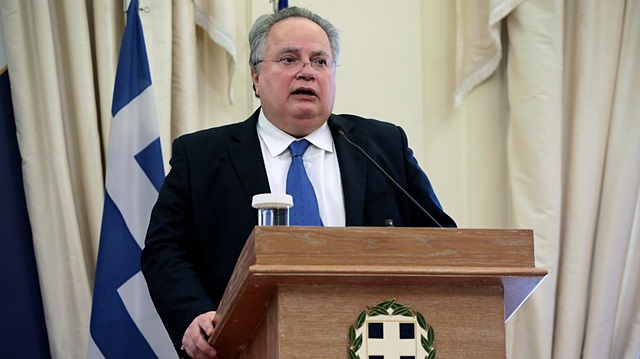
Nikos Kotzias
Greek Prime Minister Alexis Tsipras accepted the resignation of Foreign Minister Nikos Kotzias on Wednesday and will himself take over the foreign affairs portfolio, Tsipras's office said.
Earlier, Greek media reported that Kotzias had clashed with Defence Minister Panos Kammenos over a deal that aims to end a decades-old name dispute with neighbouring Macedonia.
Kotzias was Athens' main negotiator in the talks that led to the June accord with Skopje to rename Greece's northern neighbour North Macedonia. Its fate is now uncertain because a referendum in Macedonia on the deal failed to reach a minimum turnout threshold to make it constitutionally valid.
Macedonia on Thursday will officially begin accession negotiations with NATO, the country’s Defense Minister Radmila Sekerinska said on Tuesday.Sekerinska's remarks came at a joint news conference in capital Skopje with Serbian Foreign Minister Nikola Dimitrov and National NATO Coordinator Stjepan Pendarovski."We have entered with a lot of optimism and desire for success. It is ahead of us that our country becomes a member of the most powerful alliance for the collective security […] with the highest quality of life and with more than 900 million inhabitants," said Sekerinska.The defense minister called on the lawmakers from all political parties in Macedonia to "show themselves in action.”During the news conference, Dimitrov said this is a short process and will end later this year or early next year."We have prepared a program for the continuation of reforms, with emphasis on the rule of law and judicial reforms, fight against corruption and organized crimes," Dimitrov said.
Macedonia begins negotiations with NATO
Kammenos is from a right-wing junior coalition partner vehemently opposed to the accord with Skopje. The right-wing party's support is crucial for Tsipras, leader of the left-wing Syriza party, as he has a razor-thin parliamentary majority.
Greek media reported on Wednesday that Kotzias and Kammenos had argued during a cabinet meeting on Tuesday.
Greece's parliament is also meant to ratify the name deal.
Macedonia's hopes of joining the European Union and NATO were in limbo on Monday, a day after voters backed a plan to change the country's name by a large margin but failed to hit the 50 percent turnout required for the referendum result to be valid.Prime Minister Zoran Zaev said he would press on regardless with a vote in parliament to endorse the change of name to the 'Republic of North Macedonia' but the defence minister said an early election might now prove necessary, potentially derailing the whole plan due to a tight timeframe.Some 91 percent of voters backed the name change, demanded by neighbouring Greece as a precondition for it lifting its veto on Macedonia joining the EU and NATO. But turnout was just 36.9 percent, final figures showed, far below the required threshold.The EU, echoing the pro-Western Zaev, hailed the referendum result as a ringing endorsement of Macedonia's plans to join the bloc and NATO. But Russia, which opposes NATO eastern expansion, said tersely it expected the law in Macedonia to be respected.Zaev lacks the two thirds majority in parliament to push through the name change, and the main nationalist opposition VMRO-DPMNE has vowed to block the legislation. Many of its supporters did not vote in order to invalidate the result."In the coming week we will assess if we can secure the necessary majority for the constitutional changes, and if not we will call an early election," Defence Minister Radmila Sekerinska told Reuters."The downside is that the election would postpone adoption of the constitutional changes for 45 to 60 days," she said.Macedonia prepares to hold historical referendum"Political Crisis"Political analysts said the outcome greatly complicated the tiny ex-Yugoslav republic's push to join Western structures."Instead of having a clearer picture the outcome of the referendum will only deepen the political crisis,' said Petar Arsovski a political analyst. "We are likely heading towards early elections and Macedonia does not have time for that."Greece and the EU tried to put a brave face on the setback."We hope that Mr. Zaev's initiative for a constitutional reform will be successful," Greek government spokesman Dimitris Tzanakopoulos said on Monday."The Greek government will continue with sobriety and prudence ... to support the need for an implementation of the deal. This opportunity must not be wasted," he said.Greece has insisted on the change because it views the name 'Macedonia' as implying a territorial claim on a northern Greek region of that name. Greece's parliament must also approve the June name deal and, like Zaev, leftist Greek Prime Minister Alexis Tsipras also faces opposition from his nationalist foes.An early election could be called in Macedonia for the end of November at the earliest, pushing the constitutional changes into the spring."The biggest risk is that this drags on and the EU’s electoral calendar overtakes things," an EU official said, referring to next May's elections to the European Parliament.EU foreign policy chief Federica Mogherini and EU Enlargement Commissioner Johannes Hahn said in a joint statement: "The (Macedonia) parliament will now be called upon to proceed with the next steps for implementation of the name agreement by deciding on adoption" of the legal changes.A NATO diplomat was more circumspect, saying the alliance did not want to be drawn into Macedonian domestic politics."But we have made it very clear that should the country turn its back on this opportunity, we don’t expect it to arise again for a very long time," he said.In Moscow, which regards NATO enlargement as a threat to its own security, Kremlin spokesman Dmitry Peskov said: "We are observing closely and of course think that all the processes should remain within the framework of the law.Macedonia voting on landmark name deal with Greece
Macedonia's bid to join EU, NATO in limbo after vote, early poll possible