

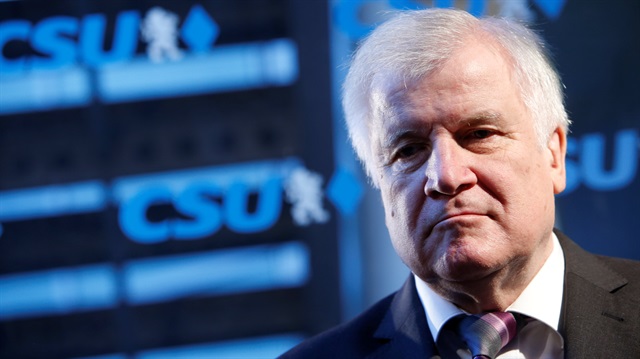
Horst Seehofer
Chancellor Angela Merkel's Bavarian ally said Monday that the “grand coalition” partners would continue to work together despite historical election losses in regional polls on Sunday.
"Despite some comments made yesterday, we will play our part, so that the grand coalition can carry on its work in a stable way," Christian Social Union leader and Interior Minister Horst Seehofer told a news conference Monday.
The Christian Social Union (CSU) suffered a heavy blow on Sunday in regional elections in Bavaria, which it has governed almost continuously since 1946, triggering speculations on the future of Merkel-led federal coalition government.
Germany woke up on Monday to the news that its crisis-prone government could become even more unstable after the parties ruling in a loveless coalition suffered humiliating results in an election in the southern state of Bavaria.Chancellor Angela Merkel's Bavarian allies slumped to their worst election results in almost 70 years and her junior coalition partners, the centre-left Social Democrats (SPD), saw support in Bavaria halved."It's gonna be turbulent," headlined the Die Welt newspaper. "The result in Bavaria is a vote against the grand coalition in Berlin."The SPD had hoped that infighting over immigration between Merkel's Christian Democrats (CDU) and the Bavarian Christian Social Union (CDU) allies would give them a boost in Bavaria.Merkel’s ally suffers defeat in Bavarian electionBut instead, the party saw support fall to just under 10 percent, prompting a discussion over the sustainability of its alliance with Merkel's conservatives at the national level.SPD members are still bitter over their leaders' decision to join a Merkel-led government after vowing before the general election in September 2017 to sit in opposition if they lost to the conservatives. They are now demanding consequences.The party's General Secretary Lars Klingbeil told Deutschlandfunk radio that members wanted a change in the style of government.SPD leaders have promised members opposed to a coalition with the conservatives they will hold a review after two-years in government and decide whether the partnership was still viable.Plane crash in central Germany kills threeAsked if disgruntled SPD members were demanding that the review be brought forward, Klingbeil said:"The evaluation is planned for the middle of the legislative period but something must happen now. There must be different style of government."He said the CSU under Horst Seehofer must stop picking arguments, especially on issues like migrant policy. "If the style of government doesn't change, there will be a debate in the SPD and the critical voices will get stronger," he said.Polls indicate that the ruling parties will be chastened again in two weeks in an election in the western state of Hesse, where they are expected to bleed support to the far-right Alternative for Germany (AfD) and the ecologist Greens.The state is ruled by Merkel's CDU in a coalition with the Greens and a slump in support for the conservatives there would almost certainly further weaken her authority."If the CDU loses the government in Hesse, this will probably start a discussion within the CDU about Merkel's position," wrote mass-selling Bild. 
Humiliating losses in Bavarian election shake Merkel's coalition
According to the preliminary official results, the CSU has won 37.2 percent, a sharp fall from the 47.7 percent the party scored in the last election in 2013.
Merkel’s other coalition partner in Berlin, the Social Democratic Party (SPD), also suffered heavy losses on Sunday, drawing only 9.7 percent of the vote, less than half of its showing of 20.6 percent five years ago.
Seehofer said Monday that the CSU would now seek to form a stable coalition government in Bavaria and hold talks with all parties except for the far-right Alternative for Germany (AfD).
The CSU apparently had two major coalition government options, either the Green Party or the Free Voters of Bavaria.
Chancellor Angela Merkel's sister party the Christian Social Union (CSU) suffered a heavy blow in regional elections in Bavaria on Sunday, according to projections by public broadcaster ARD.The CSU, which has governed Bavaria almost continuously since 1946, managed to win only 35.6 percent, a sharp fall from the 47.7 percent the party scored in the last election in 2013.It was the second-worst result for the Bavarian conservatives since the end of World War II, also showing that the CSU would lose its majority in the state parliament.The Social Democratic Party (SPD) also suffered heavy losses on Sunday, drawing only 9.7 percent of the vote, less than half of its showing of 20.6 percent five years ago.The environmentalist, pro-immigration Green Party scored a record 18.3 percent, up from 9.8 percent in the last election, making it the second-largest group in the state parliament.The moderate right Free Voters of Bavaria came in third with 11.6 percent.Projections showed the Islamophobic, far-right Alternative for Germany (AfD) with 10.9 percent of the vote, thereby entering the Bavarian parliament for the first time.'United against racism', Germans stage mass protest against far rightCoalition optionsInterior Minister Horst Seehofer, also the CSU leader, voiced regret over the disappointing results, but also stressed that his party now has a clear task to form a stable government.“This is not a good result, there's nothing to quibble about,” he told reporters in Munich.“On the other hand, today, Bavarian voters gave us a clear task to form a new government for the free state of Bavaria. And we will undertake this responsibility,” he stressed.Early seat projections suggested that the CSU will hold 80 seats in the Bavarian state parliament, and the Green Party 39.Germany urges Riyadh to cooperate on missing journalistThe Free Voters of Bavaria was set to take 25 seats, the AfD 24, the SPD 21, and the liberal Free Democratic Party (FDP) 11.Public broadcaster ARD’s projections showed that the CSU would have two major coalition government options, either the Green Party or the Free Voters of Bavaria, to secure its coalition a majority in parliament.Sunday night Seehofer was silent on possible coalition options, but said the party’s executive committee would meet in the coming days to discuss the election results, and government options.Merkel's Bavarian allies brace for election bruising
Merkel’s ally suffers defeat in Bavarian election
The environmentalist, pro-immigration Green Party scored a record 17.5 percent, up from 9.8 percent in the last election, making it the second-largest group in the state parliament.
The moderate right Free Voters of Bavaria came in third with 11.6 percent.
Sunday’s election saw the far-right, Islamophobic AfD win about 10 percent of the vote, thereby entering the Bavarian parliament for the first time.