

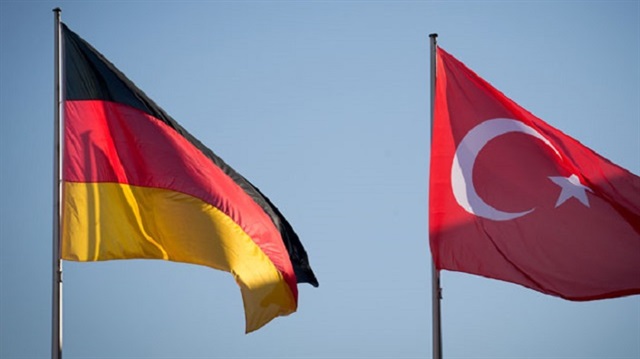
File photo
Germany has an interest in a stable Turkish economy and is monitoring the situation closely, a government spokesman said, when asked about the Turkish currency.
A spokeswoman for the German finance ministry said there had been no crisis talks among members of the G20 industrialised countries on the situation.
The spokeswoman said it was too early to comment on the exposure of German companies to the economic situation in Turkey, and declined to assess the latest developments there.
This month has seen several foreign currencies lose value against the U.S. dollar (USD), according to data compiled and analyzed by Anadolu Agency.In Europe, since Aug. 1, the euro (EUR) lost around 2.3 percent against the dollar, while the British pound (GBP) dropped over 2.5 percent.On Aug. 1, the U.S. dollar was traded for €0.86 and £0.76, but as of the beginning of Monday it had risen to €0.88 and £0.78. At the beginning of 2018 the USD/EUR and USD/GBP exchange rates were 0.8 and 0.73.The Chinese yuan (CYN), Indonesian rupee (IDR), and Indian rupee (INR) in Asia fell by 0.73 percent, 1.2 percent, and 1.6 percent versus the dollar, respectively, in this period.Turkish economic structure solid: Presidential aideThe U.S. dollar/Chinese yuan exchange rate rose from 6.82 to 6.87, while the USD/IDR and USD/INR exchange rates reached 14,621 and 69.46, respectively.This January, the USD/CYN, USD/IDR, and USD/INR exchange rates were 6.5, 13,567, and 63.68.Russia's ruble (RUB) also lost ground, down 7.4 percent since the beginning of the month. The USD/RUB exchange rate was 57.2 in January, 63.03 on Aug. 1, and 67.7 on Monday.In South America, the Brazilian real (BRL) dropped 2.9 percent against the dollar, with BRL/USD exchange rate rising from 3.75 to 3.86 in the period. At the beginning of the year, it was 3.31.How Turkey should respond to US’s economic warCurrencies from Oceania and Africa also lost value against the dollar this month.The Australian dollar (AUD), New Zealand dollar (NZD), and South African rand (ZAR) suffered 1.5 percent, 3.4 percent, and 9 percent over the last two weeks.On Aug. 1 the USD/AUD rate was 1.35, USD/NZD was 1.47, and USD/ZAR was 13.2, but by Monday they rose to 1.37, 1.52 and 14.4, respectively.At the beginning of the year, one dollar was traded for 1.28 Australian dollars, 1.4 New Zealand dollars, or 12.3 South African rands.Turkey 'most suitable' for investment despite perception operations: FMTurkey launches probe into suspected actions targeting economic securityTurkey Central Bank to provide all liquidity banks need
Broad basket of currencies losing ground against dollar
Turkey and the U.S. are currently experiencing rocky relations following Washington’s imposition of sanctions on Interior Minister Süleyman Soylu and Justice Minister Abdulhamit Gül for not releasing American Pastor Andrew Brunson, who faces terrorism charges in Turkey.
U.S. President Donald Trump on Friday ramped up his attack on Turkey by doubling U.S. tariffs on Turkish aluminum and steel imports to 20 percent and 50 percent, respectively.
Presidential spokesman Ibrahim Kalin on Monday said the government is taking necessary steps for stability in the country urging people not to pay heed to speculations about Turkish economy."Turkish economy's structure is solid, nobody should trust speculative news and actions," he wrote on his official Twitter account.Kalin added that Turkey's Treasury and Finance Ministry, the Central Bank, the Banking Regulatory and Supervision Agency, the Capital Markets Board and other institutions are taking steps for financial stability."Turkey will come out stronger from this process," Kalin added.His remarks came after Trump ramped up his attack on Turkey by raising U.S. tariffs on Turkish aluminum and steel imports to 20 percent and 50 percent, respectively.Turkey and the U.S. are currently experiencing rocky relations following Washington’s imposition of sanctions on Interior Minister Suleyman Soylu and Justice Minister Abdulhamit Gul for not releasing American Pastor Andrew Brunson, who faces terrorism charges in Turkey.Turkey 'most suitable' for investment despite perception operations, says FMTurkey launches probe into suspected actions targeting economic securityTurkey Central Bank to provide all liquidity banks needRussia to increase use of local currencies for trade
Turkish economic structure solid: Presidential aide
Turkey should respond to the economic war imposed by U.S. President Donald Trump with hefty customs duties. Big U.S. brands that benefit from Turkey’s market should be subject to these import duties in response to the doubling U.S. tariffs on Turkish aluminum and steel imports to 20 percent and 50 percent, respectively. The tariffs followed Washington’s imposition of sanctions on Interior Minister Süleyman Soylu and Justice Minister Abdulhamit Gül for not releasing American Pastor Andrew Brunson, who faces terrorism charges in Turkey.Turkey should also impose substantial customs duties on technology brands such as IBM and Apple as well as construction machinery and equipment company Caterpillar Inc. Ankara could impose import duties on luxury lifestyle products as well as computers, phones, cosmetics, yachts, boats, automobiles, racecars, data processing machines and construction machines.Turkey launches probe into suspected actions targeting economic securityCurrent account deficit should be reducedThe $3.3 billion deficit in bilateral trade between the U.S. and Turkey could be narrowed by additional customs taxes. The additional tax that could be imposed on luxury lifestyle items could lead to great savings in the domestic market.Apple’s technology products and Caterpillar Inc.’s construction machinery obtain hundreds of millions of dollars’ worth of profits in Turkey each year. Even though the iPhone is not the bestselling smartphone in Turkey, it makes up 80 percent of smartphone sales’ profits.In addition to the additional customs duties backed by the public, it is expected that consumers support Turkey’s economy by boycotting U.S.-made products.Turkey Central Bank to provide all liquidity banks needEra of domestic product useIt is also expected that industry figures utilize raw materials and intermediate goods resources domestically in order to support Turkey’s economic independence struggle. Turkey’s exports to the U.S., which stood at $8.5 billion last year, have risen considerably since the beginning of 2018.Turkey’s third biggest export market is the U.S., and it is the fifth largest country where Turkey exports its goods, with trade volume amounting to $20.6 billion in 2017, official data showed.Erdoğan slams US for preferring terrorists as partnerImports from other marketsTurkey’s imports from the U.S. rose by 9.9 percent to $11.9 billion in 2017 compared to the previous year. Turkey’s foreign trade deficit with the U.S. has decreased over the past three years, showing a reduction of 22.4 percent in 2017 compared to the previous year. It is expected that Turkey will respond to U.S. economic and political pressure by imposing hefty customs duties.Retaliatory tariffs two months agoTwo months ago, Turkey imposed additional customs duties on 22 U.S. products with an import value of $1.8 billion. The tariffs were imposed on imports of U.S. coal, paper, walnuts, almonds, tobacco, unprocessed rice, whisky, automobiles, cosmetics, machinery equipment and petrochemical products.No deposits will be seized: Turkish FinMinGermany slams US tariffs decision against TurkeyIran slams Trump's tariffs decision targeting Turkey
How Turkey should respond to US’s economic war
Turkey is one of the most suitable countries in the world for investment despite being subjected to all types of perception operations and campaigns, said Turkish Foreign Minister Mevlüt Çavuşoğlu on Monday. “We’re working to increase foreign investments and we’re at the service of Turkish citizens,” said Çavuşoğlu at the 10th Ambassadors Conference.We expect the U.S. to be faithful to our traditional friendship and NATO alliance, said the Turkish FM, noting that Washington should learn that “they will not achieve results with threats.” He also pointed that Turkey has done enough to repair its ties with the U.S., stressing that the White House acted “contrary to their alliance regarding fundamental security issues.”Turkey Central Bank to provide all liquidity banks needBanks' liquidity needs will be provided by the Central Bank of the Republic of Turkey (CBRT), the bank announced on Monday after the Turkish lira experienced a sharp decrease in value following an escalating row between NATO allies Ankara and Washington."In the framework of intraday and overnight standing facilities, the Central Bank will provide all the liquidity the banks need," the bank said in a written statement.Turkey and the U.S. are currently experiencing rocky relations following Washington’s imposition of sanctions on Interior Minister Suleyman Soylu and Justice Minister Abdulhamit Gül for not releasing American Pastor Andrew Brunson, who faces terrorism charges in Turkey.Erdoğan slams US for preferring terrorists as partnerTurkish senior official warns of perception operationU.S. President Donald Trump on Friday ramped up his attack on Turkey by doubling U.S. tariffs on Turkish aluminum and steel imports to 20 percent and 50 percent, respectively.Erdoğan challenges USTurkish President Recep Tayyip Erdoğan in his turn said Turkey would turn toward new markets, new partners and alternative financial tools.“If you pressure us through the dollar, we will look for other ways to carry out our works,” he said.Terming the recent U.S. tariffs on Turkey as an “economic war,” the Turkish president said: “We’ve seen your game and we challenge it.”The aim of the recent U.S. pressure is “to ensnare Turkey in every field from finance to politics,” the president noted.“We will not surrender,” Erdoğan asserted.
Turkey 'most suitable' for investment despite perception operations: FM
Istanbul prosecutor's office launched an investigation into individuals suspected of involved in actions that threaten Turkey's economic security.Turkey was targeted by an economic attack, the prosecutor's office said and pledged to take legal action against all written and visual news as well as social media accounts which it deemed to serve towards the purpose of this attack.Turkey Central Bank to provide all liquidity banks needErdoğan slams US for preferring terrorists as partnerNo deposits will be seized: Turkish FinMin
Turkey launches probe into suspected actions targeting economic security