

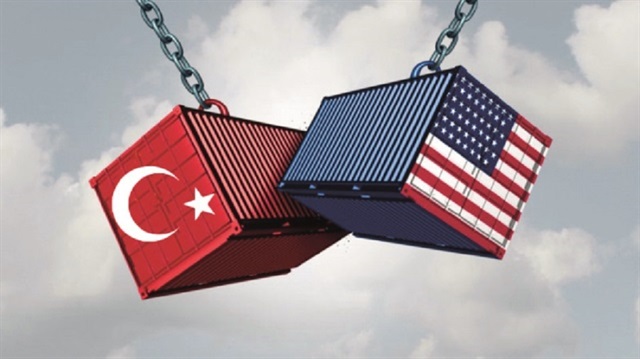
Turkey should impose hefty customs duties on US products
Turkey should respond to the economic war imposed by U.S. President Donald Trump with hefty customs duties. Big U.S. brands that benefit from Turkey’s market should be subject to these import duties in response to the doubling U.S. tariffs on Turkish aluminum and steel imports to 20 percent and 50 percent, respectively. The tariffs followed Washington’s imposition of sanctions on Interior Minister Süleyman Soylu and Justice Minister Abdulhamit Gül for not releasing American Pastor Andrew Brunson, who faces terrorism charges in Turkey.
Turkey should also impose substantial customs duties on technology brands such as IBM and Apple as well as construction machinery and equipment company Caterpillar Inc. Ankara could impose import duties on luxury lifestyle products as well as computers, phones, cosmetics, yachts, boats, automobiles, racecars, data processing machines and construction machines.
Istanbul prosecutor's office launched an investigation into individuals suspected of involved in actions that threaten Turkey's economic security.Turkey was targeted by an economic attack, the prosecutor's office said and pledged to take legal action against all written and visual news as well as social media accounts which it deemed to serve towards the purpose of this attack.Turkey Central Bank to provide all liquidity banks needErdoğan slams US for preferring terrorists as partnerNo deposits will be seized: Turkish FinMin
Turkey launches probe into suspected actions targeting economic security
Current account deficit should be reduced
The $3.3 billion deficit in bilateral trade between the U.S. and Turkey could be narrowed by additional customs taxes. The additional tax that could be imposed on luxury lifestyle items could lead to great savings in the domestic market.
Apple’s technology products and Caterpillar Inc.’s construction machinery obtain hundreds of millions of dollars’ worth of profits in Turkey each year. Even though the iPhone is not the bestselling smartphone in Turkey, it makes up 80 percent of smartphone sales’ profits.
In addition to the additional customs duties backed by the public, it is expected that consumers support Turkey’s economy by boycotting U.S.-made products.
Banks' liquidity needs will be provided by the Central Bank of the Republic of Turkey (CBRT), the bank announced on Monday."In the framework of intraday and overnight standing facilities, the Central Bank will provide all the liquidity the banks need," the bank said in a written statement.It added: "Banks will be able to borrow foreign exchange deposits in one-month maturity in addition to one-week maturity."If needed, the Central Bank may increase lenders' current foreign exchange deposit limits -- $50 billion -- and improve utilization conditions.No deposits will be seized: Turkish FinMinTo provide banks flexibility in their collateral management, the Central Bank revised discount rates for collaterals against Turkish lira transactions, said the statement.The bank added: "Through this regulation, the discounted value of banks’ current unencumbered collaterals is projected to increase by approximately 3.8 billion Turkish liras ($555.4 million)."The Central Bank also raised foreign exchange deposit limits for lira transactions of lenders from €7.2 billion ($8.2 billion) to €20 billion ($22.8 billion).The Central Bank also lowered Turkish lira reserve requirement ratios by 250 basis points for all maturity brackets, and reserve requirement ratios for non-core FX liabilities by 400 basis points for up to three-year maturities.Russia to increase use of local currencies for tradeThe bank also announced that it will continue its intermediation in the foreign exchange deposit market."Accordingly, through the intermediation of the Central Bank, banks will be able to borrow from and lend to each other at the FX deposit market as per the rules set by the Implementation Instructions on the Foreign Exchange and Banknotes Markets," it added.It said: "Banks will continue to purchase foreign bank notes from the Central Bank via foreign exchange transactions within their pre-determined limits at the Foreign Exchange and Banknotes Markets."The bank also said that it raised the maximum average maintenance facility for foreign exchange liabilities to 8 percent."With this revision, approximately 10 billion Turkish liras ($1.46 billion), $6 billion, and $3 billion equivalent of gold liquidity will be provided to the financial system," it added.Market depth and price formations will be monitored by the Central Bank closely, which will take all necessary measures to protect financial stability, if needed, said the bank.
Turkey Central Bank to provide all liquidity banks need
Era of domestic product use
It is also expected that industry figures utilize raw materials and intermediate goods resources domestically in order to support Turkey’s economic independence struggle. Turkey’s exports to the U.S., which stood at $8.5 billion last year, have risen considerably since the beginning of 2018.
Turkey’s third biggest export market is the U.S., and it is the fifth largest country where Turkey exports its goods, with trade volume amounting to $20.6 billion in 2017, official data showed.
President Recep Tayyip Erdoğan on Sunday criticized the U.S., saying Turkey will say “goodbye” to those, who prefer terrorists as their strategic partner.Erdoğan was speaking at ruling Justice and Development (AK) Party’s meeting in northeastern Turkish province of Trabzon.“We will say goodbye to those, who sacrifice its strategic partnership and alliance with a country of 81 million people on the altar of its relations with terror organizations," he said.Turks sprint to support national currency after Erdoğan callTurkish senior official warns of perception operationTurkey and the U.S. are currently experiencing rocky relations following Washington’s imposition of sanctions on Interior Minister Suleyman Soylu and Justice Minister Abdulhamit Gul for not releasing American Pastor Andrew Brunson, who faces terrorism charges in Turkey.U.S. President Donald Trump on Friday ramped up his attack on Turkey by doubling U.S. tariffs on Turkish aluminum and steel imports to 20 percent and 50 percent, respectively.No deposits will be seized: Turkish FinMinErdoğan said Turkey would turn towards new markets, new partners and alternative financial tools.“If you pressure us through the dollar, we will look for other ways to carry out our works,” he said.“We will give our response to the person -- who declares war against the whole world including our country -- by turning towards new markets, new partners and new alliances," Erdoğan added.Terming the recent U.S. tariffs on Turkey as an “economic war,” the Turkish president said: “We’ve seen your game and we will challenge it.”The aim of the recent U.S. pressure is “to seize Turkey in every field from finance to politics,” the president noted.“We will not surrender,” Erdoğan asserted. “We will continue producing. We will continue increasing our exports,” he said.
Erdoğan slams US for preferring terrorists as partner
Imports from other markets
Turkey’s imports from the U.S. rose by 9.9 percent to $11.9 billion in 2017 compared to the previous year. Turkey’s foreign trade deficit with the U.S. has decreased over the past three years, showing a reduction of 22.4 percent in 2017 compared to the previous year. It is expected that Turkey will respond to U.S. economic and political pressure by imposing hefty customs duties.
Retaliatory tariffs two months ago
Two months ago, Turkey imposed additional customs duties on 22 U.S. products with an import value of $1.8 billion. The tariffs were imposed on imports of U.S. coal, paper, walnuts, almonds, tobacco, unprocessed rice, whisky, automobiles, cosmetics, machinery equipment and petrochemical products.
Turkey’s treasury and finance minister early Monday vowed to fight “lies” that deposit money would be seized or that foreign currencies in bank accounts would be converted into Turkish liras, saying that no such steps will be taken."Deposit money will not be seized. Foreign currencies in bank accounts will not be converted into Turkish liras. However, those lies will be fought off until the end in the judicial sphere," Berat Albayrak tweeted.Albayrak said an action plan is coming into effect starting early Monday."Our institutions will take the necessary steps to relax the markets," he said.Albayrak said they prepared the plan together with banks for the real sector, the sector the most affected by recent currency fluctuations."We will take the necessary steps rapidly, together with our banks and the Banking Regulation and Supervision Agency," he added.Russia says will cut holdings of US securities amid sanctionsIran slams Trump's tariffs decision targeting TurkeyTurks sprint to support national currency after Erdoğan call
No deposits will be seized: Turkish FinMin
Germany’s economy minister criticized U.S. President Donald Trump's decision to impose additional tariffs on Turkey, local media reported Sunday."This trade war slows down and destroys economic growth and produces new uncertainties," Peter Altmaier said according to Germany’s Bild am Sonntag newspaper."The past has shown that consumers are particularly affected by trade wars, as the products are becoming more expensive," Altmaier said.His remarks come after Trump ramped up his attack on Turkey by doubling U.S. tariffs on Turkish aluminum and steel imports to 20 percent and 50 percent, respectively.“Turkey stands for security and reliability in Europe, we are working together well with Ankara in terms of migration,” he said.Altmaier said that they now “have the opportunity to return to objectivity” as the elections in Turkey are over.Regarding his planned visit on Oct. 25-26 to Turkey to boost bilateral economic ties, accompanied by a 80-member business delegation of leading companies, Altmaier said: “I represent the interests of more than 7,000 German companies operating in Turkey.”He added: “We want Turkey to be a stable and democratic country, and good economic relations contribute to that.”Political relations between Ankara and Berlin suffered several setbacks in the past two years, but both sides have taken steps towards the normalization of the ties.Turkish President Recep Tayyip Erdogan is expected to pay an official visit to Berlin next month.
Germany slams US tariffs decision against Turkey
Iranian Foreign Ministry spokesman Bahram Qassemi on Saturday criticized U.S. President Donald Trump's decision to impose additional tariffs on Turkey.Qassemi said Turkey and the Turkish people can succeed against external pressures."The will of the nations cannot be changed by bullying and threats," Qassemi told Iranian television, emphasizing the importance of cooperation between the countries of the region.US tariffs decision against Turkey 'shameful,' Iran saysUS tariff hike on Turkey fails to make economic senseQassemi's remarks followed those of Iranian Foreign Minister Javad Zarif, who had said: "Trump's jubilation in inflicting economic hardship on its NATO ally Turkey is shameful. The U.S. has to rehabilitate its addiction to sanctions bullying or entire world will unite -- beyond verbal condemnations -- to force it to."We’ve stood with neighbors before, and will again now," Zarif wrote on his official Twitter account.Zarif's remarks came a day after Trump ramped up his attack on Turkey by doubling U.S. tariffs on Turkish aluminum and steel imports to 20 percent and 50 percent, respectively.Turkish Foreign Ministry spokesman Hami Aksoy on Friday said in a statement that Trump's decision, which disregards World Trade Organization rules, "cannot be associated with seriousness expected from a state"."All the steps taken against Turkey will be given a befitting response as they have been given before," Aksoy added.
Iran slams Trump's tariffs decision targeting Turkey