

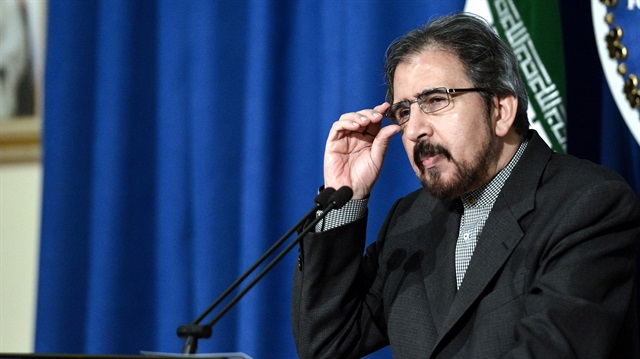
Iranian Foreign Ministry spokesman Bahram Ghasemi
Iranian Foreign Ministry spokesman Bahram Qassemi on Saturday criticized U.S. President Donald Trump's decision to impose additional tariffs on Turkey.
Qassemi said Turkey and the Turkish people can succeed against external pressures.
"The will of the nations cannot be changed by bullying and threats," Qassemi told Iranian television, emphasizing the importance of cooperation between the countries of the region.
Iranian Foreign Minister Javad Zarif on Saturday criticized U.S. President Donald Trump's decision to impose additional tariffs on Turkey."Trump's jubilation in inflicting economic hardship on its NATO ally Turkey is shameful. The U.S. has to rehabilitate its addiction to sanctions bullying or entire world will unite -- beyond verbal condemnations -- to force it to."We’ve stood with neighbors before, and will again now," Zarif wrote on his official Twitter account.Zarif's remarks came a day Trump ramped up his attack on Turkey by doubling U.S. tariffs on Turkish aluminum and steel imports to 20 percent and 50 percent, respectively.Turkish Foreign Ministry spokesman Hami Aksoy on Friday said in a statement that Trump's decision, which disregards World Trade Organization rules, "cannot be associated with seriousness expected from a state"."All the steps taken against Turkey will be given a befitting response as they have been given before," Aksoy added.
US tariffs decision against Turkey 'shameful,' Iran says
U.S. President Donald Trump's decision to double tariffs on Turkish steel and aluminum imports fails to make economic sense, an expert told Anadolu Agency on Saturday.Trump said Friday on Twitter that he authorized the doubling of tariffs, noting that "aluminum will now be 20% and steel 50%. Our relations with Turkey are not good at this time!"He later said in a proclamation released by the White House that the additional tariffs would begin on Aug. 13."Economically, it does not make any sense. It's a terrible decision," said Mayra Rodriguez Valladares, the managing principal of New York-based financial consulting and research firm MRV Associates."It will hurt U.S. manufacturers that import steel and aluminum from Turkey, although that only constitutes a small portion of domestic steel and aluminum consumption," she added.Turkey came in sixth place among the countries the U.S. imported steel from last year, while Turkish steel's share was 7 percent of total U.S. steel imports.The U.S. was the top destination for Turkish steel exports in 2017, which were worth $1.1 billion."If they [U.S. manufacturers] are importing from Turkey and they rely on them, then tariffs are going to make it more expensive for them by raising their own costs," said William Jackson, chief emerging markets economist at London-based Capital Economics.Higher tariffs “could raise some of the costs for the U.S., or rather offset some of the falling prices that they [US manufacturers] enjoyed," he added.U.S. manufacturers that import steel from Turkey have been benefiting from the rising value of the dollar against the Turkish lira, which climbed to a fresh all-time high Friday.Jackson said the weakness of the lira would boost competitiveness for Turkey's exports, but the tariffs on steel and aluminum would offset that.Turkey’s steel exports were valued at $11.5 billion last year, accounting for 7.3 percent of its total exports worth $157 billion, according to the Turkish Steel Exporters’ Association.Trump's decision to double tariffs on Turkey is another salvo in the growing dispute between the two NATO allies.Turkey and the U.S. are currently experiencing rocky relations following Washington’s imposition of sanctions on Interior Minister Suleyman Soylu and Justice Minister Abdulhamit Gul for not releasing American Pastor Andrew Brunson, who faces terrorism charges in Turkey."Trump using tariffs as a tool is not even a bargaining chip because there is no bargain here. It is a threat," said Rodriguez Valladares."He is using tariffs as a threat to get what he wants politically or economically," she said, adding "the message he sends is that he cannot be trusted. His behavior is erratic."In the wake of Trump's decision to impose higher tariffs, the three major U.S. indexes ended Friday with losses of around 0.7 percent, with the Dow Jones Industrial Average falling nearly 200 points."Investors said 'Here we go again. Tariffs on another country'," said Rodriguez Valladares."Emerging market economies move more aggressively; the knee-jerk reaction is stronger. We have to be careful about that," she added.
US tariff hike on Turkey fails to make economic sense
Qassemi's remarks followed those of Iranian Foreign Minister Javad Zarif, who had said: "Trump's jubilation in inflicting economic hardship on its NATO ally Turkey is shameful. The U.S. has to rehabilitate its addiction to sanctions bullying or entire world will unite -- beyond verbal condemnations -- to force it to.
"We’ve stood with neighbors before, and will again now," Zarif wrote on his official Twitter account.
Zarif's remarks came a day after Trump ramped up his attack on Turkey by doubling U.S. tariffs on Turkish aluminum and steel imports to 20 percent and 50 percent, respectively.
Turkish Foreign Ministry spokesman Hami Aksoy on Friday said in a statement that Trump's decision, which disregards World Trade Organization rules, "cannot be associated with seriousness expected from a state".
"All the steps taken against Turkey will be given a befitting response as they have been given before," Aksoy added.