

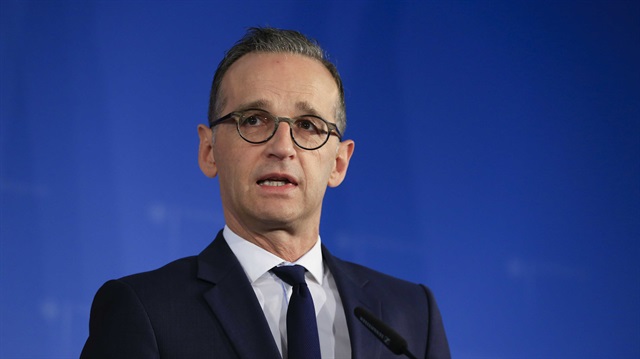
Heiko Maas
German Foreign Minister Heiko Maas hailed Turkey’s constructive role in Syria’s Idlib province after President Recep Tayyip Erdoğan and his Russian counterpart Vladimir Putin announced on Monday that their troops would enforce a new demilitarized zone in Idlib.
“We have also seen that Turkey has played an extraordinarily positive role regarding discussions in Syria and Idlib - ultimately Turkey managed to agree with Russia on a demilitarized zone and that’s extremely important,” Maas said at a news conference on Friday in Berlin.
Ankara and Moscow signed an agreement Monday that calls for the demilitarization of Idlib, following a summit in Russia's coastal Black Sea town of Sochi.
The U.S. State Department omitted the PYD/YPG terrorist group from its 2017 Country Reports on Terrorism, which was released Wednesday. The previous edition of the report noted that Turkey views the Syria-based PYD/YPG as an extension of the PKK terror group.With this move, Washington has made public its support of terrorism and its desire to split Syria. The activity in the region shows that Washington is laying the foundations for a terror state.Arms deploymentThe U.S. has accelerated its arms deployment to the PYD/PKK terror group. The U.S. dispatched 250 heavy weapons and armored vehicles to the Democratic Syrian Armed Forces (SDF), which is dominated by the YPG, in June. Over 200 trucks loaded with supplies were sent to the SDF on Aug. 6, and another deployment of several armored vehicles and 250 trucks with weapons and ammunition was sent on Aug. 15.The Syrian Observatory for Human Rights reported that over 1,200 shipments and trucks entered Syria in August alone.Syria’s Idlib under siege by foreign terroristsOccupation expandingThe PKK/YPG claims that the U.S.-supplied weapons will be used in an offensive against Daesh, however the Syrian Observatory for Human Rights has reported that Washington is working to expand several bases in Kobani, Aleppo and Hasakah.The PKK/YPG is extending its occupation to the east of the Euphrates with Washington’s support. Raqqa and Deir ez-Zor are under the siege of the terror group under the guise of fighting against Daesh. The terror group has also taken control of the region’s petrol and water sources.The YPG-dominated SDF controls an area of about 53,000 square kilometers with a percentage of 28.6 of Syrian territory.Details of Turkish-Russian Idlib deal revealedNew administration in NE Syria formed with Washington’s supportWith the support of the U.S., a new administration was created for northeastern Syria during a meeting for the Syrian Democratic Council (SDC) in Ayn Issa in early September. The new administration has been dubbed a coordination body that will connect the self-administrations of the Kurdish majority areas and the civil administrations in Arab majority areas that have their own civil councils.The self-administrations in the Euphrates, Afrin, and Jazeera region with the civil councils in Raqqa, Manbij, Tabqa, and Deir ez-Zor will be linked by the new administration.Top U.S. official visits terror groupWilliam Roebuck, the U.S. ambassador to Bahrain, visited northern Syria on Aug. 26 amid negotiations between the so-called Rojava canton and Damascus over the future of the region.“We are prepared to stay here, as the president (Donald Trump) has made clear,” Roebuck said during his trip.James Jeffrey, the former U.S. ambassador to Turkey who was named U.S. special representative to Syria on Aug. 17, echoed Roebuck’s sentiment as he declared that Washington would remain in the region until it was completely cleared of Daesh.US removes PYD/YPG from annual terrorism reportThe U.S has supplied the PYD terror organization and its armed wing, the YPG, with more than 5,000 truckloads of weapons to allegedly use in the fight against Daesh, despite Ankara’s warnings that the fact they are the Syrian offshoots of the PKK terror organization.Pentagon’s no-fly zone strategyThe Washington administration, which intends to maintain a permanent presence in Syria, has completed the construction of three advanced radar systems in Syria’s Hasakah-Tal Baidar countryside along with the Ayn al-Arab and Sarrin regions, and has set up 13 portable and fixed observation-intelligence radar systems.Pentagon’s preparation for a no-fly-zone indicates that the U.S. administration also wants to interfere in Turkey’s military operations to ensure the safety of PKK terrorists after Ankara’s successful ops conducted in Syria’s Hasakah, Qarrah Chouk Mountains and Iraq’s Sinjar.Sean Ryan, spokesperson for the U.S.-led Coalition against Daesh stated: “The Coalition installs satellites or other necessary equipment wherever needed within our area of operations.”US sends Castle International mercenaries to fight alongside YPG/PKK in SyriaU.S. spreads bases across SyriaWith its initial base establishing activities that were initiated in October 2015, Washington set up two air bases in al-Hasakah, and eight operational military bases in Raqqa and Manbij. Since July 2017, the U.S. has established five new bases, two of which were constructed in Manbij and close to the Euphrates Shield area. Two military bases were also established southwest of Tal Abyad.U.S. sends mercenaries to fight alongside YPG/PKK in SyriaIt has been found that the U.S. works with Castle International, an American giant in the international military services marketplace, in Syria.Specialized in aviation and medical support, Castle International mercenaries are employed by the U.S. in order to fight alongside YPG/PKK terrorists in Syria. Castle International’s social media accounts posted photographs of heavily armed commandos fighting and training beside YPG/PKK terrorists.
US bolsters support to PKK terror group in Syria
Opposition groups in Idlib will remain in areas in which they are already present, while Russia and Turkey will conduct joint patrols in the area to prevent any renewal of fighting.
Located near the Turkish border, Idlib is home to more than 3 million Syrians, many of whom fled to other cities following attacks by Assad regime forces.
Last month, the regime announced plans to launch a major military offensive in Idlib, Syria’s last opposition stronghold.
Turkey will continue its counter-terrorism activities in Syria, according to a declaration issued by the country’s National Security Council's Thursday.According to the declaration, Turkey is determined to continue its increasing activities to “eliminate terrorism in Syria’s other regions.”It called on international community to fulfill its political and humanitarian responsibilities more quickly and effectively.Turkey expects the implementations of an agreed roadmap to clear Syrian city of Manbij from the terrorist organization, it said.On Tuesday, a U.S. military spokesman said Washington is sticking to its agreement with Turkey on a roadmap for the northern Syrian city of Manbij, and not including the PKK/YPG.Col. Sean J. Ryan, the spokesman for the U.S.-led Combined Joint Task Force, emphasized there are little elements of the YPG left in the area."As far as I'm tracking, there's very little YPG if any at all. And we are adhering to that agreement that the YPG will not be part of Manbij," Ryan told Anadolu Agency.Turkey and the U.S. conducted more than 40 rounds of separate coordinated patrols in the region between areas liberated by Turkey's Operation Euphrates Shield and Manbij, according to Turkish officials.Separate patrols by Turkish and U.S. troops in the region began June 18, however, joint patrols have yet to be conducted.The YPG is a Syrian branch of the terrorist organization PKK and the focus of Turkey's counter-terrorist Operation Olive Branch in Afrin, Syria, near the border with Turkey.In its more than 30-year terror campaign against Turkey, the PKK -- listed as a terrorist organization by Turkey, the U.S. and the EU -- has been responsible for the death of some 40,000 people, including those of women and children.The declaration also pointed out the importance of Turkey-Russia agreement that called for demilitarization of the Syrian city of Idlib.Syria’s Idlib under siege by foreign terroristsTurkey’s presidency submits motion on Iraq, SyriaRussia says Israel must provide more data on plane downing near SyriaTurkish foundation ready for Syrian migration waveIsrael to improve coordination with Moscow over Syria after plane crashUK thanks Turkey for its 'longstanding role' in Syria
Turkey to continue anti-terror activities in Syria
Stable Turkish economy in Germany's interest
Maas also noted that it was in Germany’s interests for Turkey to be economically stable, and added that he thought Turkey was able to make the necessary decisions to restore that stability after the lira lost value against the U.S. dollar amidst a row with Washington.
Maas said his visit to Turkey early this month was the beginning of a new process of improving ties between Berlin and Ankara, and stressed that high-level visits will continue in the coming days and weeks.
“It think it is much better if we engage with each other and talk to each other, instead of talking about each other,” he said.