

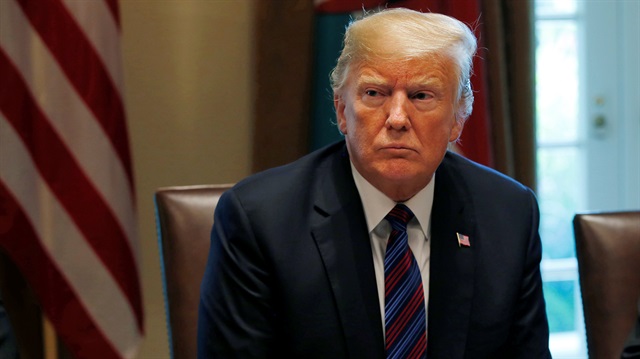
U.S. President Donald Trump
Nearly three out of four companies doing business in Germany and the United States doubt that a U.S.-European trade truce reached last month will be followed by a lasting agreement on large-scale tariff cuts, a survey showed on Tuesday.
U.S. President Donald Trump agreed during a meeting with European Commission President Jean-Claude Juncker in July to refrain from imposing tariffs on European cars while the two sides said they would negotiate to cut other tariffs.
The interim deal has reduced the risk of a full-blown transatlantic trade dispute, bringing relief especially for German carmakers and lifting business morale in Europe's largest economy in August.
A survey by the American Chamber of Commerce in Germany (AmCham) showed, however, that company executives on both sides of the Atlantic remain sceptical, with 71 percent doubting whether a lasting agreement to cut tariffs can be reached.
The Washington administration, which intends to maintain a permanent presence in Syria, has completed the construction of three advanced radar systems in Syria’s Hasakah-Tal Baidar countryside along with the Ayn al-Arab and Sarrin regions, and has set up 13 portable and fixed observation-intelligence radar systems.Speaking to Yeni Şafak daily, former Commander of Syria's Deir Ezzor Military Assembly Fayez al-Esmer evaluated the U.S.’s latest moves in Syria and said that in an addition to all attempts to protect Kurdistan Workers’ Party (PKK) terrorists in the region, Pentagon is in preparation to set up a missile defense shield in Syria’s Hasakah and Rmeilan.“The U.S.’s next step is to build a missile defense shield in the region which must be considered as a part of Washington’s long-term plan for chaos in the region,” he said.The U.S. has already begun to create a new no-fly-zone in northern Syria, the same tactic used in the 1991 occupation of Iraq, and started to install advanced radar systems in a 26,000 square kilometer area occupied by the Syrian affiliate of the Kurdistan Workers’ Party (PKK), the PYD, east of the Euphrates. US sets up radars in northern Syria to ‘protect PKK terrorists’Alternatives to Incirlik Air Base Additionally, the U.S administration is looking for alternatives to Incirlik Air Base because of its current strained relationship with Turkey.Incirlik Air base was used during the defeated 15 July coup attempt to aid terrorists of the Fetullah Terrorist Organization (FETÖ) as well as to provide logistics support to Kurdistan Workers’ Party (PKK) in Syria.U.S. warplanes at Incirlik Air Base were moved to other bases, and only cargo planes, refueling aircraft, and scout planes remain.Lately, the U.S. is converting its bases into aerial operation centers in Iraq’s Al Asad, Ayn al-Asad, Qayyarah, as well as those in Rimeylan, Ayn el Arab, Tal Baidar and Sarrin in Syria.Turkey and the U.S. are currently experiencing rocky relations following Washington’s imposition of sanctions on Interior Minister Süleyman Soylu and Justice Minister Abdülhamit Gül for not releasing American Pastor Andrew Brunson, who faces terrorism charges in Turkey.U.S. President Donald Trump ramped up his attack on Turkey by doubling U.S. tariffs on Turkish aluminum and steel imports to 20 percent and 50 percent, respectively. They will monitor Turkey from the border Stressing Pentagon’s lengthy plan for chaos in the region, al-Esmer said that all these steps indicate that the U.S. administration intends to strengthen its presence in Syria while providing support to PKK terrorists.The advanced radar systems will especially be used to monitor Turkey’s air and ground operations at the border, he added.Esmer also said that U.S. warplanes will be more active in the regions of Hasakah, Raqqa and Deir ez-zor and that information received from these points will be transferred to the air forces to create a protection shield.He stressed that all these initiatives must be considered as moves to “intimidate” Turkey, Russia and Iran.Russia and Turkey, along with Iran are sponsoring the Astana peace talks, which focuses on a cease-fire and ending the seven-year civil war in Syria.“The Washington administration has realized that the PKK is insufficient regarding its plans related to east of the Euphrates. Therefore, it will further fortify its military presence in the region. On the other hand, U.S. activities carried out in Syria and Iraq is due to its determination to exploit underground resources,” Esmer added.The U.S has supplied the PYD terror organization and its armed wing, the YPG, with more than 5,000 truckloads of weapons to allegedly use in the fight against Daesh, despite Ankara’s warnings that the fact they are the Syrian offshoots of the PKK terror organization.Russia says sees signs US preparing for possible strike on Syria836 detainees die in Syrian regime prisons: NGODriven from home, White Helmet rescuers start over in north SyriaIran and Syria sign deal for military cooperation
‘US seeks to strengthen presence in Syria by setting up missile defense shield’
More than 40 percent of German companies doing business in the United States said the U.S. market had become less important for them since the escalation of the trade dispute, the survey showed.
This compared with 20 percent of U.S. companies doing business in Germany who said the German market had become less important for them.
German Chancellor Angela Merkel and Trump agreed during a telephone call on Monday that they strongly supported ongoing discussions between Washington and Brussels to remove barriers to a deeper trading relationship, the White House has said.
Washington is pressing the EU to speed up the trade negotiations launched after last month's meeting between Trump and Juncker, German and U.S. officials told Reuters over the weekend.
The European Union wants to see a stable economic development in Turkey, Germany’s foreign minister said on Tuesday.Speaking to German business representatives and ambassadors at the Foreign Ministry, Heiko Maas criticized U.S. President Donald Trump’s sanctions and his economic pressure policy towards Turkey.“Of course we Europeans have a great interest in a stable economic development in Turkey,” he stressed.Maas said he will visit Turkey next week to meet Turkish government officials and discuss recent economic developments.The German foreign minister is scheduled to pay a two-day visit to Turkey on Sept. 5-6, ahead of Turkish President Recep Tayyip Erdogan’s key visit to Berlin on Sept. 28-29.Over the past two years political relations between Ankara and Berlin have suffered setbacks, but in recent months both sides have taken steps towards improving ties.Germany is Turkey’s main economic and trade partner. More than 7,500 German companies are active in Turkey. In 2017, the bilateral trade volume reached €37.6 billion ($43.6 billion).Germany condemns far-right demo in eastern city after fatal disputeGermany slams US President Trump’s sanctions policyCanada appeals for German backing amid Saudi rights rowRacism in Germany ‘must be taken seriously,’ says Merkel after Özil debateGermany says Turkey’s stability important for EuropeGerman CEO sees rebound in Turkish tourism sector
EU for stable economic development in Turkey: Germany