

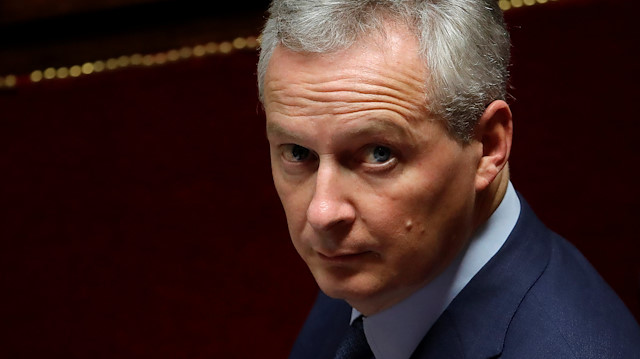
French Finance Minister Bruno Le Maire
French Finance Minister Bruno Le Maire on Monday said tax cuts should be accelerated, and by consequence the pace of public spending cuts quickened, to foster greater prosperity for all citizens.
"We cannot take away with one hand what we are giving to those who are working with our other hand, and therefore as a consequence we have to speed up our tax cut plans," Le Maire told reporters at a news conference.
"Less public spending and less taxes, those are the conditions needed to put France back on the right track, those are the conditions for the prosperity of all French people, those are the conditions to get us out of our debt burden," he added.
Egypt and France began a joint military drill in the Red Sea on Sunday, according to the Egyptian military.In a statement, the army said naval forces from both countries carried out a naval training in the Red Sea with the participation of a French warship and a number of Egyptian navy vessels.“The military exercise aims to enhance the combat capability of both countries to deal with naval threats, including the protection of important shipments and counter-terrorism,” the statement said.The Red Sea is a strategic route for the Gulf oil to Europe and the U.S. through Egypt's Suez Canal.Last month, the Egyptian army conducted joint naval exercises with French military forces in the northern Mediterranean Sea.In February and March, both countries conducted three separate joint naval exercises in the Red Sea and the Mediterranean.Ever since President Abdel-Fattah al-Sisi assumed power in June of 2014, Cairo and Paris have signed a range of arms deals, making France -- alongside the U.S. and Russia -- one of Egypt’s main sources for weapons.
Egypt, France begin war games in Red Sea
When Emmanuel Macron rose to power, he put the environment at the heart of his agenda. Eighteen months later, anger over those policies has stoked protests that are a huge challenge for the French president.Rioters torched cars and buildings in central Paris on Saturday following two weeks of protests caused partly by higher fuel taxes which Macron says are needed to fight climate change. Some protesters called for him to resign.Macron's plight illustrates a conundrum: How do political leaders' introduce policies that will do long-term good for the environment without inflicting extra costs on voters that may damage their chances of re-election?It is a question facing leaders across the world as delegates hold talks in the Polish city of Katowice this week to try to produce a "rule book" to flesh out details of the 2015 Paris Agreement on fighting climate change."Clearly, countries where inequalities are the highest are the ones where these kinds of push-backs are mostly likely," Francois Gemenne, a specialist in environmental geopolitics at SciencesPo university in Paris, said of the political risks.Naming Italy, the United States and Britain as countries where environmental moves could risk a voter backlash, he said: "I guess it's one of the reasons why populist leaders tend to be very sceptical about climate change and environmental measures."The protests in France have inspired a similar movement in neighbouring Belgium, where protesters took to the streets on Friday.There have also been small-scale protests in Canada over Prime Minister Justin Trudeau's plan to impose a federal carbon tax on provinces unwilling to combat climate change.What was once widely seen by governments as a win-win transition to cleaner energies now looks more like causing short-term costs with huge social disruption, followed by possible long-run gains.Another challenge facing leaders is over how they use the proceeds from policies intended to help the environment: Should money raised from carbon taxes be used directly to combat climate change, or to plug holes in national accounts?French police clash with 'yellow vest' protesters in Paris, 122 arrestedCarbon TaxesMacron said after the latest protests in Paris that he would convene ministers to discuss the crisis on his return from a G20 summit in Argentina. Prime Minister Edouard Philippe cancelled plans to go to Katowice for the climate change summit.Macron introduced new carbon taxes to urge motorists to change behaviour and protect the environment.Macron has watered down some of his campaign pledges on the environment since he took office, and his popular environment minister quit in August over the sluggishness of progress. But he has shown little willingness to compromise in the face of the protests.The fuel tax is accompanied by other measures including incentives to encourage people to buy electric vehicles.Unveiling a medium-term energy plan for France last week, he held out an olive branch by saying he would review fuel prices each quarter, but said the carbon taxes would stay.His goal is for France to cut carbon emissions by 40 percent by 2030 and boost the use of cleaner energies at the same time. Emissions are currently rising and 75 percent of energy use in France originates from fossil fuels."When we talk about the actions of the nation in response to the challenges of climate change, we have to say that we have done little," he said.Macron has also said he will fight to try to save the Paris climate agreement, which aims to keep global temperature rises to between 1.5 and 2 degrees Celsius, a critical threshold.Scientists are increasingly concerned that countries are falling short on their targets and must be more ambitious. Yet citizens are worried about their immediate lives.French police brace for more violent protests over rising fuel costs"Policies Of Transition"In Canada, addressing the question of how governments use the money raised from carbon taxes, Trudeau's government has promised to return the money collected from the provinces directly to taxpayers.But in France most of the revenue generated will be used to tackle the national budget deficit, increasing anger at Macron, who left-wing opponents call the "president of the rich".Of the 34 billion euros ($38.71 billion) the French government will raise on fuel taxes in 2018, a sum of only 7.2 billion euros is earmarked for environmental measures.Simon Dalby, a specialist in the political economy of climate change at Wilfrid Laurier University in Canada, says carbon taxes should be part of wider measures to alter how people live, including better, greener transport and buildings."It is all about policies for transition to a post-fossil-fuel world, something that needs to be done quickly if the worst of the predicted climate disruptions are to be avoided in the coming decades," he said.Gemenne said the protests in France were unlikely to go away soon, and may emerge in other countries as they take more determined action on emissions.The danger, he said, was inaction, or acting too late to prevent global warming. At the same time, politicians need to be able to show they were acting fairly and equitably. Overturning Napoleon-era rights, France bans smacking kids
France's Macron learns the hard way: green taxes carry political risks
French President Emmanuel Macron immediately went to the Arc de Triomphe after returning to Paris on Sunday from Argentina to assess the damage after rioters looted and defaced the famous landmark during a day of riots.TV images showed the inside of the monument ransacked with a statue of Marianne, a symbol of the French republic, smashed, and graffiti sprawled on the exterior ranging from anti-capitalist slogans to social demands. 
France's Macron visits Arc de Triomphe after Saturday Paris riots
The "yellow vest" protests spread to the Netherlands on Saturday as people staged anti-government protests in various cities.Responding to calls on social media, the protesters took to the streets in the cities of The Hague, Nijmegen, Maastricht, Alkmaar, Leeuwarden and Groningen.Some 200 protesters demonstrated in front of the parliament building in The Hague.Following police action some protesters left the venue while others demanded that they be let to walk around the parliament building.Some of them removed their yellow vests upon calls from the police.Police detained four protesters.The 'yellow vest' protests first started in France two weeks ago against a rise in fuel prices.On Friday, they also spread to Belgium.EU unemployment rate at 6.7 pct in OctoberUnilever CEO Polman to retire, replaced by beauty head Jope
'Yellow vest' protests spread to Netherlands