

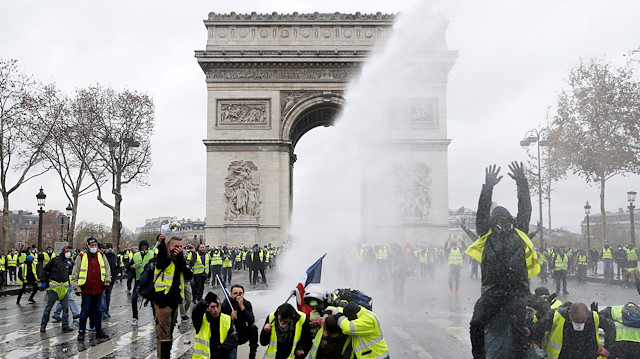
Protesters wearing yellow vests, a symbol of a French drivers' protest against higher diesel taxes, stand up in front of a police water canon at the Place de l'Etoile near the Arc de Triomphe in Paris, France.
When Emmanuel Macron rose to power, he put the environment at the heart of his agenda. Eighteen months later, anger over those policies has stoked protests that are a huge challenge for the French president.
Rioters torched cars and buildings in central Paris on Saturday following two weeks of protests caused partly by higher fuel taxes which Macron says are needed to fight climate change. Some protesters called for him to resign.
Macron's plight illustrates a conundrum: How do political leaders' introduce policies that will do long-term good for the environment without inflicting extra costs on voters that may damage their chances of re-election?
It is a question facing leaders across the world as delegates hold talks in the Polish city of Katowice this week to try to produce a "rule book" to flesh out details of the 2015 Paris Agreement on fighting climate change.
"Clearly, countries where inequalities are the highest are the ones where these kinds of push-backs are mostly likely," Francois Gemenne, a specialist in environmental geopolitics at SciencesPo university in Paris, said of the political risks.
Naming Italy, the United States and Britain as countries where environmental moves could risk a voter backlash, he said: "I guess it's one of the reasons why populist leaders tend to be very sceptical about climate change and environmental measures."
The protests in France have inspired a similar movement in neighbouring Belgium, where protesters took to the streets on Friday.
There have also been small-scale protests in Canada over Prime Minister Justin Trudeau's plan to impose a federal carbon tax on provinces unwilling to combat climate change.
What was once widely seen by governments as a win-win transition to cleaner energies now looks more like causing short-term costs with huge social disruption, followed by possible long-run gains.
Another challenge facing leaders is over how they use the proceeds from policies intended to help the environment: Should money raised from carbon taxes be used directly to combat climate change, or to plug holes in national accounts?
Police fired tear gas, stun grenades and water cannon in battles with "yellow vest" protesters around the Champs Elysees in Paris on Saturday, marking the third weekend of demonstrations across France against high living costs.Police said 122 people had been arrested amid concerns that violent far-right and far-left groups were infiltrating the "yellow vests" movement, a spontaneous grassroots rebellion over the struggle of many in France to make ends meet.For more than two weeks, the "gilets jaunes" (yellow vests) have blocked roads in protests across France, posing one of the largest and most sustained challenges Emmanuel Macron has faced in his 18-month-old presidency.In Paris, masked and hooded protesters picked up and hurled crowd barriers and other projectiles in running battles with police around the world famous Champs Elysees boulevard.Six policemen and 14 protesters have been injured, Paris police said.Video: Riot police use teargas against yellow vest protesters in Paris"We are attached to dialogue, but also the respect for the law," Edouard Philippe told reporters. "I am shocked by the attacks on the symbols of France."Several hundred yellow vests sat down around the Tomb of the Unknown Soldier under the Arc de Triomphe at the top of the avenue, singing La Marseillaise, France's national anthem, and chanting, "Macron Resign!"On the facade of the towering 19th-century arch, protesters scrawled in big black letters: "The yellow vests will triumph."After several hours of skirmishes in the morning, police had appeared to clear the area around the Arc, but rioters and peaceful protesters subsequently returned. Clashes in adjacent streets also broke out where barricades were put up, car windows were smashed and at least two vehicles set alight.Along the Champs Elysees, peaceful demonstrators held up a slogan reading, "Macron, stop treating us like idiots!"Galeri: Protests against high fuel prices cripple ParisMACRON WON'T BE BOUNCED BY "THUGS"Macron said on Tuesday he understood the anger felt by voters outside France's big cities over the squeeze that fuel prices have put on households, but insisted he would not be bounced into changing policy by "thugs".Philippe said across France there were some 36,000 protesters and 5,500 in Paris. Police unions said there were 582 road blockages in France. Nantes airport in western France was briefly closed after protesters reached the tarmac.A week ago thousands of protesters, who have no leader and have largely organised themselves online, converged on Paris for the first time, turning the Champs Elysees into a battle zone as they clashed with police firing tear gas and water cannon."What message do the yellow vests want to pass today? That we set France on fire, or find solutions? I find this (violence) absurd," Jacline Mouraud, a prominent activist within the yellow vests movement, told BFM television.Galeri: French police clash with protesters in ParisBut a retired yellow-vest protester said: "The government is not listening. Revolution cannot happen without violence."The outburst of anger is strongest on the outskirts of smaller provincial towns and villages, and underlines the gap between metropolitan elites and working class voters that has boosted anti-establishment politics across the Western world.The immediate trigger for the protest wave was Macron's decision to raise tax on diesel fuel in a move to encourage the driving of less-polluting cars.The yellow vests, who enjoy widespread public support, get their name from the high-visibility jackets all motorists in France must carry in their vehicles.When they began, the protests caught Macron off-guard just as he was trying to counter a fall in his popularity rating to 30 percent. His unyielding response has exposed him to charges of being out of touch with ordinary people.
French police clash with 'yellow vest' protesters in Paris, 122 arrested
Carbon Taxes
Macron said after the latest protests in Paris that he would convene ministers to discuss the crisis on his return from a G20 summit in Argentina. Prime Minister Edouard Philippe cancelled plans to go to Katowice for the climate change summit.
Macron introduced new carbon taxes to urge motorists to change behaviour and protect the environment.
Macron has watered down some of his campaign pledges on the environment since he took office, and his popular environment minister quit in August over the sluggishness of progress. But he has shown little willingness to compromise in the face of the protests.
The fuel tax is accompanied by other measures including incentives to encourage people to buy electric vehicles.
Unveiling a medium-term energy plan for France last week, he held out an olive branch by saying he would review fuel prices each quarter, but said the carbon taxes would stay.
His goal is for France to cut carbon emissions by 40 percent by 2030 and boost the use of cleaner energies at the same time. Emissions are currently rising and 75 percent of energy use in France originates from fossil fuels.
"When we talk about the actions of the nation in response to the challenges of climate change, we have to say that we have done little," he said.
Macron has also said he will fight to try to save the Paris climate agreement, which aims to keep global temperature rises to between 1.5 and 2 degrees Celsius, a critical threshold.
Scientists are increasingly concerned that countries are falling short on their targets and must be more ambitious. Yet citizens are worried about their immediate lives.
French authorities have drafted thousands of additional police officers into Paris ahead of a third demonstration on Saturday by protesters angry at high fuel prices as security officials warned of renewed violence.For more than two weeks, the "yellow vests" have blocked roads across France in a spontaneous, popular rebellion against diesel tax hikes and the high cost of living. It has grown into one of the largest and most stubborn challenges Emmanuel Macron has faced in his 18-month-old presidency.A week ago thousands of protesters, who have no leader and have largely organised themselves online, converged on Paris for the first time, turning the Champs Elysees into a battlezone as they clashed with police firing tear gas and water canon."We're worried that small groups of rioters that aren't yellow vests will infiltrate (the demonstration) to fight security forces and challenge the authority of the state," said Denis Jacob, Secretary General of the Alternative Police union."Given the high level of security around the Champs the fear is thugs will go to other places," he said.Officials said they expected some 5,000 police and gendarmes in Paris, up from about 3,000 last Saturday. Another 5,000 will be deployed across the country for other yellow vests protests.Workmen erected metal barriers and plywood boards on the glass-fronted facades of restaurants and boutiques lining Paris' most famous avenue on Friday. The Champs Elysees will be closed to traffic and pedestrians will be funnelled through checkpoints."There's a lot of incitement on social media and we are expecting excess and violence," David Michaux of the UNSA Police union told Reuters, adding that far-right and far-left groups were expected.Three protests are officially planned across Paris on Saturday, including the "yellow vests", a union protest against unemployment and a separate demonstration against racism.For now, the "yellow vests" -- who take their name from the high-visibility jackets all motorists in France must carry in their vehicles -- enjoy widespread public support.When they began, the protests caught Macron off-guard just as he was trying to counter a plunge in popularity, with his approval at barely 20 percent. His unyielding response has exposed him to charges of being out of touch with ordinary people.
French police brace for more violent protests over rising fuel costs
"Policies Of Transition"
In Canada, addressing the question of how governments use the money raised from carbon taxes, Trudeau's government has promised to return the money collected from the provinces directly to taxpayers.
But in France most of the revenue generated will be used to tackle the national budget deficit, increasing anger at Macron, who left-wing opponents call the "president of the rich".
Of the 34 billion euros ($38.71 billion) the French government will raise on fuel taxes in 2018, a sum of only 7.2 billion euros is earmarked for environmental measures.
Simon Dalby, a specialist in the political economy of climate change at Wilfrid Laurier University in Canada, says carbon taxes should be part of wider measures to alter how people live, including better, greener transport and buildings.
"It is all about policies for transition to a post-fossil-fuel world, something that needs to be done quickly if the worst of the predicted climate disruptions are to be avoided in the coming decades," he said.
Gemenne said the protests in France were unlikely to go away soon, and may emerge in other countries as they take more determined action on emissions.
The danger, he said, was inaction, or acting too late to prevent global warming. At the same time, politicians need to be able to show they were acting fairly and equitably.
Members of the French parliament voted in favour of a ban on parents smacking their children, falling into line with the majority of European Union member states, although there will be no punishment for breaking the law.The civil code will be updated to state that parental authority must be exercised without violence and that parents may not resort to "physical, verbal or psychological violence, nor to corporal punishment or humiliation".The ban was approved in a thinly attended National Assembly session in the early hours of Friday, with 51 votes in favour, one against and three abstentions.It reverses parental rights to discipline children using corporal punishment granted under Napoleon in the early 1800s."Education through violence can only create more violence in society. It also leads to failure at school, illness, suicide, anti-social behaviour and delinquence," said Maud Petit of the centrist MoDem party, a partner in parliament with French President Emmanuel Macron's LREM party.The ban was proposed by France's gender equality minister, Marlene Schiappa, who told Le Parisien newspaper that parents are wrong to believe that shouting, slapping or twisting children's ears are appropriate ways to assert authority."No violence is educational," she said.French First Lady Brigitte Macron also supported the ban, but a few conservative and far-right MPs have condemned it as an interference in families' private lives.As part of the vote, the government will prepare a report about parental violence and propose measures to educate parents.Following the example of Sweden in 1966, some 54 countries - including 22 of the EU's 28 member countries - have introduced similar laws banning corporal punishment in the home, according to French data. (Reporting by Elizabeth Pineau Writing by Geert De Clercq Editing by Luke Baker and Peter Graff)
Overturning Napoleon-era rights, France bans smacking kids