

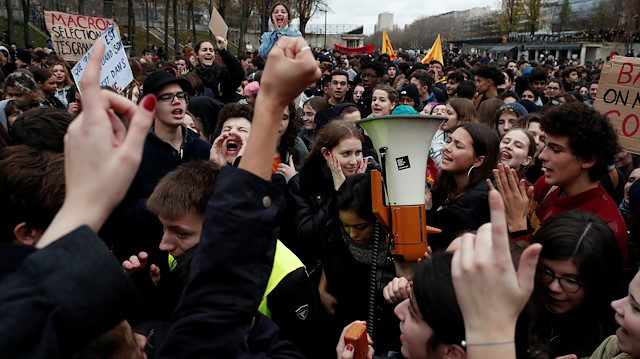
Youths and high school students attend a demonstration to protest against the French government's reform plan, in Paris, France, December 7, 2018.
France hunkered down for another wave of potentially violent protests on Saturday as under-fire President Emmanuel Macron planned to address the nation next week over public anger at the cost of living, senior allies said.
Much of Paris will be in lockdown and tens of thousands of police deployed across the nation to contain what protesters are billing as 'Act IV' to the 'yellow vest' rebellion that has seen the worst unrest in the capital since 1968 student riots.
Navigating his biggest crisis since being elected, Macron has left it largely to his prime minister, Edouard Philippe, to deal in public with the turmoil and offer concessions.
But the 40-year-old is under mounting pressure to speak more fully as his administration tries to regain the initiative following three weeks of unrest in the G7 nation.
At least 89,000 police officers will be deployed across France amid fears of violence during anti-government protests this weekend.Some 8,000 police officers will be on duty in Paris and armored vehicles will also be deployed, Prime Minister Edouard Philippe told French television station TF1 Thursday."We face people who do not come to protest but to destroy," he said.Shops and restaurants on Paris's Champs-Elysees and some museums will also be closed.The Eiffel Tower’s management announced on its Twitter account that it will remain closed to the public Saturday due to demonstrations and visitors will be automatically refunded.Thousands of "yellow vest" protesters have been gathering in major French cities including Paris since Nov. 17 to protest President Emmanuel Macron's controversial fuel tax hikes and the deteriorating economic situation in France.The demonstrators, who generally live in rural areas due to high rents in the cities, called on Macron to cut fuel taxes and make economic arrangements to ease their lives.Galeri: French police clash with protesters in ParisPhilippe announced Tuesday that France would delay fuel tax increases for six months and the suspension would also apply to increases in gas and electricity prices. The government abandoned the fuel tax hikes the following day.“The government is ready for dialogue and is showing it because this tax increase has been dropped from the 2019 budget bill,” Philippe said in a speech at the National Assembly, or lower house of parliament.At least three people have died during the riots while 1,043 others have been injured, including 222 members of the security forces. As many as 1,424 people have been arrested.According to a recent survey, 84 percent of the French people -- mostly from the middle-income group -- support the protests.Fuel prices in France have risen more than 20 percent this year.
France braces for more violence over high living costs
"The President will speak early next week. I think this is what the French people want, they want answers," Transport Minister Elisabeth Borne told Sud Radio on Friday.
"The President will send a message to the French that he is listening to their anger (...) and that new answers have obviously to be found."
Protesters want Macron to go further on easing the budgets of hard-pressed households: an increase to the minimum wage is one demand. But the president, mindful of the country's deficit and not wanting to flout EU rules, will have little wriggle room for more concessions.
Scrapping next year's hikes to fuel taxes, the first major U-turn of his presidency, has already cost the Treasury 4 billion euros ($4.5 billion).
French authorities warned another wave of "great violence" and rioting could be unleashed in Paris this weekend by a hard core of 'yellow vest' protesters, as senior ministers sought to defuse public anger with conciliatory languages on taxes.Despite capitulating this week over plans for higher fuel taxes that inspired the nationwide revolt, President Emmanuel Macron has struggled to quell the anger that led to the worst street unrest in central Paris since 1968.Rioters torched cars, vandalised cafes, looted shops and sprayed anti-Macron graffiti across some of Paris's most affluent districts, even defacing the Arc de Triomphe. Scores of people were hurt and hundreds arrested in battles with police.An official in Macron's office said intelligence suggested that some protesters would come to the capital this Saturday "to vandalise and to kill."Prime Minister Edouard Philippe said 65,000 security personnel would be deployed across the country on that day to keep the peace.France cancels fuel tax hikes amid protestsIn a bid to defuse the three-week crisis, Philippe had told parliament late on Wednesday that he was scrapping the fuel-tax increases planned for 2019, having announced a six-month suspension the day before.Finance Minister Bruno Le Maire told a conference he was prepared to bring forward tax cutting plans and that he wanted workers' bonuses to be tax-free.But he added: "In this case, it must go hand-in-hand with a decrease in spending."He also said France would impose a tax on big internet firms in 2019 if there was no consensus on a European Union-wide levy, seeking to appeal to the "yellow vests'" anti-business sentiment.Video: Car burns in Paris as high-school students protestSOCCER MATCHES CANCELLEDThe threat of more violence poses a security nightmare for the authorities, who make a distinction between peaceful 'yellow vest' protesters and violent groups, anarchists and looters from the deprived suburbs who they say have infiltrated the movement.On Facebook groups and across social media, the yellow vests are calling for an "Act IV", a reference to what would be a fourth weekend of disorder."France is fed up!! We will be there in bigger numbers, stronger, standing up for French people. Meet in Paris on Dec. 8," read one group's banner.Education Minister Jean-Michel Blanquer urged people to stay at home during the coming weekend. Security sources said the government was considering using troops currently deployed on anti-terrorism patrols to protect public buildings.France could change position on wealth tax, Macron ally suggestsSeveral top-league soccer matches on Saturday have been cancelled and the Louvre museum said it and others were awaiting word from Paris officials on whether to close their doors.The protests, named after the fluorescent jackets French motorists are required to keep in their cars, erupted in November over the squeeze on household budgets caused by fuel taxes. Demonstrations swiftly grew into a broad, sometimes-violent rebellion against Macron, with no formal leader.Their demands are diverse and include lower taxes, higher salaries and Macron's resignation.France's hard-left CGT trade union on Thursday called on its energy industry workers to walk out for a 48 hours from Dec. 13, saying it wanted to join forces with the yellow vests. The movement, with no formal leader, has so far not associated itself with any political party or trade union.Macron's popularity hits new low amid French protests: pollSTREET POLITICSThe fuel-tax volte-face was the first major U-turn of Macron's 18-month presidency.The unrest has exposed the deep-seated resentment among non-city dwellers that Macron is out-of-touch with the hard-pressed middle class and blue-collar labourers. They see the 40-year-old former investment banker as closer to big business.Trouble is also brewing elsewhere for Macron. Teenage students on Thursday blocked access to more than 200 high schools across the country, burning garbage bins and setting alight a car in the western city of Nantes.Meanwhile, farmers who have long complained that retailers are squeezing their margins and are furious over a delay to the planned rise in minimum food prices, and truckers are threatening to strike from Sunday.Le Maire said France was no longer spared from the wave of populism that has swept across Europe."It's only that in France, it's not manifesting itself at the ballot box, but in the streets."'Yellow vests' riots in Paris cost at least €3M
Macron administration warns of 'great violence' in Paris from hard core 'yellow vests'
"SMASHING THINGS UP"
The Eiffel Tower, opera house, and Louvre are among dozens of museums and tourist sites that will close on Saturday.
Authorities have also ordered shut scores of luxury boutiques, restaurants and private businesses on the Champs Elysees avenue and around the presidential palace.
The trouble is jeopardising a timid economic recovery in France. Small retailers saw revenue fall 20-40 percent last Saturday, and hotel reservations are down 15-25 percent.
Patrick Delmas, 49, will be closing his bar "Le Monte Carlo" next to the Champs Elysees on Saturday, blaming hoodlums from anarchist and anti-capitalist groups, as well as the yellow vest movement's violent fringe.
France has abandoned an increase in fuel taxes following weeks of violent demonstrations.“The government is ready for dialogue and is showing it because this tax increase has been dropped from the 2019 budget bill,” Prime Minister Edouard Philippe said Wednesday in a speech at the National Assembly, or lower house of parliament.The move follows an announcement by Philippe the previous day that tax hikes would be delayed for six months and that the suspension would also apply to increases in gas and electricity prices.Thousands of protesters wearing yellow vests have been gathering in major French cities, including Paris, since Nov. 17 to protest President Emmanuel Macron's controversial fuel tax hikes and the deteriorating economic situation in France.France could change position on wealth tax, Macron ally suggestsThe demonstrators, who generally live in rural areas due to high rents in the cities, called on Macron to cut fuel taxes and make economic arrangements to ease their lives.On Saturday, French police cracked down on protesters around the famous Champs-Elysees in Paris with tear gas and water cannons.Demonstrators set a large number of vehicles and trash cans ablaze and pelted police with stones and bottles.At least three people have died during the riots while 1,043 others have been injured, including 222 members of the security forces. As many as 1,424 people have been arrested.According to a recent survey, 84 percent of the French people -- mostly from the middle-income group -- support the protests.Fuel prices in France have risen more than 20 percent this year.
France cancels fuel tax hikes amid protests
"We have lost 60 percent of business over the last 15 days," he said. "The problem is all those people who arrive with the sole intention of smashing things up."
The protests, named after the high visibility vests French motorists carry in their cars, erupted in November due to the impact on family budgets of already raised fuel taxes.
Reminiscent of Spain's anti-austerity "Indignados" movement in 2011, the French protests swiftly grew into a broad rebellion against the government, but without formal leaders.
Their diverse demands include lower taxes, higher salaries, cheaper energy, better retirement provisions and even Macron's resignation.
A day after President Emmanuel Macron's administration backed down in the face of nationwide protests and suspended a fuel-tax, the government has suggested it could also amend a wealth tax that critics say goes too easy on the rich.Speaking on RTL radio, government spokesman Benjamin Griveaux, a close ally of Macron's, said all policies involving taxation needed to be reevaluated from time to time and, if deemed not to be working, should be changed."If a measure that we have taken, which is costing the public money, turns out not to be working, if it's not going well, we're not stupid - we would change it," he said.France could change position over wealth tax, says government spokesmanHe defended Macron's decision on coming into office last year to amend the wealth tax - known in France as 'ISF' - by narrowing it to a tax on real estate assets, rather than covering all worldwide assets, from jewellery to yachts to investments, over the value of 1.3 million euros.Those changes earned Macron the label "president of the rich" because they were seen by his critics as accommodating the wealthy.Asked whether the government would be willing to go back on that decision, Griveaux suggested it was possible."We did not cancel the ISF, we transformed it, I want to remind you that we maintained the tax on real estate... The tax that was removed was to encourage investments in the real economy. It was not a gift to the rich," he said, before adding:Paris climate deal 'fatally flawed': Trump"We are evaluating it, we are controlling it. This money was to be invested in our SMEs for them to develop, innovate and hire. If that is not the case, if the evaluation is not good, then we can reopen it for discussion."Over the past three weeks, Macron has come under immense pressure in the face of nationwide protests against a fuel-tax increase that was set to begin in January.The so-called "yellow vest" movement, named for the high-visibility jackets motorists in France must have in their cars, led to violent clashes with police in Paris at the weekend, and on Tuesday prompted the government to change course.Prime Minister Edouard Philippe said the carbon-tax increase would be suspended for six months and the time used to examine other steps to ease the burden on blue-collar workers and the squeezed middle-class.French PM suspends planned fuel tax increases for six-month periodIt marked the first major U-turn by Macron in his 18-months in office and comes at a time when he is far down in the polls, with his popularity at barely more than 20 percent.U.S. President Donald Trump appeared to mock Macron over the policy shift, which will make it harder for France to meet its CO2 emissions reduction target, a core element of the Paris climate agreement of 2015."I am glad that my friend @EmmanuelMacron and the protestors in Paris have agreed with the conclusion I reached two years ago," Trump tweeted late on Tuesday."The Paris Agreement is fatally flawed because it raises the price of energy for responsible countries while whitewashing some of the worst polluters."If the government were to look at reimposing some of the dropped elements of the ISF tax it would mark a fundamental change of direction for Macron, who came to power promising to be "neither of the left nor the right" politically. 
France could change position on wealth tax, Macron ally suggests
Macron's government has this week offered a rush of sweeteners to soothe public anger, beginning with Philippe's climb-down on fuel taxes. Yet all signs are that the government has failed to quell the revolt.
Some 89,000 policemen will be on duty to stop a repeat of last Saturday's mayhem. About 8,000 of them are to be deployed in Paris where rioters last weekend torched cars, looted shops and defaced the Arc de Triomphe with anti-Macron graffiti.
Another weekend of violence may raise doubts over the durability of Macron's prime minister, though aides to Macron and Philippe say there is no discord between them.