

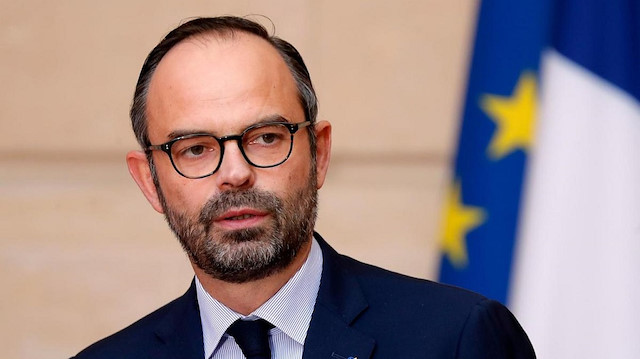
Edouard Philippe
France has abandoned an increase in fuel taxes following weeks of violent demonstrations.
“The government is ready for dialogue and is showing it because this tax increase has been dropped from the 2019 budget bill,” Prime Minister Edouard Philippe said Wednesday in a speech at the National Assembly, or lower house of parliament.
The move follows an announcement by Philippe the previous day that tax hikes would be delayed for six months and that the suspension would also apply to increases in gas and electricity prices.
Thousands of protesters wearing yellow vests have been gathering in major French cities, including Paris, since Nov. 17 to protest President Emmanuel Macron's controversial fuel tax hikes and the deteriorating economic situation in France.
A day after President Emmanuel Macron's administration backed down in the face of nationwide protests and suspended a fuel-tax, the government has suggested it could also amend a wealth tax that critics say goes too easy on the rich.Speaking on RTL radio, government spokesman Benjamin Griveaux, a close ally of Macron's, said all policies involving taxation needed to be reevaluated from time to time and, if deemed not to be working, should be changed."If a measure that we have taken, which is costing the public money, turns out not to be working, if it's not going well, we're not stupid - we would change it," he said.France could change position over wealth tax, says government spokesmanHe defended Macron's decision on coming into office last year to amend the wealth tax - known in France as 'ISF' - by narrowing it to a tax on real estate assets, rather than covering all worldwide assets, from jewellery to yachts to investments, over the value of 1.3 million euros.Those changes earned Macron the label "president of the rich" because they were seen by his critics as accommodating the wealthy.Asked whether the government would be willing to go back on that decision, Griveaux suggested it was possible."We did not cancel the ISF, we transformed it, I want to remind you that we maintained the tax on real estate... The tax that was removed was to encourage investments in the real economy. It was not a gift to the rich," he said, before adding:Paris climate deal 'fatally flawed': Trump"We are evaluating it, we are controlling it. This money was to be invested in our SMEs for them to develop, innovate and hire. If that is not the case, if the evaluation is not good, then we can reopen it for discussion."Over the past three weeks, Macron has come under immense pressure in the face of nationwide protests against a fuel-tax increase that was set to begin in January.The so-called "yellow vest" movement, named for the high-visibility jackets motorists in France must have in their cars, led to violent clashes with police in Paris at the weekend, and on Tuesday prompted the government to change course.Prime Minister Edouard Philippe said the carbon-tax increase would be suspended for six months and the time used to examine other steps to ease the burden on blue-collar workers and the squeezed middle-class.French PM suspends planned fuel tax increases for six-month periodIt marked the first major U-turn by Macron in his 18-months in office and comes at a time when he is far down in the polls, with his popularity at barely more than 20 percent.U.S. President Donald Trump appeared to mock Macron over the policy shift, which will make it harder for France to meet its CO2 emissions reduction target, a core element of the Paris climate agreement of 2015."I am glad that my friend @EmmanuelMacron and the protestors in Paris have agreed with the conclusion I reached two years ago," Trump tweeted late on Tuesday."The Paris Agreement is fatally flawed because it raises the price of energy for responsible countries while whitewashing some of the worst polluters."If the government were to look at reimposing some of the dropped elements of the ISF tax it would mark a fundamental change of direction for Macron, who came to power promising to be "neither of the left nor the right" politically. 
France could change position on wealth tax, Macron ally suggests
The demonstrators, who generally live in rural areas due to high rents in the cities, called on Macron to cut fuel taxes and make economic arrangements to ease their lives.
On Saturday, French police cracked down on protesters around the famous Champs-Elysees in Paris with tear gas and water cannons.
Demonstrators set a large number of vehicles and trash cans ablaze and pelted police with stones and bottles.
At least three people have died during the riots while 1,043 others have been injured, including 222 members of the security forces. As many as 1,424 people have been arrested.
According to a recent survey, 84 percent of the French people -- mostly from the middle-income group -- support the protests.
Fuel prices in France have risen more than 20 percent this year.