

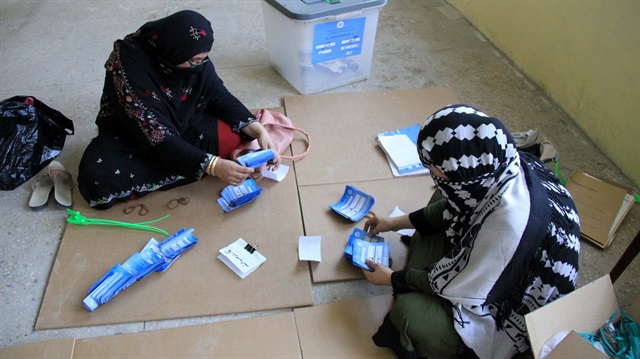
File photo: Election in Afghanistan
The UN’s top envoy in Afghanistan is calling on the nation’s political actors and institutions to work to secure fair elections.
Tadamichi Yamamoto, the Secretary-General’s Special Representative for Afghanistan, briefed the UN Security Council on the situation in the war-torn country Monday, saying the key to peace and security is through fair and secure polls.
"I urge all political actors and institutions to perform their duties and act responsibly and to think of the Afghan people, bearing in mind the country's bitter past," said Yamamoto, who is also head of the UN Assistance Mission in Afghanistan (UNAMA).
Afghanistan is scheduled to hold parliamentary elections on Oct. 20, but they have been delayed twice in the past year.
The Independent Election Commission (IEC) of Afghanistan, which will be in charge of the polls, is facing pressure from the international community to restore trust among the Afghan people in the election process.
Afghan lawmakers are perceived as corrupt, and people fear the next parliament will be no different. Meanwhile, although potential voters must visit registration centers and get their identity cards stamped with special stickers, there have been allegations of massive voter fraud where IDs have been faked and stickers misused.
Yamamoto also criticized supporters of a political coalition in the country for blocking provincial election commissions, saying additional safeguards needed to be in place before elections can occur.
"These actions hinder the work of the IEC and jeopardize the holding of the elections on time," Yamamoto said.
"At this critical juncture, the Independent Election Commission, as the lead institution on elections, will be looked upon to discharge its function with the highest degree of integrity, professionalism and with full accountability to the Afghan people."
Afghanistan and Pakistan on Saturday agreed to hold tripartite conference with China as part of a peace process, an official said on Saturday.Sibghatullah Ahmadi, spokesman for the Ministry of Foreign Affairs, told journalists in Kabul the agreement was reached in meetings among the top Afghan officials and the visiting Foreign minister of Pakistan, Shah Mehmood Qureshi.Without specifying a date, the spokesman said the meeting would take place “soon,” and the two sides have also agreed upon joint efforts to bring the Taliban to the negotiation table, and hold a conference of the religious scholars.“The new government in Pakistan seems inclined towards peace and stability in Afghanistan and mutual cooperation”, he added.Pakistan's Khan vows to strengthen ties with TurkeyQureshi landed in Kabul in the morning on his first trip abroad in a move signifying the importance Islamabad attaches to Afghanistan.He met Afghan president Mohammad Ashraf Ghani, in the afternoon at Arg (presidential palace).During the meeting, the two sides discussed security, peace and stability in the region, counter-terrorism and Afghanistan-Pakistan Action Plan for Peace and Solidarity, according to a statement issued by Ghani’s office.Ghani emphasized the importance of the action plan, saying the plan was comprehensive and its effectiveness will be observed when it is implemented.The meeting also discussed Pakistan’s support for Afghan-led and Afghan-owned peace process, the statement added.In 2015, Pakistan hosted the maiden direct talks between the Taliban and a senior member of the Afghan government, but the announcement of the Taliban’s supreme leader Mullah Omar’s death resulted in these talks meeting a dead end.Qureshi told Pakistan’s Geo News on Saturday both the countries decided to strengthen contacts and further the reconciliation process."We have come here for the betterment of the people of both countries and we will have to deal with mutual challenges together," he added.The Taliban in Afghanistan rejected a second ceasefire offer by the Ghani administration last month insisting upon exit of foreign troops and direct talks with the U.S.
Afghanistan, Pakistan agree to work together for peace
The U.S. prefers acting solo in the Taliban reconciliation process and does not take into account interests of Afghanistan's regional partners and neighbors, the Russian presidential envoy to Afghanistan said.In an interview to Anadolu Agency, Zamir Kabulov said Moscow has been more inclusive in the process by inviting Washington in collective efforts to resolve the situation in Afghanistan.The latest attempt was an invitation to the U.S. to a meeting in Moscow, the diplomat said.The Moscow meeting was to be held on Sept. 4, but late in August Afghan President Ashraf Ghani proposed to postpone it because of a reshuffle in the government's power bloc.Some experts voiced concern over possible refusal of the Taliban to come to Moscow once the meeting has been rescheduled to the convenience of the Kabul government, as the militant group does not recognize the present government in Afghanistan.Nevertheless, Kabulov said Moscow expected Taliban to show up as the meeting provides a "unique opportunity" for dialogue with representatives of Afghanistan's neighbors and allies.A particular hindrance to the meeting is the new Afghanistan National Security Council head Hamdullah Mohib. The 35-year-old is more west-oriented and not interested in an interaction with Moscow, political observers say.Mohib previously represented Afghanistan as the country's ambassador to the United States. Mohib received a Western education and is married to a U.S. citizen Lael Adams, who is an expert on Afghanistan.“Hanif Atmar (whom Mohib replaced at the office) was a strong and influential figure in the leadership of Afghanistan. His departure will undoubtedly affect the work of the office of the National Security Council, which also dealt with issues of national reconciliation," Kabulov said.UN chief says US power in decline, world 'in pieces'US denies $5 billion offer in aid to PalestineUS should reconsider its alliances in Syria: Turkish FM'Moscow has little role, US none'Responding to the U.S. State Department statement on the absence of significant results of the first meeting in Moscow regarding the Afghan peace process, Kabulov said: "The indisputable achievements of the Moscow meeting in April 2017 are: the recognition by participants of the futility of using force on the armed opposition, the need to find a pan-Afghan agreement by political means, and the collective appeal voiced by Afghanistan and regional countries to the Taliban movement to abandon armed confrontation.""From the events held under the auspices of the United States, we do not see even such small steps that would contribute to the launch of the intra-Afghan peace process," Kabulov said.Kabulov rejected the U.S. refusal for attending the Moscow meeting on the pretext that the Afghan side was not leading it.“This thesis seems far-fetched to us, because the meeting was scheduled under the joint chairmanship of the Russian and Afghan delegations, as Washington was informed. Apparently, Americans participate only in such meetings, which are held under their leadership and meet the interests of the United States," he added.At the same time, Kabulov, acknowledged that the U.S. is a key player in Afghanistan because of its military presence, leadership of the NATO mission in the country, and financial assistance to the Kabul government."It is no coincidence that the Taliban movement declares its readiness to negotiate peace with them (the U.S.), not with Kabul, with a precondition of the withdrawal of foreign, primarily American, troops from the country," he said.Afghanistan suicide attack causes dozens of casualties as violence flaresMore Afghans displaced by drought than conflict, UN saysAfghan Taliban prepare for new peace talks with US
US acting solo on Taliban peace talks: Russian envoy