

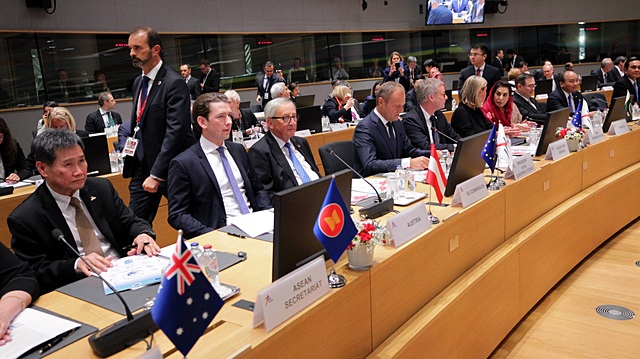
12th ASEM Summit in Brussels
The European Union will sign a trade agreement with Singapore on Friday, the highlight of a two-day meeting of 51 European and Asian leaders and a signal of the EU's push for open market accords with Asian countries.
Leaders representing 65 percent of global economic output were expected to show their climate credentials and opposition to protectionism as a counterweight to U.S. President Donald Trump.
"There are important themes on which we must work - first the fight against climate change, secondly we must push for fair and free trade, which has been cast into doubt by some in the world," Austrian Chancellor Sebastian Kurz said.
The biennial Asia-Europe Meeting (ASEM) brings together leaders from the EU, Switzerland and Norway and 21 Asian counterparts, including Chinese Premier Li Keqiang and Japanese Prime Minister Shinzo Abe.
German Chancellor Angela Merkel said on Friday that an Asia-Europe summit in Brussels showed that some two-thirds of the world was committed to multilateralism and recognised the benefits of free trade."The summit shows that countries have gathered from Europe and Asia who want a rules-based trading and have pledged themselves to multilateralism," she said, adding it was an important signal given that Europe and Asia represented almost two-thirds of world GDP, trade and population."Our theme is about creating connections, for example through free trade agreement... We can show that it's about creating win-win situations, making it clear that when one profits, the other also profits." Extension of Brexit transition would not solve the problems: German minister
Europe, Asia show commitment to free trade: Merkel
After a dinner on Thursday, sessions on improving connectivity and the multilateral system and a host of bilateral meetings will conclude on Friday with EU leaders and Singapore Prime Minister Lee Hsien Loong signing an agreement eight years in the making.
Singapore has been made to wait. Negotiations ended in 2014, but as protests mounted against other trade accords, such as one planned with the United States and one struck with Canada, the deal was sent for approval to the European Court of Justice
The Commission hopes the agreement, which still requires backing by the European Parliament, will take effect next year.
It would likely follow a larger free trade agreement the EU plans with Japan and would be the EU's first trade agreement with a member of the 10-country Association of Southeast Asian Nations (ASEAN).
The EU remains interested in a deal with ASEAN, after talks were shelved in 2009. In the meantime, EU negotiators have agreed a trade accord with Vietnam, are in negotiations with Indonesia and have held talks with three other ASEAN members.
China's former internet chief, Lu Wei, pleaded guilty in court on Friday of taking millions of dollars in bribes, after prosecutors accused him of abusing his power in various government posts over 15 years.The ruling Communist Party's anti-corruption watchdog said in November that Lu, who once headed the powerful Cyberspace Administration of China, was under investigation for serious discipline breaches.He had since been expelled from the party, paving the way for his prosecution and making him one of a number of senior officials caught up in a sweeping anti-graft campaign under President Xi Jinping.Prosecutors at an intermediate court in the Zhejiang province city of Ningbo said that between 2002 and 2017, Lu received illicit assets from government units or individuals worth more than 32 million yuan ($4.6 million), the official Xinhua news agency said.China arrests former vice finance minister for graft"Lu Wei also made a final statement to the court, and admitted guilt and expressed regret," Xinhua said.The news agency said a verdict would be announced later, though Lu, 58, is almost certain to be found guilty, as courts are controlled by the party and will not challenge the accusations against him.At the height of his influence, Lu, a colourful and often brash official by Chinese standards, was seen as emblematic of increasingly pervasive internet controls.He had worked his way up through the Xinhua news agency before becoming head of propaganda in Beijing and then moving to internet work in 2013. He later became a deputy propaganda minister.US-China trade frictions contributing to China equity slumpXi has presided over a sweeping corruption crackdown since coming to power in 2012 and has vowed to target both "tigers" and "flies", a reference to top officials and ordinary bureaucrats.The campaign has seen the jailing or punishment of hundreds of thousands of officials and also brought down dozens of senior party and military officials.The crackdown has not just been focused on issues like bribery and using public money to fund lavish lifestyles. It has also taken aim at those whose political loyalty is found lacking or who express doubt about party policies.China has rejected criticism that the anti-graft campaign is as much about settling political scores as about stamping out genuine criminal acts. 
Former Chinese internet chief pleads guilty in bribery trial
TRADE SANCTIONS
However, other less harmonious issues may also surface.
The EU told Cambodia earlier this month that it would lose its special access to the world's largest trading bloc and said it was considering similar sanctions for Myanmar in a toughening of EU policy on human rights in Southeast Asia.
Cambodian Prime Minister Hun Sen was in Brussels, while Myanmar sent its minister for international cooperation.
"Of course we will have to bring up questions of human rights and values in bilateral talks," German Chancellor Angela Merkel said.
Trade frictions between the United States and China, the world's two biggest economies, have contributed to the slump in China stock markets, Vice Premier Liu He said on Friday.China and the United States are "in touch", Liu told the state news agency Xinhua, without elaborating. Sri Lanka reverses $300-mln China housing deal ahead of PM's India visitExxon Mobil bets big on China LNG, sidesteps trade war
US-China trade frictions contributing to China equity slump
The summit could also see Beijing facing pressure to combat what Europe says is Chinese overcapacity, notably in steel.
China, which produces and consumes half the world's steel, has cut some 220 million tonnes of capacity since January 2016. But the EU wants China to cut more, as well as to remove subsidies - a policy that has seen it form an alliance with Tokyo and Washington.
European Commission President Jean-Claude Juncker is due to discuss subsidies with Li at a lunch on Friday, diplomats said.