

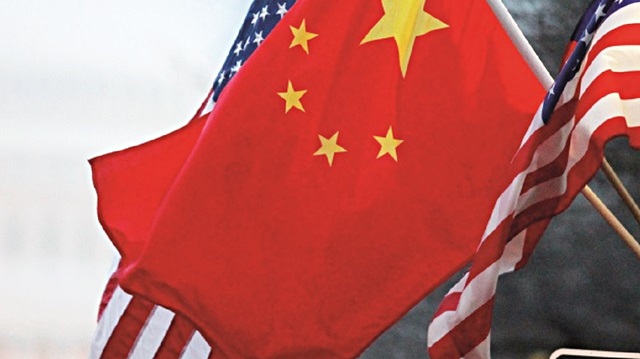
File photo
Trade frictions between the United States and China, the world's two biggest economies, have contributed to the slump in China stock markets, Vice Premier Liu He said on Friday.
China and the United States are "in touch", Liu told the state news agency Xinhua, without elaborating.
Sri Lanka has reversed a decision to award a $300-million housing deal to China in favour of a joint venture with an Indian company, the government said, ahead of a visit by the prime minister to its South Asian neighbour.Prime Minister Ranil Wickremesinghe will meet his counterpart Narendra Modi on Saturday in New Delhi, the Indian capital, for talks. The two countries have long-standing ties, partly because of cultural and ethnic links with Tamils, many of whom live in the island's north and east.In April, state-run China Railway Beijing Engineering Group Co Ltd won a tender worth more than $300 million to build 40,000 houses in Jaffna in Sri Lanka's north, with China's Exim bank to provide funding.But the project was halted after residents demanded brick houses, saying they preferred their traditional type of dwelling instead of the concrete structures the Chinese firm had planned.On Wednesday, government spokesman Rajitha Senaratne said the cabinet had approved a new proposal for 28,000 houses worth 35.8 billion rupees ($210 million) to be built by Indian firm ND Enterprises and two Sri Lankan firms in the north and east.The planned homes are part of a total requirement of 65,000, he added."The rest of the houses will be given to firms which are ready to build them at lower prices," Senaratne told reporters in Colombo, the Sri Lankan capital, adding that China could also be considered in future for the remaining housing projects.In Beijing on Thursday, foreign ministry spokesman Lu Kang told a regular news briefing China's cooperation with Sri Lanka was derived from consultations on an equal footing and he hoped that cooperation would be viewed objectively.Critics have said a big Chinese port project and related infrastructure in Sri Lanka's south have been dragging the country of 21 million people deep into debt.India has built 44,000 houses in the country's north in the first phase of reconstruction after a 26-year-war with Tamil Tiger rebels, and plans to rebuild Palaly airport and Kankesanthurai harbour, both heavily damaged in the conflict.But in recent years, China has swept in, building ports, power plants and highways as part of Beijing's String of Pearls strategy to build a network of friendly ports across Asia.India has long considered Sri Lanka, just off its southern coast, as within its sphere of influence and sought to push back against China's expanding maritime presence. ($1=170.80 Sri Lankan rupees) 
Sri Lanka reverses $300-mln China housing deal ahead of PM's India visit
In the middle of a Sino-U.S. trade war, the world's largest publicly traded oil and gas company is turning toward Beijing for business at a time when most of Corporate America is looking elsewhere to avoid the threat of tariffs.Exxon Mobil Corp is placing big bets on China's soaring liquefied natural gas (LNG) demand, coupling multi-billion dollar production projects around the world with its first mainland storage and distribution outlet.Its gas strategy is moving on two tracks: expanding output of the super-cooled gas in places such as Papua New Guinea and Mozambique, and creating demand for those supplies in China by opening Exxon's first import and storage hub, according to an Exxon manager and people briefed on the company's plans.That combination "will guarantee us a steady outlet for lots of our LNG for decades," said the Exxon manager who was not authorized to discuss the project and spoke on condition of anonymity. One of the company's top policy goals this year, the manager said, is building its Chinese client roster."China's natural gas demand is rising really fast, with imports soaring well over 10 percent annually at the moment because of the government gasification program and due to fast rising industrial demand, including in petrochemicals," the Exxon manager said.An Exxon spokesperson declined to provide an executive to discuss the company's LNG investments in China.Years in the making, the strategy delivers an added benefit: helping Exxon sidestep a global trade war. Exxon's massive LNG projects in Papua New Guinea and Mozambique will not incur the 10 percent tariff China put on U.S. gas as part of the trade war between the Trump administration and Beijing.Jason Feer, head of business intelligence at LNG tanker brokers Poten & Partners, which tracks LNG sales, said the deal provides "a sign that China is willing to let foreign interests invest in things that in the past were seen as strategic."Exxon is among the top ranked U.S. companies that are pushing ahead in China despite the trade dispute, but it is not alone. U.S. and European car makers are opening or expanding China plants to avoid hefty tariffs and transport costs. Tesla Inc this month acquired a Shanghai site for a car and battery-manufacturing complex.Exxon's Asian and African LNG will offer a cost advantage over U.S. rivals' exports that face tariffs and greater transport, while China's support for the project offers a rebuttal to Trump administration complaints about the country's closed markets.The decision to expand its LNG production and open an import terminal in the world's fastest growing LNG market is a step by Exxon Chief Executive Darren Woods to pull the company out of an earnings rut that has left its shares flat over the past seven years.Global trade system could be harmed without actionTrade war risksWoods appeared holding discussions with Chinese Premier Li Keqiang on state-run media last month days after disclosing local approvals for the LNG terminal and a massive chemical project in Guangdong province. Since becoming CEO last year, Woods has pushed Exxon to take greater risks, including in energy trading operations.His timing with LNG is key. Next year, China will become the world's largest importer of natural gas, and its LNG imports are forecast to rise 70 percent by 2020, from 38.1 million tonnes last year, estimates Beijing consultancy SIA Energy.Exxon has not publicly named its partner in the import terminal. State-run power company Guangdong Yuedian Group said on its website it will join the project. BP Plc is the only other foreign oil major with a stake in a Chinese LNG terminal.Yuedian did not respond to a request for comment.The multi-billion dollar bets still faces risks from the Sino-U.S. trade dispute. China has vowed to respond to any new tariffs by the Trump administration, which recently accused China of meddling in November elections and trying to recruit Americans to spy for it. But it remains unclear what that response will be and if it puts agreements like Exxon's in China in jeopardy.In addition to the LNG terminal, Exxon received approval for its first wholly-owned chemical plant in China, becoming one of two foreign firms including Germany's BASF to gain approval to operate such plants without a local sponsor.The terminal and chemicals plants combined will cost about $9 billion to build, consultancy IHS Markit estimates.Call for new projectsChina in 2017 embarked on a huge program to shift millions of households and factories from coal to natural gas for power and heating, a move to clear the smoggy skies over its cities.That surge has injected new life into an LNG industry that suffered from plunging prices between 2014 and 2017, which forced energy companies to put off liquefaction projects.But with prices for LNG rising this year, major producers have boosted investment. In addition to Exxon, Royal Dutch Shell PLC this month gave the go-ahead to a $31 billion LNG Canada project that will export fuel primarily to China."Major Independent Oil Companies such as Exxon aim for large-scale tier one positions, and in the LNG game that is Qatar, East Africa, and possibly some North American and Papua New Guinea projects," said Saul Kavonic, oil and gas researcher for Credit Suisse in Sydney, Australia.Exxon and other LNG producers also are adapting to changing buyer behavior. In the past, LNG was dominated by long-term supply contracts - especially with Japanese and South Korean buyers - that could span several decades and in which buyer and seller agree to a fixed monthly volume at a set price formula, usually priced off crude oil.That is changing, in part because China's importers either demand more contract flexibility or simply buy LNG at short-notice in the spot market whenever they need it.The shift away from such rigid price-supply deals is forcing producers to trade new LNG supplies and give import terminals a larger role in encouraging spot purchases."LNG players are increasingly adopting an LNG portfolio model whereby supply projects are not directly linked to end customers, with over 50 percent of contracts now coming from portfolio suppliers rather than specific projects," said Credit Suisse's Kavonic.
Exxon Mobil bets big on China LNG, sidesteps trade war