

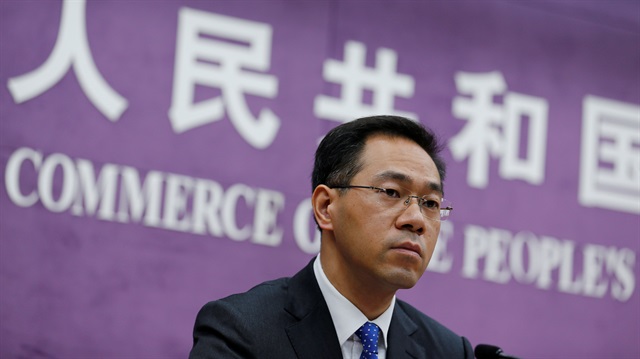
Gao Feng
China's commerce ministry said on Thursday that China has not been in touch with the United States about restarting trade negotiations and said complaints about forced technology transfers and IP theft are unacceptable.
China does not want a trade war, but it does not fear one and would fight if necessary, ministry spokesman Gao Feng told reporters at a regular briefing.
The comments came after the United States issued a list of Chinese goods worth $200 billion to be hit with the new tariffs.
President Donald Trump suggested on Monday that China might be seeking to derail U.S. efforts aimed at denuclearizing North Korea, but said he was confident that North Korean leader Kim Jong Un would uphold a pact the two agreed last month.In his first remarks about challenging diplomatic talks held at the weekend that sowed fresh doubts over North Korea's willingness to give up its nuclear arsenal, Trump said China "may be exerting negative pressure" in reaction to punitive U.S. tariffs on Chinese goods.U.S. Secretary of State Mike Pompeo reported progress from the first high-level talks since Trump and Kim met in Singapore, although he said a hard road lies ahead - North Korea accused him of "gangster-like" diplomacy after he left Pyongyang.Following the June 12 Trump-Kim summit in which Kim made a broad agreement to "work toward denuclearization" of the Korean Peninsula, Trump went on to say that North Korea was no longer a nuclear threat, even though no details were announced.China says its position on North Korean issue is consistentPompeo went to Pyongyang aiming to "fill in" details of the agreement. On Monday, he said there were "many hours" of negotiations left."Now is the time for all of us, the State Department and others to deliver, to implement the agreement between President Trump and Chairman Kim," Pompeo told NATO troops at the end of a visit to Afghanistan."To think this would happen in the course of a handful of hours would have been ludicrous," Pompeo said.The post-summit statements did not say how or when the reclusive state would dismantle its nuclear missile program that is believed to be capable of hitting the United States.North Korea welcomes UN aid officialLeaked U.S. intelligence findings have concluded that North Korea does not intend to give up its nuclear program completely.A Twitter post by Trump in which he suggested that China might be spoiling North Korea talks was another twist in his rollercoaster approach to Beijing, a mix of praise and criticism, diplomatic outreach and outright aggression."I have confidence that Kim Jong Un will honor the contract we signed &, even more importantly, our handshake. We agreed to the denuclearization of North Korea," Trump said. "China, on the other hand, may be exerting negative pressure on a deal because of our posture on Chinese Trade-Hope Not!"In Beijing on Tuesday, when asked about Trump's comments, foreign ministry spokeswoman Hua Chunying said, "First, China's position on the Korean peninsula issue is consistent. Second, China's attitude on the China-U.S. trade issue is clear. Third, China is a trustworthy and responsible power."She did not elaborate.The administration worked for months to win China's support for its "maximum pressure" campaign of sanctions to isolate North Korea, which does most of its international trade with the Chinese.While trying to keep the Chinese on board for North Korea negotiations, Trump took a tough stance on trade with China, slapping tariffs last week on $34 billion in Chinese exports to the United States, prompting retaliation in kind from Beijing.Pompeo has been criticized by some U.S. media and some Washington foreign policy observers for the lack of results and acrimony from Pyongyang, but two former U.S. officials who have negotiated with North Korea cast his talks in a more positive light."Pompeo’s visit I think was a useful beginning to set out parameters and to start working on the details of a deal," said Joel Wit, founder of the 38 North research institute. "The North Koreans talked about a vague, step-by-step simultaneous approach, which seems to me the right way to move forward. That’s the only thing that’s going to work."Retired Ambassador Robert Gallucci also called, however, for the appointment of a senior special negotiator. He said Trump should not have asserted that North Korea was no longer a nuclear threat, a claim that is "really flat-out misleading.""It leads to expectations that anybody who is serious and watching this process would say you shouldn't have those expectations," Gallucci said.
Trump suggests China might be interfering in US-North Korea talks
Chinese President Xi Jinping on Tuesday pledged a package of $20 billion in loans, and about $106 million in financial aid, to Middle East nations, as part of what he called an "oil and gas plus" model to revive economic growth in the region.Beijing has ramped up engagement in the Middle East in recent years as Arab nations play an important role in Xi's signature Belt and Road foreign policy plan for strong trade routes linking China with central and southeast Asia.China to offer aid of $15 mln to PalestineDevelopment was key to resolving many security problems in the Middle East, Xi told a gathering with representatives of 21 Arab nations in the Chinese capital."We should treat each other frankly, not fear differences, not avoid problems, and have ample discussion on each aspect of foreign policy and development strategy," he said.China would offer aid worth 100 million yuan ($15 million) to Palestine to support economic development, besides providing a further 600 million yuan ($91 million) to Jordan, Lebanon, Syria and Yemen, he added.A consortium of banks from China and Arab nations, with a dedicated fund of $3 billion, will also be set up, he said.Chinese province considers incentives for couples to have more childrenIt was unclear what the relationship between the bank consortium, financial aid and the overall loan package would be.The loans will fund a plan of "economic reconstruction" and "industrial revival" that would include cooperation on oil and gas, nuclear and clean energy, Xi said.He urged "relevant sides" to respect the international consensus in the Israel-Palestine dispute, and called for it to be handled in a just manner, so as to avoid regional disruption.China, which traditionally played little role in the Middle East conflicts or diplomacy, despite its reliance on the region for energy supplies, has been trying to get more involved in resolving long-standing disputes.China says it sticks to a policy of "non-interference" when offering financial aid and deals to developing countries, which, coupled with development, can help resolve political, religious and cultural tension.It applies this pattern of economic support, as well as a strict security regime, to its restive western region of Xinjiang. But rights groups have criticised the approach, saying the clampdown has further stoked, not eased, tension between the Muslim Uighur minority and the ethnic Han majority.
China's Xi pledges $20 bln in loans to revive Middle East
Chinese President Xi Jinping on Tuesday pledged a package of $20 billion in loans and $1.6 billion in financial aid to countries in the Middle East, as part of what he called an "oil and gas plus" model to revive economic growth in the region.Beijing has ramped up engagement in the Middle East in recent years as Arab nations play an important role in Xi's signature Belt and Road foreign policy plan for strong trade routes linking China with central and southeast Asia.Development was key to resolving many security problems in the Middle East, Xi told a gathering with representatives of 21 Arab nations in the Chinese capital."We should treat each other frankly, not fear differences, not avoid problems, and have ample discussion on each aspect of foreign policy and development strategy," he said.Israel imposes fresh sanctions on blockaded GazaChina would offer aid worth 1 billion yuan ($150 million) to Palestine to support economic development, besides providing a further 600 million to Jordan, Syria, Lebanon and Yemen, he added.A consortium of banks from China and Arab nations, with a dedicated fund of $3 billion will also be set up, he said.It was unclear what the relationship between the bank consortium, financial aid and the overall loan package would be.The loans will fund a plan of "economic reconstruction" and "industrial revival" that would include cooperation on oil and gas, nuclear and clean energy, Xi said.Israel says closing Gaza's main trade terminal in anti-Hamas crackdownHe urged "relevant sides" to respect the international consensus in the Israel-Palestine dispute, and called for it to be handled in a just manner, so as to avoid regional disruption.China, which traditionally played little role in the Middle East conflicts or diplomacy, despite its reliance on the region for energy supplies, has been trying to get more involved in resolving long-standing disputes.China says it sticks to a policy of "non-interference" when offering financial aid and deals to developing countries, which, coupled with development, can help resolve political, religious and cultural tension.It applies this pattern of economic support, as well as a strict security regime, to its restive western region of Xinjiang. But rights groups have criticised the approach, saying the clampdown has further stoked, not eased, tension between the Muslim Uighur minority and the ethnic Han majority.
China to offer aid of $15 mln to Palestine
Donald Trump on Monday raised concerns that Beijing may be seeking to derail efforts aimed at denuclearizing North Korea, but added that he was confident that Pyongyang leader Kim Jong Un will uphold his pact with the U.S. president."I have confidence that Kim Jong Un will honor the contract we signed &, even more importantly, our handshake. We agreed to the denuclearization of North Korea," Trump wrote on Twitter. "China, on the other hand, may be exerting negative pressure on a deal because of our posture on Chinese Trade-Hope Not!"Chinese Prime Minister Li Keqiang visits Berlin with trade warning for TrumpChina urges US to not endanger peace in the Taiwan Strait
Trump, eyeing China, says confident of US-North Korea deal
Turkey could gain an advantage from the trade wars between the U.S. and China, according to Ali Osman Akat, chairman of the Turkish American Business Association."Compared with the great actors of this crisis, as well as import and export figures of major parties, Turkey will be among the less affected countries in trade wars," Akat told Anadolu Agency in an interview.Saying that conventional wars nowadays have been replaced with "global trade wars," Akat added that opportunities can be explored whenever there is a crisis."We would be less affected due to the big difference between our exports and imports to the U.S., but we would suffer more from import-based manufacturing problems," he added.Akat proposed to overcome this by launching Turkish organized industries in the U.S. for being able to produce goods there and offer it to the "huge" American market right away."On behalf of Turkey, together with our investors and the small, medium and large scale industries, we long to be among the winners of trade wars," he said.In March, American President Donald Trump imposed a 25-percent tariff on imported iron and steel, and a 10-percent tariff on aluminum -- since then the issue has been discussed heatedly among the U.S. and its major trade partners.As a result, China said it would impose $3 billion worth of tariffs, between 15 to 25 percent, on 128 American goods.China will reimburse tariffs costs for soybeans bought for state reservesChina urges US to not endanger peace in the Taiwan StraitChina's 'firefighter' vice president avoids flames of US trade warAfter Washington's plan to impose 25 percent tariffs on 1,300 Chinese goods that are worth $50 billion in April, Beijing immediately said it will place 25 percent tariffs on 106 American goods worth $50 billion.Trump's moves to start trade wars, which he predicted would be "easy to win," have drawn condemnation and retaliatory tariffs worldwide.The U.S. announced that starting on June 1, 2018, it will impose additional duties of 25 percent and 10 percent respectively on imports of steel and alumminium from the EU.According to the European Commission, the U.S. measures affect EU exports worth €6.4 billion ($7.4 billion) and of this amount, the EU will rebalance on €2.8 billion ($3.2 billion) worth of exports immediately.Last Friday, the U.S. government has officially begun implementing tariffs worth $34 billion on Chinese imports signaling the start of a trade war.The U.S.' trade deficit with China was around $375 billion in 2017.
Turkey to benefit from trade wars between US and China