

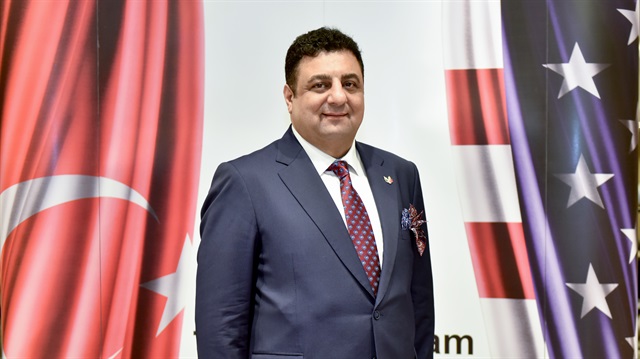
Ali Osman Akat- Turkish American Business Association (TABA) Head
Turkey could gain an advantage from the trade wars between the U.S. and China, according to Ali Osman Akat, chairman of the Turkish American Business Association.
"Compared with the great actors of this crisis, as well as import and export figures of major parties, Turkey will be among the less affected countries in trade wars," Akat told Anadolu Agency in an interview.
Saying that conventional wars nowadays have been replaced with "global trade wars," Akat added that opportunities can be explored whenever there is a crisis.
"We would be less affected due to the big difference between our exports and imports to the U.S., but we would suffer more from import-based manufacturing problems," he added.
Akat proposed to overcome this by launching Turkish organized industries in the U.S. for being able to produce goods there and offer it to the "huge" American market right away.
"On behalf of Turkey, together with our investors and the small, medium and large scale industries, we long to be among the winners of trade wars," he said.
In March, American President Donald Trump imposed a 25-percent tariff on imported iron and steel, and a 10-percent tariff on aluminum -- since then the issue has been discussed heatedly among the U.S. and its major trade partners.
As a result, China said it would impose $3 billion worth of tariffs, between 15 to 25 percent, on 128 American goods.
China will reimburse buyers for the cost of the 25 percent tariff on soybean imports from the United States if the cargoes are for state reserves, Bloomberg reported on Monday, citing unidentified sources.The United States and China slapped tariffs on $34 billion worth of each others' goods starting from July 6 including a range of U.S. farm products.State reserve buyers will pay the additional tariff before it is later reimbursed by the government, according to Bloomberg citing people familiar with the matter.
China will reimburse tariffs costs for soybeans bought for state reserves
China on Monday urged the United States to avoid actions that endanger peace and stability in the Taiwan Strait after two U.S. warships sailed through the waters, a voyage likely seen in self-ruled Taiwan as a sign of Washington's support.U.S. officials said two destroyers carried out the passage over the weekend, calling the manoeuvre a "routine transit" through international waters.It was the first trip by U.S. Navy ships through the Taiwan Strait in about a year, and comes amid heightened U.S.-China tensions as the world's two biggest economies spar in what could be a prolonged trade dispute.The ships' passage also followed a series of Chinese military drills around the island that have increased friction between Taipei and Beijing.Chinese Foreign Ministry spokeswoman Hua Chunying said China had followed the ships' movements and had "already expressed concerns to the United States over this"."We must state, the Taiwan issue is related to Chinese sovereignty and territorial integrity," Hua told reporters at a regular news briefing in Beijing."We urge the United States to at once scrupulously abide by the one-China principle...and avoid harming China-U.S. relations and peace and stability in the Taiwan Strait," she added.Taiwan's Defense Ministry said on Saturday the situation was in accordance with regulations. There has been no further comment from Taipei on the passage of the two U.S. warships.China claims Taiwan as its own and has never renounced the use of force to bring under its control what it sees as a wayward province. Beijing regularly says Taiwan is the most sensitive issue in China's relations with the United States.Washington has no formal ties with Taiwan but is the island's main source of arms and is bound by law to help it defend itself.U.S. overtures towards Taiwan, from unveiling a new de facto embassy to passing the Taiwan Travel Act, which encourages U.S. officials to visit, have further escalated tension between Beijing and Taipei.China's hostility toward Taiwan has grown since Tsai Ing-wen from the pro-independence Democratic Progressive Party won presidential elections on the island in 2016.
China urges US to not endanger peace in the Taiwan Strait
As the flames of a trade war between China and the United States lick higher, one top Chinese leader expected to help handle relations with Washington has been conspicuous for not taking a public role in the dispute - Vice President Wang Qishan.Known in Chinese government circles as "the firefighter" for his central role in tackling issues like corruption and domestic financial problems, Wang also has experience dealing with the United States - leading annual economic talks with Washington when he was a vice premier.As a result, Wang had been tipped by foreign diplomats to take a central position in handling U.S. President Donald Trump's administration when he became vice president.These expectations had been heightened when prior to his appointment in March, Wang had private meetings with U.S. ambassador to China Terry Branstad, and with former Trump adviser Steve Bannon. He also held closed-door meetings with U.S. executives in recent months, sources in the U.S. business community say.But aside from the occasional public meeting with U.S. visitors - the last time was in mid-May when he met U.S. business executives in Beijing - and the odd appearance elsewhere, including at a forum in Russia in late May, Wang has kept a low profile.The week before last, for example, the only news he appeared to make was when he met Bangladesh's foreign minister and when he was appointed honorary president of the Chinese Red Cross.For some China watchers his absence is a bad omen for the state of Sino-U.S. relations despite Trump's continued insistence that Xi is a close friend. If there was going to be a breakthrough in the trade row anytime soon then they would expect Wang to be taking a more prominent role."Wang Qishan would be crazy to get on a plane until there were far greater assurances there is a deal to be had and the deal would stick," said Scott Kennedy, deputy director of the Freeman Chair in China Studies at the Center for Strategic and International Studies in Washington.TRUMP'S LATEST THREATOne source with knowledge of Wang's meetings with U.S. business leaders said the vice president is only going to get involved when "he can have a clear view of how he can negotiate a solid outcome." When there is something to be negotiated, Wang will probably insert himself in some way, this person said.Neither the foreign ministry nor the cabinet's spokesman's office responded to a request for comment on Wang and his role in the U.S. trade dispute. There is no public contact information for the vice president's office.The last round of trade talks with Washington, led for China by Vice Premier Liu He, failed to head off a U.S. decision to impose punitive tariffs on $34 billion of Chinese imports on Friday, with another $16 billion of goods to be targeted in a second phase. China retaliated with its own increased tariffs on $34 billion of U.S. imports to China.Perhaps most worrying of all for China, Trump warned the U.S. administration may ultimately target more than $500 billion worth of Chinese goods, or roughly the total amount that the United States imported from China last year.China has indicated it will respond with its own measures against the U.S. each time Washington ratchets up the tariffs.Wang's diplomacy has been low-key and behind the scenes, and there is no sign he has lost his status as a key decision maker and political player, diplomats say.A smoker who is 70 this month, Wang is more senior than both the Chinese government's most senior diplomat, State Councillor Wang Yi, and Politburo member Yang Jiechi, who heads the Communist Party's foreign affairs commission.Unlike the urbane, Harvard-educated Vice Premier Liu, Wang does not speak English, though he has a penchant for no-nonsense, direct talk behind closed doors, those who have seen him in action say.CLOSE TO XIA senior Western diplomat said Beijing appeared to be reluctant for Wang to get involved after Liu had the rug pulled out from under him by Trump's reneging on a previously agreed "consensus" to resolve the trade spat in May.Wang is extremely close to President Xi Jinping and reports directly to him, meaning if a similar thing had happened to Wang it would be seen as a personal snub to Xi, the diplomat said."You can embarrass the vice premier but not the vice president," the diplomat said, speaking on condition of anonymity.Beijing has struggled to work out what Washington really wants, especially given the U.S. trade negotiating team has been split between those who tend to favour free trade and those who are more protectionist, a source with ties to the Chinese leadership told Reuters. This has led to confusing and sometimes contradictory statements from different officials."It's reneging on one's words," said the source, quoting a saying attributed to ancient Chinese philosopher Mencius that state media has increasingly used to refer to the U.S. administration's struggle to give a single unified message.
China's 'firefighter' vice president avoids flames of US trade war
After Washington's plan to impose 25 percent tariffs on 1,300 Chinese goods that are worth $50 billion in April, Beijing immediately said it will place 25 percent tariffs on 106 American goods worth $50 billion.
Trump's moves to start trade wars, which he predicted would be "easy to win," have drawn condemnation and retaliatory tariffs worldwide.
The U.S. announced that starting on June 1, 2018, it will impose additional duties of 25 percent and 10 percent respectively on imports of steel and alumminium from the EU.
According to the European Commission, the U.S. measures affect EU exports worth €6.4 billion ($7.4 billion) and of this amount, the EU will rebalance on €2.8 billion ($3.2 billion) worth of exports immediately.
Last Friday, the U.S. government has officially begun implementing tariffs worth $34 billion on Chinese imports signaling the start of a trade war.
The U.S.' trade deficit with China was around $375 billion in 2017.