

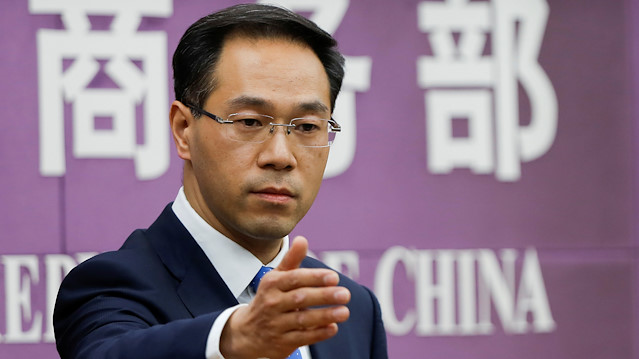
China's Ministry of Commerce spokesperson Gao Feng
China and the United States have resumed high-level talks on trade, the Chinese commerce ministry's spokesman Gao Feng said at a weekly press briefing in Beijing on Thursday, without giving details.
Earlier this month, after a phone call with Chinese President Xi Jinping, U.S. President Donald Trump said he thought the Washington would make a deal with Beijing on trade but stood ready to levy more tariffs on Chinese goods if no progress is made.
The two countries resumed talks after the call, ending a three-month hiatus that saw relations deteriorate as the United States accused China of interfering in domestic politics and seeking to undermine Trump.
China has delivered a written response to U.S. demands for wide-ranging trade reforms, three U.S. government sources said on Wednesday, a move that could trigger negotiations to bring an end to a withering trade war between the world's top economies.U.S. President Donald Trump is expected to meet Chinese President Xi Jinping when the Group of 20 industrialized nations gathers in Argentina later this month.China allows online sales of group tours to S.KoreaTrump has imposed tariffs on $250 billion of Chinese imports to force concessions from Beijing on the list of demands that would change the terms of trade between the world's two largest economies. China has responded with import tariffs on U.S. goods.Trump has repeatedly railed against Beijing over intellectual property theft, industrial subsidies, Chinese entry barriers to American businesses and the U.S. trade deficit with China.The United States has said it would not start negotiations on trade until it saw a concrete response from China to its demands.A U.S. team led by Treasury Under Secretary David Malpass discussed trade issues with a Chinese team via videoconference on Tuesday, a U.S. Treasury spokesperson said on Wednesday. Prolonging negotiations could put China-backed trade deal at risk: Singapore PM
China sends written response to US trade reform demands
Canada and China will continue to work together towards an "eventual" free trade deal, Canadian Prime Minister Justin Trudeau said on Thursday.This is despite the country being a signatory to the North American Free Trade Agreement (NAFTA), which specifies that if one of its partners enters a free trade deal with a “non-market” country such as China, the others can quit in six months and form their own bilateral trade pact."This clause doesn’t prevent us from doing what we’re already doing which is indeed continuing to negotiate with China on an eventual free trade deal,” Trudeau said in a town hall with students at the National University of Singapore.The clause, which has stirred controversy in Canada, fits in with U.S. President Donald Trump’s efforts to isolate China economically and prevent Chinese companies from using Canada or Mexico as a "back door" to ship products tariff-free to the United States.China commerce ministry says US, China have resumed high-level trade talks"There is an element of transparency. We have to keep our partners informed on how we're doing," Trudeau added.The United States and China are locked in a trade war that has seen them level increasingly severe rounds of tariffs on each other’s imports.Under the clause, the countries in the updated NAFTA, renamed the U.S.-Mexico-Canada Agreement (USMCA), must notify the others three months before entering into negotiations that could lead to a trade deal with an outside country.Trudeau said that he and Chinese Premier Li Keqiang spoke about more than just trade deals during their bilateral meeting in Singapore on Wednesday.China sends written response to US trade reform demands“Yes, we talked about deepening trade ties, increasing flows of goods and services between Canada and China for the benefit of citizens and businesses on both sides," Trudeau said."But I also talked about human rights, the situation of the Uighurs, we also talked about things that are difficult to talk about,” he added, without giving details.Beijing has faced an outcry from activists, academics, foreign governments and U.N. rights experts over mass detentions and strict surveillance of the mostly Muslim Uighur minority and other Muslim groups in its western region of Xinjiang.Trudeau's comments come just moments after Reuters reported that Canada is spearheading a group of 15 Western ambassadors in Beijing to seek a meeting with the top official in Xinjiang for an explanation of alleged rights abuses against ethnic Uighurs.
Trudeau says Canada to work with China on eventual free trade deal