

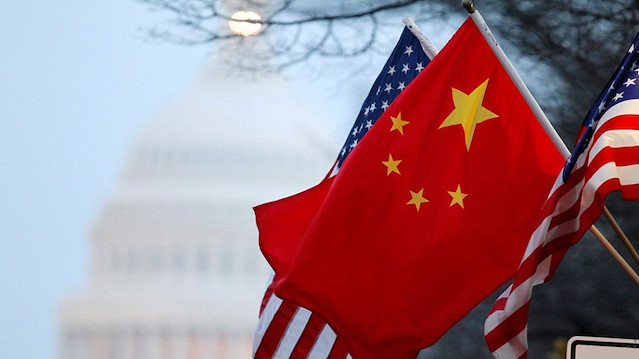
File photo
China has delivered a written response to U.S. demands for wide-ranging trade reforms, three U.S. government sources said on Wednesday, a move that could trigger negotiations to bring an end to a withering trade war between the world's top economies.
U.S. President Donald Trump is expected to meet Chinese President Xi Jinping when the Group of 20 industrialized nations gathers in Argentina later this month.
China has allowed its online travel agencies to resume selling group tours to South Korea after a prolonged diplomatic spat over the installation of a U.S.-backed, anti-missile system in South Korea, Yonhap news agency reported on Wednesday.China banned group tours to South Korea in March last year after Seoul agreed to install the U.S. Terminal High Altitude Area Defence System (THAAD). The move badly hurt South Korea's retail and service sectors. {nL4N1M9053}Chinese tourists were told to avoid any store and hotel run by conglomerate Lotte Group, which provided land in South Korea for the THAAD missile system. Lotte stores in China were also shut down amid the political tensions.As tensions thawed between the nations, China in November last year allowed over-the-counter sales of package tours from Beijing and Shandong to South Korea, but kept online curbs in place.Yonhap said on Wednesday that Chinese online travel agency Ctrip was again offering group tours to South Korea."As China's largest online travel agency Ctrip resumed the sale of group tours to South Korea, other online agencies will do the same," said a tourism industry source quoted by Yonhap.Ctrip was not immediately available for comment.The president of Korean Air Lines said last month its China route traffic remained weak due to "political issues".South Korea and the United States say the THAAD system is designed to better respond to North Korea's missile threat, but Beijing said the system's radar can probe deep into its territory, undermining its security. Prolonging negotiations could put China-backed trade deal at risk: Singapore PMMaking waves in West, China luring Pacific islands with Belt and RoadTurkey, China justice ministers seek more cooperation
China allows online sales of group tours to S.Korea
Trump has imposed tariffs on $250 billion of Chinese imports to force concessions from Beijing on the list of demands that would change the terms of trade between the world's two largest economies. China has responded with import tariffs on U.S. goods.
Trump has repeatedly railed against Beijing over intellectual property theft, industrial subsidies, Chinese entry barriers to American businesses and the U.S. trade deficit with China.
The United States has said it would not start negotiations on trade until it saw a concrete response from China to its demands.
A U.S. team led by Treasury Under Secretary David Malpass discussed trade issues with a Chinese team via videoconference on Tuesday, a U.S. Treasury spokesperson said on Wednesday.
Further prolonging negotiations for a major free trade deal in the Asia-Pacific will put it at risk of losing credibility, Singapore's Prime Minister Lee Hsien Loong said on Wednesday, as the leaders of the countries involved met to complete the pact.The 10-member Association of Southeast Asian Nations (ASEAN) along with China, Japan, South Korea, India, Australia and New Zealand are trying to achieve full conclusion of the Regional Comprehensive Economic Partnership (RCEP) agreement in 2019.The countries had earlier hoped to conclude talks for the China-backed deal by the end of this year."Market access negotiations have advanced substantially, bringing us closer to finalisation next year. We are now at the final stage of negotiations," Lee told a meeting of the leaders of the 16 countries involved in the talks.Making waves in West, China luring Pacific islands with Belt and RoadHe added: "Further prolonging negotiations puts the RCEP at risk of losing credibility and support from our stakeholders and will mean missing a major opportunity to bring in tangible benefits to our businesses and citizens".Negotiations for RCEP began in 2012, which envisions the creation of a free trade zone that will encompass 45 percent of world population and more than a third of the world’s GDP, but does not involve the United States.RCEP talks were given new impetus after President Donald Trump pulled the United States out of the competing Trans Pacific Partnership (TPP) trade deal in one of the first acts of his administration.The draft of a statement to be issued by RCEP nations later in the week, which was reviewed by Reuters, said the group would instruct "ministers and negotiators to work toward the full conclusion of the RCEP negotiations in 2019." Turkey, China justice ministers seek more cooperationUS should create fund to counter Chinese infrastructure deals: commissionChinese premier says no winner in trade war with US
Prolonging negotiations could put China-backed trade deal at risk: Singapore PM