

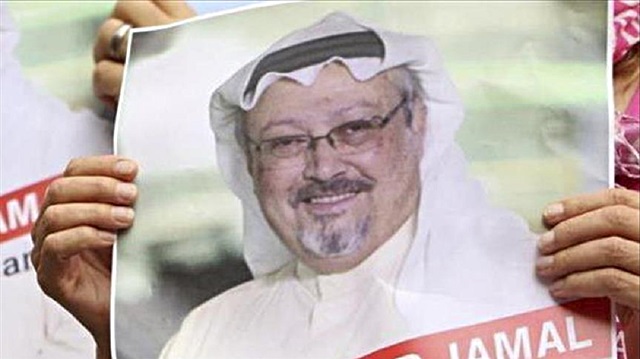
Saudi Journalist Jamal Khashoggi
Canada, Australia and New Zealand have condemned the killing of Saudi journalist Jamal Khashoggi at the Saudi Consulate in Istanbul.
Canadian Foreign Affairs Minister Chrystia Freeland in a statement on Saturday criticized Saudi Arabia's explanation regarding the killing of Khashoggi.
“The explanations offered to date lack consistency and credibility,” she said.
“Canada condemns the killing of journalist Jamal Khashoggi, which the Kingdom of Saudi Arabia has confirmed took place in its consulate in Istanbul,” the statement added.
Australian Prime Minister Scott Morrison also condemned the killing of the Saudi journalist.
“We deplore the killing of Jamal Khashoggi...We expect the Saudi government to cooperate fully with Turkish authorities regarding the investigation of this matter," he said.
The Australian government has also announced it was no longer “appropriate” to attend next week’s Future Investment Initiative in Riyadh.
New Zealand Foreign Affairs Minister Winston Peters and Minister for Trade and Export Growth David Parker in a joint statement on Sunday said: "The New Zealand government continues to condemn in the strongest possible terms the killing of journalist Jamal Khashoggi by Saudi operatives."
The European Union will sign a trade agreement with Singapore on Friday, the highlight of a two-day meeting of 51 European and Asian leaders and a signal of the EU's push for open market accords with Asian countries.Leaders representing 65 percent of global economic output were expected to show their climate credentials and opposition to protectionism as a counterweight to U.S. President Donald Trump."There are important themes on which we must work - first the fight against climate change, secondly we must push for fair and free trade, which has been cast into doubt by some in the world," Austrian Chancellor Sebastian Kurz said.The biennial Asia-Europe Meeting (ASEM) brings together leaders from the EU, Switzerland and Norway and 21 Asian counterparts, including Chinese Premier Li Keqiang and Japanese Prime Minister Shinzo Abe.Europe, Asia show commitment to free trade: MerkelAfter a dinner on Thursday, sessions on improving connectivity and the multilateral system and a host of bilateral meetings will conclude on Friday with EU leaders and Singapore Prime Minister Lee Hsien Loong signing an agreement eight years in the making.Singapore has been made to wait. Negotiations ended in 2014, but as protests mounted against other trade accords, such as one planned with the United States and one struck with Canada, the deal was sent for approval to the European Court of JusticeThe Commission hopes the agreement, which still requires backing by the European Parliament, will take effect next year.It would likely follow a larger free trade agreement the EU plans with Japan and would be the EU's first trade agreement with a member of the 10-country Association of Southeast Asian Nations (ASEAN).The EU remains interested in a deal with ASEAN, after talks were shelved in 2009. In the meantime, EU negotiators have agreed a trade accord with Vietnam, are in negotiations with Indonesia and have held talks with three other ASEAN members.Former Chinese internet chief pleads guilty in bribery trialTRADE SANCTIONSHowever, other less harmonious issues may also surface.The EU told Cambodia earlier this month that it would lose its special access to the world's largest trading bloc and said it was considering similar sanctions for Myanmar in a toughening of EU policy on human rights in Southeast Asia.Cambodian Prime Minister Hun Sen was in Brussels, while Myanmar sent its minister for international cooperation."Of course we will have to bring up questions of human rights and values in bilateral talks," German Chancellor Angela Merkel said.US-China trade frictions contributing to China equity slumpThe summit could also see Beijing facing pressure to combat what Europe says is Chinese overcapacity, notably in steel.China, which produces and consumes half the world's steel, has cut some 220 million tonnes of capacity since January 2016. But the EU wants China to cut more, as well as to remove subsidies - a policy that has seen it form an alliance with Tokyo and Washington.European Commission President Jean-Claude Juncker is due to discuss subsidies with Li at a lunch on Friday, diplomats said. 
EU to sign trade deal with Singapore, eyes deeper Asia ties
The United States is requesting that a World Trade Organization dispute resolution panel get involved in a clash over international retaliation over U.S. tariffs on steel and aluminium, according to a U.S. official familiar with the matter.The requests, filed on Thursday, cover tariffs by China, the European Union, Canada and Mexico, which followed the United States imposing a 25 percent duty on steel imports and a 10 percent tariff on aluminium imports, which it justified on national security grounds.Canada, Mexico and China had also planned to ask for a WTO panel examining those tariffs, according to another government official familiar with the matter. Earlier on Thursday, Norway said that it, the EU and other countries would seek the WTO dispute group's help.Officials representing the countries' trade delegations could not immediately be reached after normal business hours. The WTO did not immediately respond to requests for comment.The dispute marks a new dimension to the ongoing skirmish between the United States and a number of its trading partners as well as the WTO itself, where it has blocked appointments of new judges. The WTO is presiding over a record number of disputes, many of them triggered by Trump's tariffs on steel and aluminium and his trade war with China.Norway earlier said initial consultations with the United States had not led to an agreeable solution, and therefore the Nordic country had joined others in asking the WTO to set up the panel to obtain an independent assessment of the matter."We believe that additional U.S. duty on steel and aluminium is contrary to WTO rules," Norwegian Foreign Minister Ine Eriksen Soereide said in a statement."Therefore, together with the EU and several others, we asked today the WTO to establish a dispute resolution panel on the U.S. additional duty," she said.In Brussels, meanwhile, the EU, Norway and Switzerland sought Asian support for free trade, the Iran nuclear deal and fighting global warming at a regional summit that included China, Japan and Russia as a counterbalance to a more protectionist United States.U.S. Commerce Secretary Wilbur Ross told CNBC on Wednesday that trade negotiations with China appear to have taken a brief pause, and he tamped down expectations that the countries would make substantial progress toward an agreement at an upcoming G20 meeting.Despite striking a deal with Washington to overhaul the North American Free Trade Agreement (NAFTA), Mexico and Canada remain subject to the metals tariffs.On Tuesday, EU trade chief Cecilia Malmstrom held talks with Ross in Brussels on improving trade relations, though Washington accused the bloc of moving too slowly in negotiations. 
US asks for WTO panel over metals tariff retaliation
In the middle of a Sino-U.S. trade war, the world's largest publicly traded oil and gas company is turning toward Beijing for business at a time when most of Corporate America is looking elsewhere to avoid the threat of tariffs.Exxon Mobil Corp is placing big bets on China's soaring liquefied natural gas (LNG) demand, coupling multi-billion dollar production projects around the world with its first mainland storage and distribution outlet.Its gas strategy is moving on two tracks: expanding output of the super-cooled gas in places such as Papua New Guinea and Mozambique, and creating demand for those supplies in China by opening Exxon's first import and storage hub, according to an Exxon manager and people briefed on the company's plans.That combination "will guarantee us a steady outlet for lots of our LNG for decades," said the Exxon manager who was not authorized to discuss the project and spoke on condition of anonymity. One of the company's top policy goals this year, the manager said, is building its Chinese client roster."China's natural gas demand is rising really fast, with imports soaring well over 10 percent annually at the moment because of the government gasification program and due to fast rising industrial demand, including in petrochemicals," the Exxon manager said.An Exxon spokesperson declined to provide an executive to discuss the company's LNG investments in China.Years in the making, the strategy delivers an added benefit: helping Exxon sidestep a global trade war. Exxon's massive LNG projects in Papua New Guinea and Mozambique will not incur the 10 percent tariff China put on U.S. gas as part of the trade war between the Trump administration and Beijing.Jason Feer, head of business intelligence at LNG tanker brokers Poten & Partners, which tracks LNG sales, said the deal provides "a sign that China is willing to let foreign interests invest in things that in the past were seen as strategic."Exxon is among the top ranked U.S. companies that are pushing ahead in China despite the trade dispute, but it is not alone. U.S. and European car makers are opening or expanding China plants to avoid hefty tariffs and transport costs. Tesla Inc this month acquired a Shanghai site for a car and battery-manufacturing complex.Exxon's Asian and African LNG will offer a cost advantage over U.S. rivals' exports that face tariffs and greater transport, while China's support for the project offers a rebuttal to Trump administration complaints about the country's closed markets.The decision to expand its LNG production and open an import terminal in the world's fastest growing LNG market is a step by Exxon Chief Executive Darren Woods to pull the company out of an earnings rut that has left its shares flat over the past seven years.Global trade system could be harmed without actionTrade war risksWoods appeared holding discussions with Chinese Premier Li Keqiang on state-run media last month days after disclosing local approvals for the LNG terminal and a massive chemical project in Guangdong province. Since becoming CEO last year, Woods has pushed Exxon to take greater risks, including in energy trading operations.His timing with LNG is key. Next year, China will become the world's largest importer of natural gas, and its LNG imports are forecast to rise 70 percent by 2020, from 38.1 million tonnes last year, estimates Beijing consultancy SIA Energy.Exxon has not publicly named its partner in the import terminal. State-run power company Guangdong Yuedian Group said on its website it will join the project. BP Plc is the only other foreign oil major with a stake in a Chinese LNG terminal.Yuedian did not respond to a request for comment.The multi-billion dollar bets still faces risks from the Sino-U.S. trade dispute. China has vowed to respond to any new tariffs by the Trump administration, which recently accused China of meddling in November elections and trying to recruit Americans to spy for it. But it remains unclear what that response will be and if it puts agreements like Exxon's in China in jeopardy.In addition to the LNG terminal, Exxon received approval for its first wholly-owned chemical plant in China, becoming one of two foreign firms including Germany's BASF to gain approval to operate such plants without a local sponsor.The terminal and chemicals plants combined will cost about $9 billion to build, consultancy IHS Markit estimates.Call for new projectsChina in 2017 embarked on a huge program to shift millions of households and factories from coal to natural gas for power and heating, a move to clear the smoggy skies over its cities.That surge has injected new life into an LNG industry that suffered from plunging prices between 2014 and 2017, which forced energy companies to put off liquefaction projects.But with prices for LNG rising this year, major producers have boosted investment. In addition to Exxon, Royal Dutch Shell PLC this month gave the go-ahead to a $31 billion LNG Canada project that will export fuel primarily to China."Major Independent Oil Companies such as Exxon aim for large-scale tier one positions, and in the LNG game that is Qatar, East Africa, and possibly some North American and Papua New Guinea projects," said Saul Kavonic, oil and gas researcher for Credit Suisse in Sydney, Australia.Exxon and other LNG producers also are adapting to changing buyer behavior. In the past, LNG was dominated by long-term supply contracts - especially with Japanese and South Korean buyers - that could span several decades and in which buyer and seller agree to a fixed monthly volume at a set price formula, usually priced off crude oil.That is changing, in part because China's importers either demand more contract flexibility or simply buy LNG at short-notice in the spot market whenever they need it.The shift away from such rigid price-supply deals is forcing producers to trade new LNG supplies and give import terminals a larger role in encouraging spot purchases."LNG players are increasingly adopting an LNG portfolio model whereby supply projects are not directly linked to end customers, with over 50 percent of contracts now coming from portfolio suppliers rather than specific projects," said Credit Suisse's Kavonic.
Exxon Mobil bets big on China LNG, sidesteps trade war
“The killing by government operatives is deeply disturbing. Many questions remain unanswered,” Peters said.
“We look forward to the results of the investigation being led by Turkey and we urge Saudi Arabia to implement its undertaking to participate openly and transparently in that investigation,” he added.
Khashoggi, a columnist for The Washington Post, had gone missing since entering the Saudi Consulate in Istanbul on Oct. 2.
After days of denying to know his whereabouts, Saudi Arabia on Saturday claimed Khashoggi died during a fight inside the consulate.
On the day of Khashoggi’s disappearance, 15 other Saudis, including several officials, arrived in Istanbul on two planes and visited the consulate while he was still inside, according to Turkish police sources. All of the identified individuals have since left Turkey.
A joint Turkish-Saudi team completed an investigation into the case on Thursday after searching the residence of the consul general as well as the Saudi Consulate in Istanbul.
Winning photos of the Istanbul Photo Awards 2018 organized by Anadolu Agency will be displayed at the UN Headquarters in New York on Monday.Anadolu Agency Deputy Director-General Mustafa Ozkaya will preside the opening of the exhibition.Turkish and foreign representatives and consulates' officials, local and international media and winners of contest will attend the event.The exhibition at the UN headquarters will continue until Nov. 2.Roughly 37,000 photos from 125 countries entered the contest sponsored by Istanbul Metropolitan Municipality (IBB), Turkish Airlines (THY) and Turkish Cooperation and Coordination Agency (TIKA) but 27 photographers from 22 countries were awarded among them.Bosnian photo correspondent Damir Sagolj won the photo of the year prize for a child's picture in a Rohingya camp in Bangladesh.Kevin Frayer from Canada was the winner of the story news category for photos of Rohingya.German Lukas Schulze was awarded the first prize in single sports category.His photo titled 'Athlete versus Animal' was taken during the 17th FINA World Swimming Championship 2017 in Budapest.Pavel Volkov from Russia won first prize in the story sports category with his picture of a handicapped athlete.Malaysian photographer Muhamed Fathil Asri was given first prize in single nature and environment category. His photo taken from a height shows vehicles moving to an old bus terminal to escape the flood in Malaysia's Pekan Rantau Panjang in early 2017.Marcus Yam from the U.S. won the story nature and environment category. His photo series for Los Angeles Times was about the 2017 California wildfires.Andrew McConnell from Ireland won the story portrait category and Russian photographer Sergei Stroitelev won the story daily life prize.Philippine photographer Ezra Acayan was given the young photographer award.Rodrigo Cabrita from Portugal claimed the honor award in story nature and environment while Russian Anastasia Rudenko won the same award in story daily life category.All winning photos are available on "www.istanbulphotoawards.com" and professional photographers can apply for the next year's Istanbul Photo Awards contest on the same website from Nov. 1, 2018 to Jan. 31, 2019.
UN headquarters to exhibit Istanbul Photo Awards
Saudi Arabia said on Saturday that Saudi journalist Jamal Khashoggi has died, and said it fired two senior officials over the incident that has provoked an international outcry and strained relations between Riyadh and the West.Saudi state media said King Salman had ordered the dismissal of five officials, including Saud al-Qahtani, a royal court adviser seen as the right-hand man to Crown Prince Mohammed, and deputy intelligence chief Ahmed Asiri.A statement from the Saudi public prosecutor said a fight broke out between Khashoggi and people who met him in the consulate and led to his death."The investigations are still underway and 18 Saudi nationals have been arrested," the statement on state media said, adding that royal court adviser Saud al-Qahtani and deputy intelligence chief Ahmed Asiri have been fired from their positions.Khashoggi, a critic of Saudi Crown Prince Mohammed bin Salman, went missing after entering the consulate on Oct. 2 to obtain documents for his upcoming marriage.Trump: Congress to be involved in Khashoggi responsSaturday's comments marked the first time since Khashoggi went missing that the Saudis admitted to his death.Turkish officials had said they believed he was killed in the building. Saudi Arabia had previously denied the allegations and said Khashoggi had left the building shortly after.King Salman also ordered the formation of a ministerial committee headed by the crown prince to restructure the general intelligence agency, state media said.The disappearance of Khashoggi, a U.S. resident and Washington Post columnist, strained relations between Saudi Arabia and Western allies. Arab allies have rallied to Riyadh's support, but Western pressure has intensified on Saudi Arabia to provide convincing answers.Trump: Congress to be involved in Khashoggi responseBefore the Saudi announcements, U.S. President Donald Trump said he might consider sanctions against Saudi Arabia over the disappearance of Saudi journalist Jamal Khashoggi, while emphasizing the importance of the U.S.-Saudi relationship.In Istanbul, Turkish prosecutors investigating Khashoggi's disappearance questioned Turkish employees of the Saudi consulate on Friday, widening the hunt for clues in a case straining Riyadh's alliance with Western powers.Turkish police searched a forest on Istanbul's outskirts and a city near the Sea of Marmara for Khashoggi's remains, two senior Turkish officials told Reuters, after tracking the routes of cars that left the consulate and the consul's residence on the day he vanished.Investigators have recovered samples from searches of both buildings to analyze for traces of Khashoggi's DNA.Saudi prince behind Khashoggi murder: Ex-MI6 chiefSpeaking to reporters in Scottsdale, Arizona, Trump said it was too early to say what the consequences for the incident might be, but that the U.S. Congress would be involved in determining the American response.Asked whether Saudi sanctions were one of the measures he was considering, Trump said, "Could be, could be," though he provided no details."We're going to find out who knew what when and where. And we'll figure it out," Trump added.The U.S. Congress is controlled by Trump's fellow Republicans, some of whom have called for tough action against Saudi Arabia.UN chief ‘deeply troubled’ by Khashoggi’s death"I will very much listen to what Congress has to say. They feel very strongly about it also," Trump said.Trump, who said on Thursday he believes Khashoggi is likely dead and has warned of a potential "very severe" response, has appeared unwilling to distance himself too much from the Saudis, citing Riyadh's role in countering Iranian influence in the Middle East and lucrative potential arms deals."Saudi Arabia has been a great ally, they've been a tremendous investor in the United States," Trump said, adding, "That's why this is so sad.""They agreed to spend $450 billion on buying in and investing in the United States, so I hope we can keep that open. ... There are plenty of other things we can do," he said, adding, "I might know a lot by Monday. I know a lot already."Saudi prince behind Khashoggi murder: Ex-MI6 chiefThe Turkish prosecutor's office obtained testimony from 20 consulate employees.The consulate employees questioned included accountants, technicians and a driver. The investigation is being conducted by the prosecutor's terrorism and organized crime bureau.Turkey said it had not shared with any country audio recordings purportedly documenting Khashoggi's murder inside the consulate, dismissing reports it had passed them to the United States."We will share the results that emerge transparently with the whole world," Turkish Foreign Minister Mevlüt Çavuşoğlu said.US 'saddened' over confirmed death of Saudi journalistKhashoggi's disappearance has tarnished the crown prince's reputation and deepened questions about his leadership, prompting Saudi King Salman to intervene, five sources with links to the Saudi royal family told Reuters.The crown prince has painted himself as the face of a vibrant new kingdom, diversifying its economy away from oil and introducing some social changes. Other moves have faced criticism, including involvement in Yemen's war, the arrest of women activists and a diplomatic dispute with Canada.U.S. Treasury Secretary Steven Mnuchin and senior ministers from France, Britain and the Netherlands have abandoned plans to attend an Oct. 23-25 investor conference in Riyadh.On Friday, the CEOs of Deutsche Bank and ABB , plus Airbus' defense chief and energy historian Daniel Yergin, joined a list of Western business executives who have withdrawn.Pakistan's prime minister and a delegation led by Russian Direct Investment Fund head Kirill Dmitriev plan to participate. Britain's BAE Systems is sending senior representatives.A conference spokesperson confirmed the conference would proceed with an updated program that includes heads of state from the Arab world, Africa and Asia.UN chief ‘deeply troubled’ by Khashoggi’s death
Saudi Arabia sacks top officials over Khashoggi death
Disputes over U.S. tariffs and retaliatory moves by other states have sparked 12 requests for adjudication at the World Trade Organization, signalling an escalation in global trade tensions.The agenda for an Oct. 29 meeting of the WTO's dispute settlement body on Friday confirmed the legal moves, which Reuters reported late on Thursday.The dispute procedure begins with a 60-day window for talks to try to reach a settlement. The meeting agenda show that those talks have failed.By asking for adjudication, the disputants are triggering litigation that could last years.US asks for WTO panel over metals tariff retaliationChina, the European Union, Canada, Mexico, Norway, Russia and Turkey have all requested that the WTO set up a panel of adjudicators to judge the legality of steel and aluminium tariffs which U.S. President Donald Trump imposed in March.In return, the United States has asked the WTO to adjudicate on tariffs imposed by Canada, China, Mexico and the European Union in response to those U.S. steel and aluminium tariffs.It has also asked for adjudication in a separate case against China. Washington wants to impose tariffs on Beijing for its alleged failure to protect U.S. intellectual property rights.Opponents of the 25 percent U.S. duty on steel imports and 10 percent on aluminium say they breach WTO rules. Washington says they are a national security matter, and therefore outside the WTO's jurisdiction.The wheels of WTO adjudication are slow, and particularly congested at the moment, with a record number of disputes working through the system.The defendants in the disputes can reject the adjudication requests at the Oct. 29 meeting but would have to accept them at the November meeting.Then a search for adjudicators will begin. Once they are appointed, which will take months more, they may take two years or more to report on the disputes.The sides can then appeal, but the United States is threatening to cripple the WTO appeals system by blocking the appointment of judges. 
Clash over Trump tariffs heats up with barrage of WTO litigation