

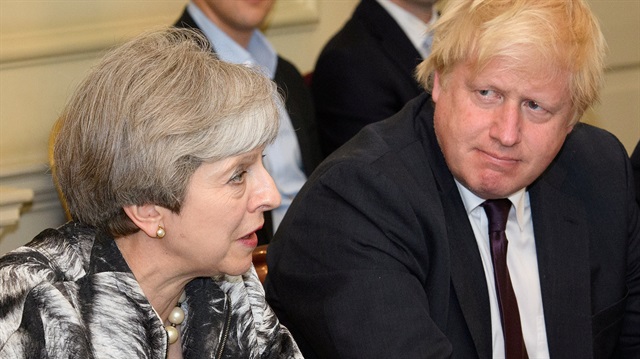
Theresa May sits next to Boris Johnson.
Britain's former Foreign Minister Boris Johnson has said he supports Prime Minister Theresa May and his opposition was not to her but to her proposals for exiting the European Union, according to a report in the Daily Telegraph on Saturday.
Following a week in which reports surfaced of a plot by Johnson's fellow eurosceptic colleagues to oust May, Johnson, bookmakers' favourite to succeed her, was quoted as saying he wanted her Chequers Brexit plan dropped, not her.
"It's not about the leadership. It's about the policy. It's not about changing prime minister. It's about chucking Chequers," he is reported to have told the newspaper at an event in Washington D.C. in the United States.
Britain and the European Union are "closing in" on a withdrawal agreement, Brexit minister Dominic Raab said on Friday, ahead of a meeting by European leaders in Salzburg next week.Britain is due to leave the bloc on March 29 but is yet to reach a full exit deal with Brussels and some rebels in Prime Minister Theresa May's Conservative Party have threatened to vote against any agreement unless she changes her proposals.Both London and Brussels are hoping to reach a deal by mid-November. May has said next week's informal EU summit will be a "staging post" in the negotiations that will allow the bloc's leaders to discuss her Brexit plans for the first time."While there remain some substantive differences we need to resolve, it is clear our teams are closing in on workable solutions to the outstanding issues in the Withdrawal Agreement, and are having productive discussions in the right spirit on the future relationship," Raab said after a phone call with EU chief negotiator Michel Barnier."We reiterated our willingness to devote the necessary time and energy to bring these negotiations to a successful conclusion," he said, adding that the pair agreed to take stock again following the Salzburg summit.Barnier issued no statement and an EU official described the call as having “taken stock of the ongoing negotiations”.EU leaders to discuss November Brexit summit next weekRoche boss says Brexit and curbs on drug use pose threat to UK scienceOn Thursday the government published a set of advice notices for Britons on how to prepare for the possibility of a "no-deal" Brexit, and May held a meeting of her top team of ministers to discuss the government's plans for leaving without an agreement.Bank of England Governor Mark Carney told the meeting Britain's property market would crash and mortgage rates spiral up in the event of a chaotic no-deal Brexit, with house prices falling 35 percent over three years, the Times newspaper reported.The Co-Operative, Britain's sixth-largest supermarket group, said it could not guarantee shortages of some food products would be avoided in the event of a no-deal Brexit.Pro-Brexit rebels in May's party have become increasingly vocal in their opposition to her Brexit proposals this week, with one former junior minister saying 80 or more of May's lawmakers were prepared to vote against them.The opposition Labour Party's foreign affairs spokeswoman Emily Thornberry told the Financial Times her party was set to vote against any Brexit deal and the lack of a viable exit from the EU would force May from office before Christmas. EU tells Britain it won't renegotiate Brexit divorce billUK PM May says 'position change' on divorce payment if no Brexit dealBrexit rebels make proposals on Irish border issue
Britain and EU 'closing in' on a Brexit agreement, Raab says
Johnson quit as foreign secretary in July after May's Chequers proposal, named after a country house where it was put forward. It called for the free trade of goods with the EU, with Britain accepting a "common rulebook" that would apply to those goods.
Opponents of the plan, like Johnson, say that would leave Britain subject to decisions made in Brussels without any input.
Since May's botched bet on a snap election in June 2017 lost her party its majority in parliament, she has faced persistent talk of a leadership challenge which has weakened her as she tries to clinch a Brexit deal with the EU.
Britain's electoral regulator misinterpreted the spending law when it allowed the main Brexit campaign to donate to a smaller, aligned group during the 2016 referendum campaign, London's High Court ruled on Friday.Britain's officially designated Brexit campaign group, Vote Leave, said the Electoral Commission had told the group it could donate to other Leave campaigners without having to count it against its own referendum expenses.But the High Court found that the Electoral Commission "misinterpreted the definition of 'referendum expenses'" in a way which was "inconsistent with both the language and the purpose of the legislation" in giving the advice.Jo Maugham, a lawyer and campaigner on the winning side of the case, said the decision was "coruscating" for the Commission, and that the main Remain campaign had not been given the same rights to make donations.'Bank of England prepared for wide range of Brexit outcomes'"What is now clear is that the Electoral Commission unlawfully tilted the playing field in the Referendum," he said in a statement.Vote Leave was separately fined by the Electoral Commission in July for co-ordinating its activities with the smaller campaign group, BeLeave, to pay digital services from Aggregate IQ, thereby exceeding spending limits. The campaign group refuted the findings.The Electoral Commission said Friday's ruling showed the court had backed up its July findings."The Court arrived at the same conclusion as the Commission did in its investigation - that Vote Leave should have accounted for the expenditure on the digital services firm, Aggregate IQ – although it found an additional reason for reaching that conclusion," the regulator said in a statement.EU leaders to discuss November Brexit summit next weekBut Vote Leave Chief Executive Matthew Elliott said the court's ruling undermined the Electoral Commission's earlier finding, adding that the campaign group would not have made the donation if they had not been advised that they could."The Electoral Commission's defeat in the High Court today has thrown electoral law for future elections and referendums into total chaos," he said in a statement."Either the Electoral Commission is wrong or the High Court is wrong."EU tells Britain it won't renegotiate Brexit divorce bill
UK court rules against electoral watchdog in Brexit spending row
The United Kingdom is due to leave the EU on March 29. The EU and Britain hope to clinch a deal later this year so parliaments on both sides can ratify it before Brexit.
Britain's opposition Labour Party created another headache for May on Friday, when one of its senior lawmakers told the Financial Times that the party would vote against any Brexit deal she reaches, predicting that the lack of a viable exit from the EU would force May from office before Christmas.
European Union leaders will discuss when they meet in Austria next week whether to hold a special summit on Brexit in November, a senior EU diplomat said on Thursday.He also said, when asked by reporters, that the EU was continuing contingency preparations in the event there is no deal before Britain leaves next March.Diplomats and EU officials say that governments have been discussing holding a special Brexit summit in Brussels around Nov. 13-15 on the assumption that a regular meeting on Oct. 18 will be too early to approve a potential deal with Britain on a withdrawal treaty.The diplomat, briefing reporters, said further discussion on a November meeting would take place among heads of state and government when they meet in Salzburg next Wednesday and Thursday.Roche boss says Brexit and curbs on drug use pose threat to UK scienceAsked whether the Salzburg summit would give EU negotiator Michel Barnier a new mandate to discuss terms for Britain's future trade relationship with the Union, the diplomat said Barnier did not need such a formal mandate. He might, however, seek further guidance from leaders during the meeting.He was asked about comments from British Brexit Secretary Dominic Raab that a failure to reach a deal on the withdrawal treaty would mean Britain not paying tens of billions of euros it has so far agreed to send to Brussels.He said that if there were no treaty, many of the agreed terms would lapse. However, he said, there was a legal argument that Britain would still owe money to the EU under the terms of its existing membership obligations. EU tells Britain it won't renegotiate Brexit divorce bill
EU leaders to discuss November Brexit summit next week