

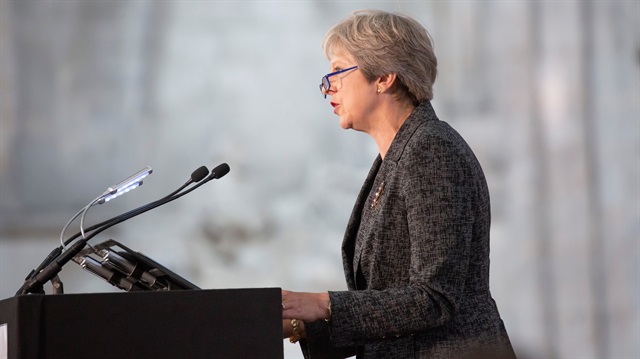
Britain's Prime Minister Theresa May
Britain will use its international aid budget to boost its national interest and deepen trade ties with Africa, Prime Minister Theresa May will tell an audience in South Africa on Tuesday.
May, battling to unite her divided party over her plan to take Britain out of the European Union, will also visit Nigeria and Kenya as part of a three-day visit to Africa alongside a group of business delegates.
She is expected to recommit to maintaining the overall British aid budget at 0.7 percent of economic output but will add that she will be "unashamed" to use it in a way that helps Britain.
President Emmanuel Macron on Monday said preserving European Union unity was more important than forging a close relationship with post-Brexit Britain, and hit out at what he called U.S. President Donald Trump's "aggressive" isolationism.Macron, who met Prime Minister Theresa May for talks on Britain's departure from the EU during the summer holiday, said he wanted to reach a Brexit deal by the end of the year and showed no signs of breaking ranks with other EU capitals."France wants to maintain a strong, special relationship with London but not if the cost is the European Union's unravelling," he told a gathering of French ambassadors.Brexit, Macron said, "is a sovereign choice, which we must respect, but it can't come at the expense of the European Union's integrity."Macron targets French welfare spending as deficit pressure risesIn a one-and-a-half hour speech outlining his diplomatic priorities for the year ahead, Macron made no major policy shifts, but spoke forcefully on what he labelled the "crisis of multilateralism" and the need to make Europe more "sovereign".Macron called on Europe to be "a trade and economic power", which defends its strategic interests and financial independence with tools that can fend off U.S. extraterritorial sanctions."Multilateralism is going through a major crisis which collides with all our diplomatic activity, above all because of U.S. policy," he said."The partner with whom Europe built the new post-World War order appears to be turning its back on this shared history," he said.In his first year, Macron banked on nurturing relationships with awkward leaders such as U.S. President Donald Trump and Russian leader Vladimir Putin, appearing engaged on the world stage but often remaining non-committal and trying to mediate without unsettling anyone.That approach has been tested after Trump shunned Macron and other allies, pulling out of a global climate pact, imposing extraterritorial sanctions on Iran, and imposing tariffs on EU steel and aluminium.In Syria, despite French strikes, the French leader has had little influence over Putin.Meanwhile, French forces' operations to combat an Islamist uprising in West Africa, started under Macron's predecessor and made a priority by the 40-year old, have struggled to root out jihadists in Mali and neighbouring countries.
Macron says Brexit cannot divide EU, criticises Trump's isolationism
The target has previously come under fire from many of May's own lawmakers who say it is a blunt tool that is too high and should be spent elsewhere or in Britain itself.
May will say she wants Britain to become the biggest investor in Africa out of the countries in the Group of Seven nations, overtaking the United States, by using the aid budget to help British private sector companies invest on the continent.
"I am unashamed about the need to ensure that our aid programme works for the UK," May will say in her speech, according to extracts released by her office.
"Today I am committing that our development spending will not only combat extreme poverty, but at the same time tackle global challenges and support our own national interest. This will ensure that our investment in aid benefits us all, and is fully aligned with our wider national security priorities."
Russia accused Britain's Royal Air Force (RAF) of intercepting its military aircraft over the Black Sea in a dangerous fashion designed to provoke Moscow after the RAF made two such interceptions in a single week.The accusation, levelled by Russia's embassy in London, came after the RAF intercepted a Russian maritime patrol aircraft over the Black Sea on Friday and scrambled to intercept two suspected Russian fighter aircraft on Wednesday.".... What kind of threat to Britain or even its allies does a Russian patrol aircraft hypothetically pose while conducting flights near Russia's own coastline, more than 2,000 km (1242.74 miles) from the British Isles," the Russian embassy said in a statement released on Saturday."Instead of strengthening anyone's security, the British authorities are using such a military presence (in the Black Sea area) for provocative actions. Not just by making verbal statements, regrettable as they are, but also in real military terms, which is simply dangerous."The British defence and foreign ministries declined to comment on Sunday.Three countries bordering the Black Sea - Romania, Bulgaria and Turkey - are NATO allies of Britain.Britain's Minister of State for the Armed Forces, Mark Lancaster, spoke about "an ever more assertive Russia" in a speech in London in July. He said the RAF had been forced to intercept Russian military aircraft more than 80 times over the last decade.Relations between London and Moscow are languishing at a post-Cold War low after the poisoning by nerve agent of former Russian double agent Sergei Skripal and his daughter Yulia in March in the English city of Salisbury.London holds Moscow responsible for the attack, something Russia denies.Britain's RAF maintains a presence in the Baltic countries and in Romania to deter potential Russian military action after Moscow's 2014 annexation of Ukraine's Crimea. Moscow says its activity in the Black Sea region is routine and compliant with international law.
Russia calls Britain's Black Sea air force interceptions dangerous
The U.S., U.K. and France are preparing to strike Syria due to the Assad regime using chemical weapons in Idlib, according to the Russian Defense Ministry.‘They’re planning a chemical attack’Russian Defense Ministry spokesman Igor Konashenkov said on Saturday that Western powers are preparing to blame a chemical attack that will take place in Idlib’s Jissr al-Shughur region on the Syrian regime. Konashenkov said militants who have been trained by specialists of the U.K. private military company Olive to handle chemical warfare agents have also arrived in Idlib, noting that they have been tasked to simulate a rescue operation for locals allegedly hurt in the chemical attack and will be clad in the outfits of the White Helmets group."The U.S. Navy’s destroyer Sullivans with 56 cruise missiles on its board arrived in the Persian Gulf several days ago while a B-1B strategic bomber of the US Air Force armed with AGM-158 JASSM air-to-surface missiles was redeployed to the al-Udeid air base in Qatar," the Russian general said."The staging of this provocation with the active participation of the UK special services is set to serve as a new pretext for missile and bomb strikes by the United States, Great Britain and France," he continued. "Therefore, the actions by Western countries contrary to public statements are aimed at another dramatic escalation of the situation in the Middle East and at disrupting the peace process on the territory of Syria," he concluded.Austrian minister says curtsey to Putin was not a sign of submissionTurkey, Russia discuss cooperation in technologyTies with Russia crucial for region: Turkish FM
Russia says US, UK, France preparing to strike Syria again