

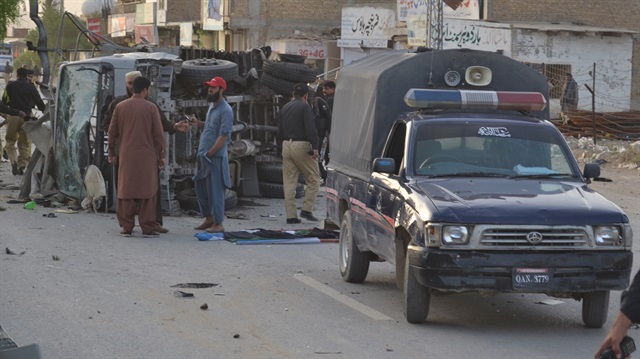
File photo
At least 38 people were killed and over 80 others injured in two separate blasts targeting election rallies in southwest and northwest Pakistan on Friday, officials and local media reported.
A suspected suicide bomber detonated himself in an election rally in remote Mastung district of mineral-rich Balochistan province, killing at least 33 people and injured over 50, state-run Pakistan Television reported.
The dead included a candidate from Mastung, Siraj Raisani, a brother of the former Chief Minister Balochistan Nawab Aslam Raisani.
At least four people were killed and over 20 injured in a suspected suicide blast in an election rally in northwest Pakistan on Friday, police and local media reported. The bomber, who acted alone, rammed his explosive-laden motorbike into a vehicle minutes after the end of an election rally in the remote Bannu district, bordering the restless North Waziristan tribal region. Senior politician Akram Kham Durrani, a candidate of the five-party religious alliance Muttehida Majlis Amal (MMA), was an apparent target of the attack but escaped unscathed, local broadcaster ARY News reported. A former chief minister of the northwestern Khyber Pakhtunkhawa province, Durrani is running against Imran Khan, a popular former cricket star from Bannu. Durrani told ARY News that he was not at the venue when the blast occurred. This was the second attack on MMA candidates in Bannu in the last two weeks. The bombing followed a suicide blast at an election rally earlier this week in Peshawar, Khyber Pakhtunkhawa’s capital, that killed 21 people, including a candidate. The Pakistani Taliban's mother coalition, Tehrik-e-Taliban-Pakistan, had claimed responsibility for the Peshawar attack. Pakistan’s elections are scheduled for July 25.
Suicide blast at election rally in NW Pakistan kills 4
Raisani, who was critically injured in the blast, had been shifted to the hospital in provincial capital Quetta but he could not survive, his brother and a former parliamentarian Haji Lashkari Raisani told reporters.
Police were not sure about the nature of the explosion however some local channels quoted eyewitnesses terming the incident as an “act of a suicide bomber”.
Earlier in the day, a suspected suicide bomber rammed his explosive-laden motorbike into a vehicle minutes after the end of an election rally in the remote Bannu district, bordering the restive North Waziristan tribal region, killing five people and injuring another 30.
Pakistanis will go to general elections on July 25 to elect the new government for the next five years.Over 100 million voters, which constitute almost half of the country’s total population, will vote for some 272 general seats of the lower house -- the National Assembly -- and 577 general seats of the four provincial assemblies.Pakistan’s Parliament consists of the two Houses known as the National Assembly (lower house) and the Senate (upper house).US rejects French request for Iran exemptionsThe National Assembly members are elected through direct franchise for five years, whereas the senators are elected by the national Assembly members for a period of six years.The National Assembly has a total of 342 seats, of which 272 are filled through direct elections while 60 seats are reserved for women and 10 for religious minorities. Reserved seats are later allotted to the parties as per their number of general seats.According to data released by the Election Commission of Pakistan (ECP), around 12,027 candidates are in the run for the national and provincial assembly seats. Of them, 3,631 candidates will contest for the general seats of National Assembly while 8,396 are running for the general seats of the four provincial assemblies.Kim wants North Korea to be 'normal': South's leaderPunjab -- the country’s most populous and richest province -- has the highest number of seats (148); whereas the mineral-rich Balochistan, the smallest province in terms of population but the largest in terms of land, has only 14 National Assembly seats.The Federal Administered Tribal Area (FATA), a conglomerate of several tribal regions along the Afghanistan border, has 12 seats, while three seats are allocated for the federal capital Islamabad.The second largest southern Sindh province, and northwestern Khyber Pakhtunkhawa (KP) have 61 and 35 National Assembly seats, respectively.Over 100 held ahead of ex-PM Sharif’s return: PakistanPunjab, which constitutes around 60 percent of the country’s total population usually decides which party will form the federal government.Punjab Assembly comprises the highest number of members i.e. 371 followed by Sindh Assembly (168), KP Assembly (124), and Balochistan Assembly (65). Some 74, 38, 25 and 14 seats have been reserved for women and minorities in the provincial assemblies respectively.Twenty-four seats have been added to the incumbent strength of the KP Assembly following the merger of the tribal region with KP province following a constitutional amendment in May this year.However, elections on these 24 seats will be held next year.Also, the new election rules have bound the contesting parties to field at least 5 percent women candidates on general seats with a view to further increasing the women representation in the parliament.Leader of the HouseSince Pakistan follows the parliamentary government system, the National Assembly members will elect the new Leader of the House -- the prime minister -- with minimum 51 percent votes. The prime minister himself must be a member of the National Assembly.The four provincial assemblies elect their respective leaders of the house -- chief ministers -- in the same manner.The parties can forge an alliance in the parliament to form the government but no individual parliamentarian can vote against his or her party for the prime minister’s election.CONTESTING PARTIESAround 120 political, religious, and nationalist parties are registered with the Election Commission of Pakistan. However, a dozen parties had representation in the previous parliament from 2013 to 2018.In the upcoming elections, scores of parties have fielded their candidates but political analysts believe that three mainstream political parties, and a five-party religious alliance are likely to clinch a majority of seats in the national and the provincial assembly seats.Pakistan Muslim League (Nawaz)The right-wing party is one of the several breakaway groups of Pakistan’s founding party established in 1906 before partition.Led by the three-time Prime Minister Nawaz Sharif , the PML(N) was founded in 1993, and since then it has ruled this South Asian nuclear Muslim state three times i.e. 1990 to 1992, 1997 to 1999, and 2013 to 2018.However, the party could only complete its constitutional five-year term only once (2013 to 2018).Sharif’s two previous governments were dismissed on corruption charges in 1992 and through a bloodless military coup in 1999 respectively.Sharif, who has been sentenced to 10 years in jail in a corruption case by the country’s top court, has already been disqualified for lifetime for holding any public office, including his party’s leadership. He, however, still enjoys a strong grip over his party and currently holds a title of “Quaid” (leader).Shehbaz Sharif, his younger brother and three-time chief minister of Punjab, has recently replaced elder Sharif as party president but the latter still calls the shots.The party has strong roots in Punjab, especially in the industrial part of the province. It has a solid vote bank in parts of KP and Balochistan provinces, but the party is mainly relying on Punjab.The party is also known as GT (Grand Trunk) Road party because of its popularity in the cities located along the historic road from garrison city of Rawalpindi to the border districts of KP province. It carries the election symbol of Lion.Pakistan Tehrik-e-Insaf (PTI)Founded by the country’s former cricket star, Imran Khan in 1992, the PTI emerged as the second largest party in terms of votes in the 2013 elections. The party not only amassed over 8 million votes -- second after PML(N) -- in 2013 but also managed to form government in the KP province.It is posing a serious threat to the PML(N) in Punjab with many dubbing the party as “favorite” in the forthcoming elections.PTI enjoys a huge support in Punjab, KP FATA, and even in Karachi that makes it the only party having a national posture.Many believe the upcoming elections are a one-to-one contest between the two right-wing parties -- PML(N) and PTI -- in Punjab, the main battlefield.Pakistan People's Party (PPP)The left-wing party has ruled Pakistan more than any other party since 1970. Founded by former Prime Minister Zulfikar Ali Bhutto in 1967, the party came into power just three years after its inception in 1970.Bhutto’s government was toppled by the then army chief Gen Zia-ul-Haq in a bloodless coup on the charge of rigging in 1977 elections. He was later hanged in a murder case in 1979.His charismatic daughter and the first woman prime minister of the Muslim world -- Benazir Bhutto -- came into power twice in 1988 to 1990, and 1993 to 1996, but her both governments were dismissed before completion of the constitutional term on corruption charges.Bhutto was assassinated in garrison city of Rawalpindi in 2007 during an election rally. Her party, now jointly led by her widower Asif Ali Zardari and son Bilawal Bhutto Zardari, came into power in 2008 elections and completed its five-year term in 2013.However, once Pakistan’s most popular party has now almost been wiped out in Punjab, KP and Balochistan provinces amid a series of corruption scandals.The party still has a strong vote bank in Sindh, where it has ruled for two consecutive terms from 2008 to 2018.It is again viewed as the single largest party in Sindh though it is facing a strong challenge from PTI, MMA, and a regional conglomerate Grand Democratic Alliance (GDA) in different parts of the province.Muttahida Majlis-e-Amal (MMA)The alliance is a combination of five religious parties belonging to all major Sunni and Shia schools of thought in Pakistan. The parties included Jamat-e-Islami, Jamiat Ulema-e-Islam, Jamiat Ulema-e-Pakistan, Tehrik-e-Islami and Jamiat Ahl-e-Hadit.Founded in 2002, The MMA had surprised the political pundits by emerging as the third largest group in the National Assembly, and the majority party in KP and Balochistan provinces in 2002 general elections.The alliance, however remained dormant for a decade due to differences between the two major components -- Jamat-e-Islami and Jamiat Ulema-e-Islam. The poor performances of the two parties forced them to revive the alliance earlier this year.MMA has encouraging prospects in KP, Balochistan and Karachi. The alliance enjoys little support in Punjab.Other PartiesTwo newly-formed religious groups -- Tehreek-i-Labbaik Pakistan (TLP) and Milli Muslim League (MML) -- representing Barelvi and Ahl-e-hadith schools of thought respectively have made inroads in recent by-elections in Punjab.Analysts believe the two parties are not in a position to cause a major upset against PML(N) and PTI but they can still damage the vote bank of the two key parties in several constituencies in Punjab, and of MMA in KP and Karachi.Some consider TLP the third largest party in Punjab in terms of votes.Left-wing Awami National Party (ANP) and newly-formed Balochistan Awami Party (BAP) are also viewed as vote catchers in parts of KP and Balochistan respectively.
All you need to know about Pakistani elections
Senior politician Akram Khan Durrani, a candidate of the five-party religious alliance Muttehida Majlis Amal (MMA), was an apparent target of the attack but escaped unscathed, local broadcaster ARY News reported.
Durrani, a former chief minister of the northwestern Khyber Pakhtunkhawa province, is running against Imran Khan, a popular former cricket star, in Bannu.
Durrani told ARY News that he was not at the venue when the blast occurred.
This was the second attack on MMA candidates in Bannu in the last two weeks.
The latest bombings followed a suicide blast at an election rally earlier this week in Peshawar, Khyber Pakhtunkhawa’s capital, that killed 21 people, including a candidate.
The Pakistani Taliban's mother coalition, Tehrik-e-Taliban-Pakistan, had claimed responsibility for the Peshawar attack.
Pakistan’s elections are scheduled for July 25.