

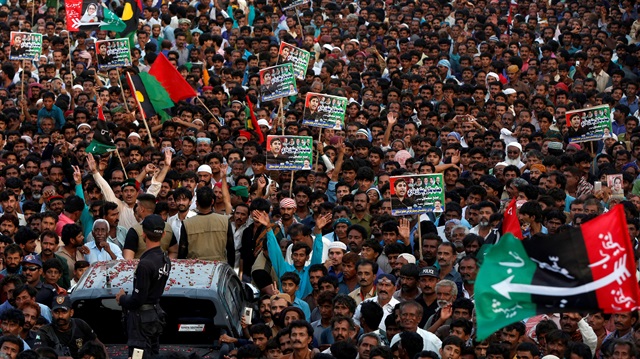
File Photo: A campaign rally for the election in Pakistan
Pakistanis will go to general elections on July 25 to elect the new government for the next five years.
Over 100 million voters, which constitute almost half of the country’s total population, will vote for some 272 general seats of the lower house -- the National Assembly -- and 577 general seats of the four provincial assemblies.
Pakistan’s Parliament consists of the two Houses known as the National Assembly (lower house) and the Senate (upper house).
The United States has rejected a French request for waivers for its companies operating in Iran that Paris sought after President Donald Trump imposed sanctions on the Islamic Republic, French Finance Minister Bruno Le Maire told Le Figaro.Paris had singled out key areas where it expected either exemptions or extended wind-down periods for French companies, including energy, banking, pharmaceuticals and automotive.French officials had expressed little hope for securing the waivers, which were critical for oil and gas major Total to continue a multi-billion-dollar gas project in Iran and for carmaker PSA Group to pursue its joint venture .Trump says Putin 'not my enemy'"We have just received Treasury Secretary Steve Mnuchin's response: it's negative," Le Maire told Le Figaro in an interview published on Friday.Le Maire said Europe needed to react quickly and protect its economic sovereignty."Europe must provide itself with the tools it needs to defend itself against extra-territorial sanctions," Le Maire added.S.Korea's Moon urges North, United States to move forward on denuclearisationWashington announced in May it was imposing new economic penalties on Tehran after pulling out of a multilateral 2015 agreement, under which Tehran had agreed to curb its nuclear activities in return for sanctions relief.Trump's sanctions are aimed at pressuring Iran to negotiate a new agreement to halt its nuclear programmes that might include Tehran's regional activities and ballistics development. In particular, Washington wants to curtail the oil exports that are key to Iran's economic revival.Earlier this month, Iranian President Hassan Rouhani appeared to threaten to disrupt oil shipments from its neighbours if Washington pressed ahead with trying to force countries to stop buying Iranian oil.
US rejects French request for Iran exemptions
The National Assembly members are elected through direct franchise for five years, whereas the senators are elected by the national Assembly members for a period of six years.
The National Assembly has a total of 342 seats, of which 272 are filled through direct elections while 60 seats are reserved for women and 10 for religious minorities. Reserved seats are later allotted to the parties as per their number of general seats.
According to data released by the Election Commission of Pakistan (ECP), around 12,027 candidates are in the run for the national and provincial assembly seats. Of them, 3,631 candidates will contest for the general seats of National Assembly while 8,396 are running for the general seats of the four provincial assemblies.
South Korean President Moon Jae-in maintained Friday that his North Korean counterpart Kim Jong-un is serious about change, despite concerns that the North is not taking its denuclearization agreements with Seoul and Washington seriously.Drawing on his two meetings with the North's leader, Moon said during a lecture while visiting Singapore that "Chairman Kim has a great desire to break away from ideological confrontations and develop North Korea into a normal country.""We must create a chance for North Korea to fulfill its role as a responsible member of the international community," he was quoted as saying by Yonhap News Agency.Hours earlier, U.S. President Donald Trump said on Twitter that "great progress" was being made with the North, while posting images of a letter from Chairman Kim expressing optimism for their future ties.However, American Secretary of State Mike Pompeo returned from negotiations in Pyongyang last week without any clear denuclearization plan, and North Korea also delayed talks with the U.S. that were expected to take place Thursday.Following criticisms that Seoul and Washington have already conceded too much to the North by suspending military drills, Moon insisted that "corresponding measures" by South Korea and the U.S. could help speed up Pyongyang's denuclearization.He also emphasized that sanctions would only be removed after North Korea completely abandons its nukes.SKorea's Moon says North's criticism of US a negotiating strategySeoul denies forcing North Koreans to defectUN aid chief says 'clear evidence of humanitarian need' in North Korea
Kim wants North Korea to be 'normal': South's leader
Punjab -- the country’s most populous and richest province -- has the highest number of seats (148); whereas the mineral-rich Balochistan, the smallest province in terms of population but the largest in terms of land, has only 14 National Assembly seats.
The Federal Administered Tribal Area (FATA), a conglomerate of several tribal regions along the Afghanistan border, has 12 seats, while three seats are allocated for the federal capital Islamabad.
The second largest southern Sindh province, and northwestern Khyber Pakhtunkhawa (KP) have 61 and 35 National Assembly seats, respectively.
Over 100 supporters of former Prime Minister Nawaz Sharif were arrested in northeastern city of Lahore on late Wednesday, ahead of his return from London later this week, local media reported.Sharif and his daughter Maryam Nawaz, who were handed jail terms in a corruption case earlier this month, are all set to return to their country on Friday.Several elected members of local city councils held by the Pakistan Muslim League (Nawaz) (PML-N) were also picked up from their houses during overnight operations against Sharif’s party to halt the gathering to welcome the Sharifs from London, Geo News, a local broadcaster, reported on Thursday.Pakistani president hails ‘strong ties’ with TurkeyOn July 6, a Pakistani court had handed down a 10-year jail term to Sharif and also imposed 8 million pounds ($10.58 million) fine on him in a graft case linked to the buying of four luxury apartments at Avenfiled House in London's posh Park Lane area in 1993 allegedly through illegal means.His daughter Maryam and her husband Safdar were sentenced to seven years and one year in jail, respectively. The court had also ordered the confiscation of the four apartments in London, and imposed a fine of 2 million pounds ($2.65 million) on Maryam.Pakistan's army denies meddling, to deploy 371,000 troops to guard voteThe local TV channels showed videos of PML-N leaders and workers protesting outside the police stations in Lahore, where their workers were detained.Shehbaz Sharif, former Punjab chief minister and president of the PML-N, condemned the detention of party workers.“We are not afraid of jails and shackles and a warm welcome for our party supremo is our legal and constitutional right,” Sharif told Geo News in an interview.“I will go to the airport along with party workers to receive Nawaz on Friday,” he maintained.Government's responseMeanwhile, Syed Ali Zafar, the caretaker federal information minister said, the government is not taking action against the individuals of any party.Russian military enters opposition-held enclave in Syria's Daraa city“The implementation of the court order is our constitutional obligation and if anyone has a complaint against the decision he can go to the Supreme Court and High court,” Zafar told reporters in Islamabad.“The government is impartial and our mandate is to run the affairs peacefully,” he added.Sharif, who is currently in London to see his ailing wife, has already announced that he will return to Pakistan on July 13 despite the court verdict against him.“Doctors said they can’t say when my mother would regain consciousness but we have decided to return Pakistan on Friday,” Maryam Nawaz, who is also in London, said on Twitter.Last July, 68-year-old Sharif was barred from holding public office by the Supreme Court over the whistleblower Panama Papers scandal, which also led to the filing of three corruption cases, including the Avenfield properties case against him and his family.Not long after, the top court also barred him from holding the leadership of his political party, the Pakistan Muslim League (PML-N).The former premier insists all transactions he and his family made were legal.Sharif, who served as the premier from 1990 to 1992, 1997 to 1999, and 2013 to 2017, could not complete even a single five-year term. His two previous governments were dismissed over corruption charges and through a bloodless military coup in 1992 and 1999, respectively.
Over 100 held ahead of ex-PM Sharif’s return: Pakistan
Punjab, which constitutes around 60 percent of the country’s total population usually decides which party will form the federal government.
Punjab Assembly comprises the highest number of members i.e. 371 followed by Sindh Assembly (168), KP Assembly (124), and Balochistan Assembly (65). Some 74, 38, 25 and 14 seats have been reserved for women and minorities in the provincial assemblies respectively.
Twenty-four seats have been added to the incumbent strength of the KP Assembly following the merger of the tribal region with KP province following a constitutional amendment in May this year.
However, elections on these 24 seats will be held next year.
Also, the new election rules have bound the contesting parties to field at least 5 percent women candidates on general seats with a view to further increasing the women representation in the parliament.
Leader of the House
Since Pakistan follows the parliamentary government system, the National Assembly members will elect the new Leader of the House -- the prime minister -- with minimum 51 percent votes. The prime minister himself must be a member of the National Assembly.
The four provincial assemblies elect their respective leaders of the house -- chief ministers -- in the same manner.
The parties can forge an alliance in the parliament to form the government but no individual parliamentarian can vote against his or her party for the prime minister’s election.
CONTESTING PARTIES
Around 120 political, religious, and nationalist parties are registered with the Election Commission of Pakistan. However, a dozen parties had representation in the previous parliament from 2013 to 2018.
In the upcoming elections, scores of parties have fielded their candidates but political analysts believe that three mainstream political parties, and a five-party religious alliance are likely to clinch a majority of seats in the national and the provincial assembly seats.
Pakistan Muslim League (Nawaz)
The right-wing party is one of the several breakaway groups of Pakistan’s founding party established in 1906 before partition.
Led by the three-time Prime Minister Nawaz Sharif , the PML(N) was founded in 1993, and since then it has ruled this South Asian nuclear Muslim state three times i.e. 1990 to 1992, 1997 to 1999, and 2013 to 2018.
However, the party could only complete its constitutional five-year term only once (2013 to 2018).
Sharif’s two previous governments were dismissed on corruption charges in 1992 and through a bloodless military coup in 1999 respectively.
Sharif, who has been sentenced to 10 years in jail in a corruption case by the country’s top court, has already been disqualified for lifetime for holding any public office, including his party’s leadership. He, however, still enjoys a strong grip over his party and currently holds a title of “Quaid” (leader).
Shehbaz Sharif, his younger brother and three-time chief minister of Punjab, has recently replaced elder Sharif as party president but the latter still calls the shots.
The party has strong roots in Punjab, especially in the industrial part of the province. It has a solid vote bank in parts of KP and Balochistan provinces, but the party is mainly relying on Punjab.
The party is also known as GT (Grand Trunk) Road party because of its popularity in the cities located along the historic road from garrison city of Rawalpindi to the border districts of KP province. It carries the election symbol of Lion.
Pakistan Tehrik-e-Insaf (PTI)
Founded by the country’s former cricket star, Imran Khan in 1992, the PTI emerged as the second largest party in terms of votes in the 2013 elections. The party not only amassed over 8 million votes -- second after PML(N) -- in 2013 but also managed to form government in the KP province.
It is posing a serious threat to the PML(N) in Punjab with many dubbing the party as “favorite” in the forthcoming elections.
PTI enjoys a huge support in Punjab, KP FATA, and even in Karachi that makes it the only party having a national posture.
Many believe the upcoming elections are a one-to-one contest between the two right-wing parties -- PML(N) and PTI -- in Punjab, the main battlefield.
Pakistan People's Party (PPP)
The left-wing party has ruled Pakistan more than any other party since 1970. Founded by former Prime Minister Zulfikar Ali Bhutto in 1967, the party came into power just three years after its inception in 1970.
Bhutto’s government was toppled by the then army chief Gen Zia-ul-Haq in a bloodless coup on the charge of rigging in 1977 elections. He was later hanged in a murder case in 1979.
His charismatic daughter and the first woman prime minister of the Muslim world -- Benazir Bhutto -- came into power twice in 1988 to 1990, and 1993 to 1996, but her both governments were dismissed before completion of the constitutional term on corruption charges.
Bhutto was assassinated in garrison city of Rawalpindi in 2007 during an election rally. Her party, now jointly led by her widower Asif Ali Zardari and son Bilawal Bhutto Zardari, came into power in 2008 elections and completed its five-year term in 2013.
However, once Pakistan’s most popular party has now almost been wiped out in Punjab, KP and Balochistan provinces amid a series of corruption scandals.
The party still has a strong vote bank in Sindh, where it has ruled for two consecutive terms from 2008 to 2018.
It is again viewed as the single largest party in Sindh though it is facing a strong challenge from PTI, MMA, and a regional conglomerate Grand Democratic Alliance (GDA) in different parts of the province.
Muttahida Majlis-e-Amal (MMA)
The alliance is a combination of five religious parties belonging to all major Sunni and Shia schools of thought in Pakistan. The parties included Jamat-e-Islami, Jamiat Ulema-e-Islam, Jamiat Ulema-e-Pakistan, Tehrik-e-Islami and Jamiat Ahl-e-Hadit.
Founded in 2002, The MMA had surprised the political pundits by emerging as the third largest group in the National Assembly, and the majority party in KP and Balochistan provinces in 2002 general elections.
The alliance, however remained dormant for a decade due to differences between the two major components -- Jamat-e-Islami and Jamiat Ulema-e-Islam. The poor performances of the two parties forced them to revive the alliance earlier this year.
MMA has encouraging prospects in KP, Balochistan and Karachi. The alliance enjoys little support in Punjab.
Other Parties
Two newly-formed religious groups -- Tehreek-i-Labbaik Pakistan (TLP) and Milli Muslim League (MML) -- representing Barelvi and Ahl-e-hadith schools of thought respectively have made inroads in recent by-elections in Punjab.
Analysts believe the two parties are not in a position to cause a major upset against PML(N) and PTI but they can still damage the vote bank of the two key parties in several constituencies in Punjab, and of MMA in KP and Karachi.
Some consider TLP the third largest party in Punjab in terms of votes.
Left-wing Awami National Party (ANP) and newly-formed Balochistan Awami Party (BAP) are also viewed as vote catchers in parts of KP and Balochistan respectively.