

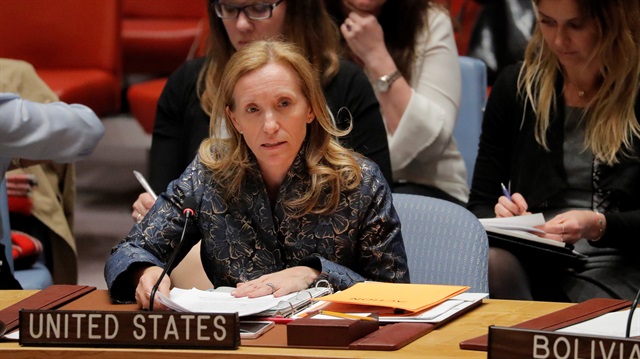
United States Ambassador for the Economic and Social Council at the U.N. Kelley Currie
The world has failed to end the Rohingya crisis in Myanmar, where hundreds of thousands of people were driven from their homes by fire, rape and murder, a U.S. envoy said Monday.
Ambassador Kelley Currie, the U.S. Representative to the United Nations Economic and Social Council, said the world has said "never again" many times over the past 70 years in places like Rwanda, Bosnia and Darfur, calling it a "sad irony."
She was speaking at a panel hosted by Washington-based think tank the Heritage Foundation.
"These places haunt us for our collective failure," said Currie.
Currie, who also specializes in humanitarian assistance and human rights, emphatically highlighted the world's failure to stop the violence against Rohingya Muslims in Rakhine State.
"We all watched in August 2017, September 2017, week by week in horror," she said, referring to two major attacks against Rohingya Muslims conducted by Myanmar’s military.
Floods after heavy monsoon rains displaced more than 16,000 people in Myanmar, local media reported on Thursday.A total of 16,792 people were displaced by floods -- which began over the weekend in southeastern Kayin State -- as of Wednesday, the Myanmar Times reported, quoting the Department of Disaster Management.Some 10,368 people were forced to flee their homes in the state capital Hpa-an because of flood water from the Thanlwin River, it added.Flood hits over 300 Rohingya shelters in no man’s landMany evacuation centers were set up across the state to provide temporary shelters for the victims.Monsoon rains affected a large part of the Philippines, Japan and Southeast Asia this summer.In Bangladesh, the Rohingya Muslims face the risk of losing shelters due to monsoon rains and many infectious diseases due to polluted water sources.
Myanmar: Over 16,000 displaced by floods in Kayin State
More than 300 Rohingya shelters in no man’s land were hit by a flood on Tuesday night, a local online broadcaster reported on Wednesday.“At no man’s land nearly 7,000 Rohingya up to date are sheltering since last year, when they were forced to flee their homes in northern Rakhine state,” Rohingya Vision reported.No man's land is a small strip of land along the border between Bangladesh and Myanmar.Since Aug. 25, 2017, more than 750,000 refugees, mostly children and women, have fled Myanmar and crossed into Bangladesh after Myanmar forces launched a crackdown on the minority Muslim community, according to Amnesty International.Myanmar claws through rubble for 27 buried in jade mine landslideFive children killed in landslide in SE BangladeshAt least 9,400 Rohingya were killed in Rakhine from Aug. 25 to Sept. 24 last year, according to Doctors Without Borders.In a report published recently, the humanitarian group said the deaths of 71.7 percent or 6,700 Rohingya were caused by violence. They include 730 children below the age of 5.The Rohingya, described by the UN as the world's most persecuted people, have faced heightened fears of attack since dozens were killed in communal violence in 2012.The UN documented mass gang rapes, killings -- including of infants and young children -- brutal beatings, and disappearances committed by security personnel.
Flood hits over 300 Rohingya shelters in no man’s land
Since Aug. 25, 2017, more than 750,000 refugees, mostly women and children, have fled Myanmar and crossed into Bangladesh after Myanmar forces launched a crackdown on the minority Muslim community, according to Amnesty International.
At least 9,400 Rohingya were killed in Rakhine from Aug. 25 to Sept. 24 last year, according to Doctors Without Borders.
In a report published last December, the global humanitarian group said the deaths of 71.7 percent or 6,700 Rohingya were caused by violence. They include 730 children below the age of 5.
The U.S. envoy urged Myanmar’s government to provide Rohingya Muslims safe return to their homes and grant them citizenship, access to school, places of worship and medical care.
She added the refugees and those who are still hiding in Myanmar must know that their return will be safe and voluntary.
She noted that Rohingya Muslims must be confident that they will not face the same abuses that drove them from their homes.
Currie also called on the Myanmar government not to confine the returnees to camps or ghettos as second-class citizens and to respect their freedom of movement and basic human rights along with their rights of citizenship.
Thousands of Rohingya refugees were relocated on Wednesday (July 25) due to risk of landslides as heavy monsoon rains hit Bangladesh. Videos uploaded to social media by Kevin J. Allen, Head of emergency operations at UNHCR, showed people building reinforcements, refugees leaving camps and UNHCR tents.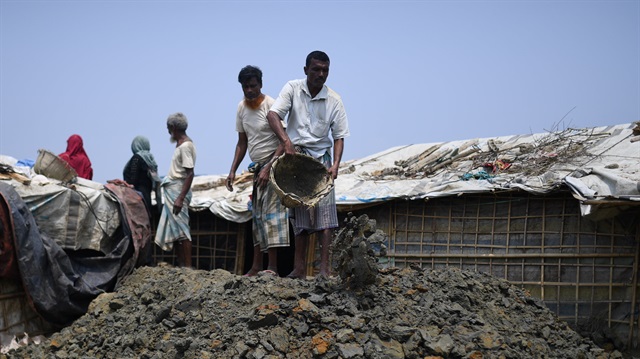
Rohingya refugees camps relocated for landslide risk in Bangladesh
On whether she believes the efforts of the U.S. and other major countries are enough to stop the persecution of Rohingya, she said the U.S. was the "single largest donor" helping Rohingya through financial assistance and is working with both Bangladesh and Myanmar to stop “shockingly vicious” military operations of the Burmese military.
The U.S. also imposed a visa ban, restrictions on members of the military and held Burmese military generals who took part in the violence responsible, she said.
The Rohingya, described by the UN as the world's most persecuted people, have faced heightened fears of attack since dozens were killed in communal violence in 2012.
The UN documented mass gang rapes, killings -- including of infants and young children -- brutal beatings, and disappearances committed by security personnel.
In a report, UN investigators said such violations may have constituted crimes against humanity.