

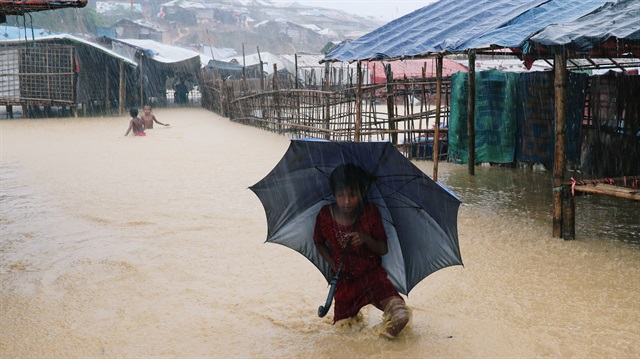
A Rohingya refugee girl walks along the water with umbrella
More than 300 Rohingya shelters in no man’s land were hit by a flood on Tuesday night, a local online broadcaster reported on Wednesday.
“At no man’s land nearly 7,000 Rohingya up to date are sheltering since last year, when they were forced to flee their homes in northern Rakhine state,” Rohingya Vision reported.
No man's land is a small strip of land along the border between Bangladesh and Myanmar.
Since Aug. 25, 2017, more than 750,000 refugees, mostly children and women, have fled Myanmar and crossed into Bangladesh after Myanmar forces launched a crackdown on the minority Muslim community, according to Amnesty International.
Authorities in Myanmar used excavators on Wednesday to hunt for 27 people buried for two days in a landslide, officials said, the latest disaster to hit a northern centre of the Southeast Asian nation's lucrative jade trade.Deadly landslides during Myanmar's rainy season from May to October frequently bury informal scavengers, or handpickers, who scour large piles of earth for jade, production of which stood at $31 billion in 2014, advocacy group Global Witness says.Small-scale miners who flouted repeated warnings in their search for jade at a defunct mining site were buried by muddy earth that slid off a cliff on Monday, said Kyaw Swar Aung, the administrator of Hpakant in Kachin state.Myanmar violated UN child rights pact in Rohingya crackdown"There were 4 inches of rain the night before it happened," he said, adding that no survivors or bodies had yet been pulled from the rubble. "Warnings had been issued twice not to do mining at that site."Six backhoes were brought in on Tuesday to help with the search in the village of Ma Mone, said fire brigade official Aye Thein."We could not perform the search when it happened, since we did not have the machinery," he said.Those trapped had come from nearby villages to pick through tailings for jade, he said. Experts say most of the stones are smuggled to neighbouring China.About 100 people are estimated to have died in landslides this year in the Hpakant region, said Dashi La Seng, a lawmaker for the ruling National League for Democracy. A large landslide on July 14 killed at least 15 people and injured 45.Myanmar officials planned genocide of Rohingya: NGODozens feared dead in Myanmar’s jade mine landslide
Myanmar claws through rubble for 27 buried in jade mine landslide
Five children -- including four members of a single family -- were killed and four others injured in landslides in the Cox’s Bazar area of southeast Bangladesh on Wednesday.The landslides were triggered by days of torrential rainfall amid the country’s monsoon season. In one early morning landslide, a chunk of mud from a hill collapsed on a house while all those inside were asleep, leaving four dead, Faid Uddin Khandaker, the officer in charge of Cox’s Bazar Model Police Station, told Anadolu Agency.In a later landslide, a boy was killed and three others injured. The injured were taken to a local hospital, according to local police.Video: Monsoon flood cuts off Rohingya camp in Bangladesh The deceased were identified as Marjia Begum, 15, Pabiya Begum, 10, Abdul Hye, 8, and Khairunnessa, 6, and Morshed Alam, 5.Over the last 24 hours, some 228 millimeters of rain has been recorded in the area, according to state meteorologists.Though the deaths took place outside the local camps for some 700,000 Rohingya refugees, last month at least three Rohingya Muslims were killed and hundreds of others injured in Cox’s Bazar by mudslides after monsoon rains.The UN and rights groups have also warned the monsoon season could lead to disease outbreaks and other problems at the camps.
Five children killed in landslide in SE Bangladesh
At least 9,400 Rohingya were killed in Rakhine from Aug. 25 to Sept. 24 last year, according to Doctors Without Borders.
In a report published recently, the humanitarian group said the deaths of 71.7 percent or 6,700 Rohingya were caused by violence. They include 730 children below the age of 5.
The Rohingya, described by the UN as the world's most persecuted people, have faced heightened fears of attack since dozens were killed in communal violence in 2012.
The UN documented mass gang rapes, killings -- including of infants and young children -- brutal beatings, and disappearances committed by security personnel.