

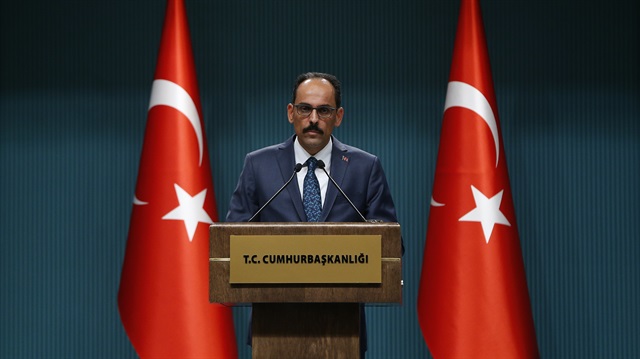
Turkish Presidential spokesman Ibrahim Kalın
Turkey's presidential spokesman has blasted Washington for disregarding the legal process in the case of an American pastor facing terrorism-related charges.
In a written statement to Reuters late Wednesday, Ibrahim Kalın said: “There is the rule of law in Turkey, and the Andrew Brunson case is a legal issue. There is an ongoing legal process related to this individual.
“It goes without saying that we find unacceptable the disregard of the legal process by the United States, which has been making certain demands.”
Someone being a priest or a clergyman is not enough to make a person innocent, Kalın said.
"The judiciary is the decision-maker, and everybody, including the U.S., has to respect the decision of the Turkish judiciary. Just as it has so far, this rule will continue to hold."
His remarks came after U.S. National Security Adviser John Bolton earlier told Reuters that Turkey made a “big mistake” in not releasing Brunson.
Turkey and the U.S. are facing rocky relations following Washington’s imposition of sanctions on two Cabinet ministers for not releasing pastor Andrew Brunson, who faces terrorism-related charges in Turkey.
On Aug. 10, U.S. President Donald Trump ramped up his attack on Turkey by doubling U.S. tariffs on Turkish aluminum and steel imports.
In retaliation, Turkey raised tariffs on several U.S.-origin products, including alcohol and tobacco products and cars.
Germany's former foreign minister slammed U.S. President Donald Trump on Tuesday for pursuing the ‘irresponsible” policy of threatening Ankara with economic pressure and sanctions.“Under the Trump administration, the U.S. is now trying to exploit Turkey’s economic difficulties, so to say, it is pushing Turkey off a cliff. I think this is irresponsible,” Sigmar Gabriel said in Berlin.The Social Democrat politician stressed the importance of Turkey’s economic stability for European states, and urged the latter to look for ways to support Ankara, should it seek financial support from Europe.“A destabilization of the Turkish economy, its society is not in our interest. The U.S. is far away, but we are neighbors. We have to shoulder any negative consequence,” he stressed.Turkey-U.S. relations took a nosedive on Aug. 1, when the Trump administration announced sanctions on Turkey’s interior and justice ministers after Ankara refused to release an American pastor who faces terrorism-related charges in Turkey.On Aug. 10, Trump upped the ante by doubling U.S. tariffs on Turkish aluminum and steel imports.In response, Turkey raised tariffs on several U.S.-made goods, including alcohol and tobacco products as well as vehicles.Political tensions between Ankara and Washington had sparked worries in markets, but the Turkish lira has staged a recovery last week, after positive messages from European capitals and Qatar’s decision to invest $15 billion in Turkey.
Former German minister slams Trump’s Turkey policy
Halkbank case result of 'FETÖ plot'
Moving to another thorn in Turkish-U.S. ties, Kalın said that everybody knows that Mehmet Hakan Atilla, a former executive at Turkish state-owned lender Halkbank, was unjustly imprisoned by the U.S. as the result of a “plot” by the Fetullah Terrorist Organization (FETÖ), the group behind the 2016 defeated coup in Turkey.
Atilla was sentenced this May to 32 months in prison for violating the sanctions on Iran.
“It is unacceptable that certain baseless and false allegations are made against Halkbank to weaken this public bank,” Kalın said.
“It seems that the purpose of those steps is to discredit respectable institutions and persons and to punish them unjustly rather than discover the truth," he said, adding that Turkey is "extremely disturbed by this process.”
The lawyer for the American Christian pastor on trial for terrorism charges in Turkey said on Wednesday he planned to appeal to the constitutional court to seek Andrew Brunson's release after being rejected by a lower court last week.Brunson is at the centre of a row between Turkey and the United States, which has exacerbated a crisis in Turkey's lira and reverberated across global markets.The evangelical pastor, who has lived in Turkey for two decades, has been detained for 21 months on terrorism charges, which he denies. He is under house arrest."Once the upper court's rejection has been confirmed in writing we will apply to the constitutional court," lawyer Ismail Cem Halavurt said.Once domestic legal avenues are exhausted, if necessary the defence would then apply to the European Court of Human Rights (ECHR), he said."We are hopeful regarding the constitutional court, but if it is rejected there, we will go to the ECHR without hesitation," he added.The court in Turkey's Izmir province which last week rejected the appeal said evidence was still being collected and the pastor posed a flight risk.Brunson is accused of terrorism charges and aiding the Fetullah Terrorist Organization (FETÖ), which Ankara says was responsible for a coup attempt in July 2016 against President Tayyip Erdoğan.In an interview with Reuters on Monday, U.S. President Donald Trump said he would give Turkey no concessions in return for the release of Brunson. Ankara has not responded to Trump's comments.US sanctions hurt NATO alliance, says Turkish FMTurkish court rejects US pastor’s release appeal for third time
US pastor's lawyer plans appeal to Turkish constitutional court
In an opinion piece to USA Today, Turkish Foreign Minister Mevlut Cavusoglu said on Monday the U.S. attempts to undermine Turkish economy hurt the NATO alliance.The article outlined the Turkish commitment to the alliance, both in policy and military support, and stressed that the way to solve the tensions between Ankara and Washington is through diplomacy, not tariffs."President [Donald] Trump was right when he called on members of the North Atlantic Treaty Organization to step up their defense spending. But new American sanctions targeting Turkey — and the threat of more to come — alienate one of the few NATO allies that has been ahead of the curve," Cavusoglu wrote.The foreign minister highlighted the country's commitment to NATO's defense spending, both committing to their guideline to spend 2 percent of the country's global domestic product (GDP) on defense, and already surpassing the NATO guideline of spending 20 percent on military equipment. Turkey also hosts the alliance's second largest military force."The economic sanctions Mr. Trump’s administration is imposing on Turkey, however, are poised to disrupt any atmosphere of cooperation — all while global threats demand that we strengthen, not weaken, the ties that bind us together," he said.On Syria, Cavusoglu cited a statement by a U.S. official saying that Turkey "suffered more casualties from terrorism in the past several years than any other Ally," and highlighted the strategic importance of its Incirlik air base which is being used by the U.S.-led coalition forces to fight Daesh terrorists in Syria."Over the past two years, we have arrested hundreds of suspected ISIS [Daesh] members, helping to prevent the group’s spread to Western capitals. In the face of this threat, Turkey has been the tip of the spear," Cavusoglu added.He also recalled that Turkey welcomed millions of Syrian refugees, being one of the few countries to do so.The tariffs sanctioned by the U.S. on Turkey will not just harm Turkey, but also harm the U.S. and Europe, according to Cavusoglu.He used the warning by the U.S. Chamber of Commerce, which told President Donald Trump that his actions "harm the U.S. economy and undermine American global leadership"."This reckless escalation needs to stop," said Cavusoglu, adding that both countries agree on a wide range of issues although they may have different views on significant ones."For everyone’s sake, we should address our disagreements with diplomacy, rather than threats and provocation, and with a commitment to facts and perspective," Cavusoglu added.Turkey and the U.S. are currently experiencing rocky relations following Washington’s imposition of sanctions on two government ministers for not releasing American pastor Andrew Brunson, who faces terrorism-related charges in Turkey.On Aug. 10, President Donald Trump ramped up his attack on Turkey by doubling U.S. tariffs on Turkish aluminum and steel imports. Last Wednesday, in retaliation, Turkey increased tariffs on several U.S.-origin products, including alcohol and tobacco products and cars.
US sanctions hurt NATO alliance, says Turkish FM
Bolton’s ‘desperate’ remarks
Bolton had said that he was skeptical of Qatar’s pledge last week of $15 billion in investment support for Turkey, claiming this is “utterly insufficient to have an impact on Turkey’s economy.”
His remarks on Turkey’s economic condition and Qatar’s investment plans point to a “more desperate situation,” Kalın said.
“His statement is proof that the Trump administration is targeting a NATO ally as part of an economic war.”
Kalın also mentioned that the current U.S. administration has similar disputes with Mexico, Canada, Cuba, China, Russia, Iran, the EU, and Germany.
“The Trump administration has ... established that it intends to use trade, tariffs, and sanctions to start a global trade war,” he said.
“So, there is a global problem. The problem between Turkey and the U.S. have appeared as part of the problems that the Trump administration has with the world,” Kalın added.
“Such political, judicial and economic attitudes are at odds with the soul of the alliance. These are also against NATO’s fundamental rules.”
Castigated by U.S. President Donald Trump as relying too much on Russian gas supplies, German Chancellor Angela Merkel heads to Azerbaijan this week to discuss the development of a southern pipeline to deliver gas to Europe from the Caspian.The visit underscores Merkel's openness to finding alternative sources of affordable gas even as she remains committed to the Nord Stream 2 pipeline, which will carry gas directly from Russia under the Baltic Sea to Germany."We have a big interest in further developing the Southern Corridor," a senior German government official said."This is part of the EU's diversification strategy of getting gas from other regions, not just Russia, to Europe."In Baku, Merkel will discuss energy issues, including improving the infrastructure to help transport gas from Azerbaijan to Europe via Turkey, officials said.Azerbaijan looks set to play a crucial role as it plans to launch the second stage of a gas pipeline from the vast Shah Deniz field to Europe. Shah Deniz II is expected to produce 16 billion cubic metres (bcm) of gas a year from 2020, with 10 bcm earmarked for Europe and 6 bcm for Turkey and Georgia.Later, gas could be brought from Turkmenistan, Iran and Iraq to Europe. In a sign of progress, Iran, Russia, Kazakhstan, Turkmenistan and Azerbaijan agreed in principle this month on how to divide the potentially huge oil and gas resources of the Caspian Sea.However, the southern pipeline is dwarfed by Nord Stream 2, a Gazprom initiative that will double Russia's export capacity to Europe to 110 bcm. That pipeline is welcomed by much of German industry, which wants as much cheap gas as possible.Last month Trump, who is pressing Germany to buy more U.S. liquefied natural gas, lambasted Germany as being "a captive" of Russia due to its dependence on Russian energy, a charge Germany denies. Trump has called Nord Stream 2 "horrific".Germany imported 39 percent of its gas from Russia in the first half of 2018, figures from state foreign trade authority BAFA showed.Merkel discussed energy in talks with Russian President Vladimir Putin at a palace outside Berlin at the weekend. She is trying to assuage some Nord Stream 2 critics by ensuring Ukraine does not suffer from lower gas transit revenues.Merkel also travels to Georgia and Armenia on her three-day trip, which starts on Thursday. She will hold talks with Azeri President Ilham Aliyev on Saturday.
After Trump attack on Russia ties, Merkel eyes Azeri gas
'Turkey will not be silent'
“Turkey has no intention of starting an economic war with any party. It cannot, however, be expected to keep silent in the face of attacks on its economy and judiciary,” he said.
Ankara will work with the rest of the world against “restrictive and punitive” approaches and protect the nation's interests in all areas, he added.
Kalın welcomed recent statements supporting Turkey, saying that they show Turkey is on the right path.
“Qatar’s pledge of $15 billions in investment in Turkey relieved the markets. We appreciate Qatar’s attitude. From now on Turkish-Qatari relations will continue to strengthen at all levels,” he said.
Stressing the importance of statements by Germany, France, Italy, Russia, China, and Iran in support of Turkey, Kalın praised the steps fighting back the attacks on the Turkish currency as effective.
The Treasury and Finance Ministry and related institutions will continue to take measures to help the economy, he added.
U.S. and Chinese officials are set to resume contentious trade talks on Wednesday under the cloud of a prediction by U.S. President Donald Trump that there would be no real progress.The discussions among mid-level officials could set a framework for further negotiations as each country prepares to hit the other with new tariffs on Thursday in a deepening dispute over China's economic policies.Trump has threatened to impose duties on virtually all of the more than $500 billion of Chinese goods exported to the United States unless it meets his demands.The two days of meetings are the first formal U.S.-China trade talks since U.S. Commerce Secretary Wilbur Ross met Chinese economic adviser Liu He in Beijing in June.After negotiations in May, Beijing believed it had assurances from the U.S. that tariffs were off the table. But less than 10 days later, the White House said it would push forward on punitive measures.China has said it hopes for quiet, steady talks to get "a good result on the basis of equality, parity and trust."But Trump told Reuters on Monday that he did not "anticipate much". In an interview, he said resolving the trade dispute will "take time because China's done too well for too long, and they've become spoiled."Trump also accused China of manipulating its yuan currency to make up for the effect of tariffs, while arguing the U.S. central bank should be more accommodating.On Tuesday, however, Trump administration officials were largely silent about the latest round of talks. Spokespersons for the U.S. Treasury, the U.S. Trade Representative's office and the U.S. Commerce Department did not respond to queries about the Treasury-led meetings.China expands internment camps targeting Uighurs"These are working-level discussions with representatives from across the administration," a White House official told Reuters. The official declined further comment but pointed out Trump's own pessimistic comments in the Reuters interview."This is to some extent a temperature-taking exercise," said Scott Kennedy, director of China studies at the Center for Strategic and International Studies in Washington. "Expectations are probably low on both sides."Previous talks were held by cabinet-level ministers, including Chinese Vice Premier Liu He, U.S. Treasury Secretary Steven Mnuchin and Commerce's Ross.China's Xi says military must resist 'corrosion' of corruptionThe talks on Wednesday and Thursday will led by lower-level officials, Treasury Undersecretary David Malpass and Chinese Commerce Vice Minister Wang Shouwen. Deputy USTR Jeffrey Gerrish is also expected to participate."The vice minister from Mofcom is not going to be authorized to make some great offer, but if the Chinese say one interesting thing, maybe you set up a second meeting and the level goes up a step," said Derek Scissors, a China scholar at the American Enterprise Institute, a Washington think tank."But I'd say there's an 80-90 percent chance they are a total waste of time, and that's why no one in the administration is talking about this," he added.Ultimately Trump will need to personally be involved in settling the dispute with Chinese President Xi Jinping, Scissors said.China reiterates support for Turkey's economyLengthy DemandsTrump's administration is pressing China to make sweeping economic policy changes to better protect U.S. intellectual property, end its industrial subsidy efforts and open its markets to foreign competition.In May, U.S. officials presented China with a lengthy list of demands that also included reducing the U.S. trade deficit with China by $200 billion annually. It is unclear whether that list has been revised for the latest round.Beijing denies U.S. allegations that it systematically forces the unfair transfer of U.S. technology and insists that it adheres to World Trade Organization rules.China complains about Pentagon report, says it is 'pure guesswork'The discussions this week were expected to do little to stop the scheduled activation of 25 percent U.S. tariffs on another $16 billion in Chinese goods scheduled to take effect at 12:01 a.m. EDT (0401 GMT), along with immediate retaliatory tariffs expected from China on $16 billion of U.S. goods.But this could soon trigger Trump's unveiling of a second $200 billion to $300 billion list of Chinese goods to be targeted with U.S. tariffs.On June 16, when Trump first threatened to dramatically escalate his tariffs with an initial $200 billion list of Chinese goods, he said would hit China with tariffs on another $200 billion in goods if Beijing retaliated a second time.Erin Ennis, senior vice president of the U.S.-China Business Council, said it was probably good for the two sides to start with lower level officials who could "get into the weeds" on the IP protection problems that U.S. companies are facing in China."It's good that they're talking because not talking isn’t solving the issues and is only leading to more tariffs," she said.
US, China to resume trade talks in Washington amid low expectations