

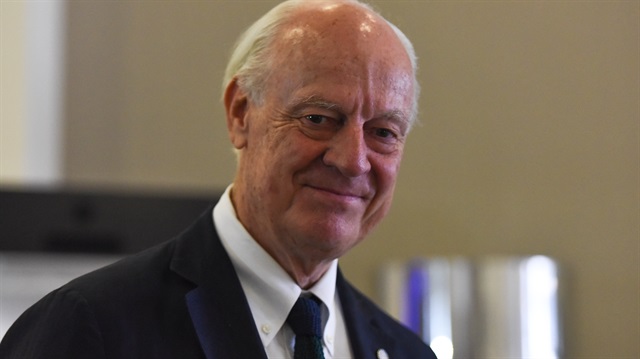
UN Special Envoy to Syria Staffan de Mistura
UN Special Envoy to Syria Staffan de Mistura will meet senior officials from Turkey, Russia, and Iran to establish a Syrian constitutional committee on Monday.
Efforts to establish a constitutional committee, which was agreed during the Syrian National Dialogue Congress on Jan. 30, 2018 in Russian resort city of Sochi, have come to a critical phase.
De Mistura will meet on Monday and Tuesday with the guarantor countries of Astana process -- Turkey, Russia, and Iran.
On Friday, he will meet with officials from Egypt, France, Germany, Jordan, Saudi Arabia, U.K., and U.S.
Deputy Foreign Minister Sedat Önal will represent Turkey during the meetings.
Former Syrian Prime Minister Riyad Hijab has ruled out a military victory by regime forces in Syria’s 7-year civil war, saying Russia will eventually realize it was mistaken in supporting the Bashar al-Assad regime.“The regime has no [enough] forces or military capability to take control of Idlib,” Hijab said in an interview with the Doha-based Al Jazeera television.“Everyone knows, even Assad himself and his top brass that they are under the protection and guardianship of Russian special forces,” he said.Hijab, a former opposition negotiator, said “signs of weakness are evident in the structure of the Syrian state”.“There is an outbreak of unacceptable and unreasonable practices such as areas in regime-held areas let alone tit-for-tat killings between militias and regime forces,” he said.He cited that more than 40 regime officers and members had been killed, but without giving a specific date for the killings."The regime is in the worst situation,” he said. “Russia is working to disband pro-regime militias.”"Russia will realize sooner or later that Assad does not deserve all this effort and support and that it has committed a mistake in supporting Assad,” Hijab said.“There is a whole series of failures and deterioration by the regime that cares about its own interests even at the expense of its own community and people."
Russia mistaken in backing Assad: Ex-Syria PM
Talks on Monday will be closed to press, while Tuesday’s meeting will be official and open to media.
The final declaration of Syria summit held by the guarantor countries in Russia in July highlighted the establishment of a constitutional committee.
On July 5, the Syrian Negotiation Commission submitted a list of 50 candidates to represent the Syrian opposition in the constitutional committee to de Mistura, according to the Turkish Foreign Ministry.
Also, Turkish President Recep Tayyip Erdogan emphasized the significance of forming a constitutional committee following a trilateral meeting with his Russian and Iranian counterparts in Tehran last week.
Foreign Minister Mevlüt Çavuşoğlu said Saturday everybody believes Turkey can stop attacks on Syria's northwestern Idlib because Turkey's Syria policy is based on humanitarian diplomacy.Speaking at an event in southern Antalya province, Cavusoglu said: "Everybody's common rhetoric, whether they like us or not, is that 'if this [Idlib attack] can be prevented, then it is Turkey that can do [prevent] it."Cavusoglu said this is not because Turkey is a neighbor of Syria or the country maintains relations with Russia and Iran; it is because Turkey's Syria policy is based on humanitarian diplomacy and it does not have a secret agenda."Everyone who loves [Turkey] or not, is partial or impartial, they are looking at and trusting Turkey [on the Idlib issue]," he added.Highlighting that the situation also needs international effort, Cavusoglu said they will continue their effort to prevent the death of thousands of people and new waves of migration.Seven civilians were killed and seven others injured in airstrikes carried out by Syrian regime forces and Russian warplanes in Syria’s northwestern Idlib province earlier in the day, according to the White Helmets.At least 28 civilians have been killed and dozens injured in airstrikes and attacks by regime forces and Russian warplanes in Idlib and Hama since the beginning of this month, the group said.The Syrian regime has recently announced plans to launch a major military offensive in the area, which has long been controlled by various armed opposition groups.The UN warned earlier this week that such an offensive would lead to the "worst humanitarian catastrophe in the 21st century".A trilateral summit of the presidents of Turkey, Russia and Iran on Friday underlined that “there could be no military solution to the Syrian conflict" and called for advancing the political process to reach a negotiated solution.
Turkey's Syria policy based on 'humanitarian diplomacy'
“Representatives of the three guarantor countries will meet again in Geneva with the UN’s Secretary-General’s special envoy on Syria in the coming days," Erdogan said on Friday.
“The formation process of a constitutional committee will be discussed, and we can say that the preparations have come to the last stage,” he added.
“Establishing and making this committee -- which is on the agenda thanks to the Astana process -- will bring a new dynamism to the political process,” he said.
Russian President Vladimir Putin had also said they agreed to help in process of establishing the committee.
The meeting held under the UN umbrella to end the seven-year-old civil war in Syria consists of four titles including transition, constitution, elections and fight against terrorism.
Turkey alone hosts half of Syrian refugees abroad, making it the country with the highest number of asylum seekers in the world with 4.5 million currently living there, according to recent data. Of the 4.5 million refugee population in Turkey, 3.5 million are Syrian refugees who fled the raging civil war in their country, which placed a heavy burden on Ankara as it shielded Europe from an even worse migration crisis.During the Tehran summit last week, Turkish President Recep Tayyip Erdoğan said Turkey has reached its capacity in taking in refugees, signaling Ankara’s reluctance to admit more migrants in the event of an influx from Syria’s Idlib region.The president of Turkey, Russia and Iran met to discuss the fate of Idlib as rival factions there prepared for what could be the Syrian conflict’s last great battle.In his remarks in Tehran, Erdoğan said any attack on Idlib would result in a disaster and that millions of civilians there would be moving toward the Turkish border.Video: Airstrikes kill five civilians in Syria’s IdlibThe Syrian regime has recently announced plans to launch a major military offensive in the area, which has long been controlled by various armed opposition groups.The UN warned earlier this week that such an offensive would lead to the "worst humanitarian catastrophe in the 21st century."Turkey home to 4.5 million refugeesWhile Turkey hosts the largest number of refugees overall at 4.5 million, neighboring Lebanon is home to the highest percentage of refugees per capita. Coming in second and third place, Pakistan and Lebanon each host 1.6 and 1.1 million refugees, respectively.Assad regime, Russia shell school in Syria’s Idlib, wound four childrenTurkey tells 50,000 FSA fighters to be ready for deployment as tensions rise in IdlibUS hosts 271,000 refugeesMeanwhile, with its population of over 300 million, the U.S. only hosts 271,000 refugees compared to Jordan, Egypt and Sweden which each host 650,000 226,000 and 169,000 people, respectively.Over 30,000 Syrians in camps As thousands of Syrian continue to return to their country following Turkish operations that cleared their towns and cities from terror elements, 40 camps were set up by Turkish NGOs in Syria that currently house 30,000 refugees.In recent days, Turkey has ramped up its preparations to meet the needs of additional refugees as it braces for a possible wave of a mass migration in the case of an attack against Idlib.Footage shows White Helmets rescuers targeted in IdlibTurkey hosts half of Syrian refugeesWith 6.1 million externally displaced Syrians in diaspora, Turkey alone hosts over 3.5 million, more than double the number of refugees than the whole of the EU.Idlib attack to trigger migration wave of 2 million refugeesDue to its proximity to the Turkish border and relative security throughout the civil war, the population of Syria’s northwestern Idlib province has swelled to 4 million after evacuation deals brokered with the regime forced hundreds of thousands of Syrian opposition fighters and their families to leave their hometowns, turning the previously sparsely populated region into a sanctuary for those opposing Assad. Close to a million of Idlib’s population lives in close to 200 camps at ground zero near the Turkish border. A possible attack against Idlib would trigger a wave of mass migration towards Turkey’s Hatay, which is a major source of concern for Turkey. In addition to risking the lives of hundreds of thousands of civilians in Idlib, an offensive will trigger a migration wave of 2 million refugees bound for Turkey and Europe, which could see terrorist elements attempting to cross the borders among those seeking asylum, possibly compounding security concerns across the continent.Turkey has been a main route for irregular migrants trying to cross into Europe, especially since 2011 when the Syrian civil war began.
Turkey welcomes half of the world’s Syrian refugees
Foreign Minister Mevlüt Çavuşoğlu said Saturday everybody believes Turkey can stop attacks on Syria's northwestern Idlib because Turkey's Syria policy is based on humanitarian diplomacy.Speaking at an event in southern Antalya province, Cavusoglu said: "Everybody's common rhetoric, whether they like us or not, is that 'if this [Idlib attack] can be prevented, then it is Turkey that can do [prevent] it."Cavusoglu said this is not because Turkey is a neighbor of Syria or the country maintains relations with Russia and Iran; it is because Turkey's Syria policy is based on humanitarian diplomacy and it does not have a secret agenda."Everyone who loves [Turkey] or not, is partial or impartial, they are looking at and trusting Turkey [on the Idlib issue]," he added.Highlighting that the situation also needs international effort, Cavusoglu said they will continue their effort to prevent the death of thousands of people and new waves of migration.Seven civilians were killed and seven others injured in airstrikes carried out by Syrian regime forces and Russian warplanes in Syria’s northwestern Idlib province earlier in the day, according to the White Helmets.At least 28 civilians have been killed and dozens injured in airstrikes and attacks by regime forces and Russian warplanes in Idlib and Hama since the beginning of this month, the group said.The Syrian regime has recently announced plans to launch a major military offensive in the area, which has long been controlled by various armed opposition groups.The UN warned earlier this week that such an offensive would lead to the "worst humanitarian catastrophe in the 21st century".A trilateral summit of the presidents of Turkey, Russia and Iran on Friday underlined that “there could be no military solution to the Syrian conflict" and called for advancing the political process to reach a negotiated solution. Turkey's Syria policy based on 'humanitarian diplomacy'
Idlib will not suffer the same fate as Syria’s southwestern Daraa province, vowed a Free Syrian Army (FSA) commander as a ground offensive against the last opposition-held stronghold looms.Russia is redeploying the same tactic it used against Daraa in the southwest, pointed out Major İbrahim Majbour, who commands the FSA-affiliated Free Idlib Army. “Russia wants to apply the Daraa model in Idlib, however, it will not suffer the same fate,” said Majbour, noting that Russia is currently trying to divide Idlib into five different regions through its intensified bombardment aimed at severing all links between them. ‘We have surprises in store for them’ Speaking exclusively to Yeni Şafak daily, the commander pointed out that while Russia does not possess any ground forces in the region, it will attempt to reach its goals through airpower backed by laying siege from the ground with the help of Iranian-backed militias.‘Possible Idlib attack to undermine peace processes’‘Turkey will not watch killing in Syria from sidelines’Noting the dissimilarities between Idlib and Daraa from geographic and strategic standpoints, Majbour revealed that the opposition has prepared a three-phase plan to defend the region. “There are very different developments in store for them in Idlib, we have surprises prepared for the regime and its allies,” said Majbour. Turkey has the strongest hand“We once again saw the true intentions of Russia and Iran during the Tehran summit. Turkey has the strongest hand both on the table and on the ground because it is the only side that wants reconciliation without bloodshed.”“The people of Idlib are behind Turkey. For months, demonstrations have been held in every town and village. The whole world sees Turkey’s intense efforts. Those who want a show of force through bloodshed will realize that they will not actualize their goals.”People take to the streets Hundreds of thousands of civilians took to the streets across Idlib in opposition to the planned invasion. Waving Turkish flags, demonstrators in a large number of towns of Idlib called for Turkish troops to enter the region, shouting anti-regime slogans and decrying Russian and Iranian actions. The biggest demonstrations were held in central Idlib, Taftanaz, Kafranbel and Maaret al-Numan.Video: Erdoğan says Turkey cannot leave Syria's Idlib to Assad’s mercyDozens of spies arrested “We were able to arrest dozens of instigators through the ongoing intelligence efforts of Turkey’s Idlib observation posts and opposition headquarters. There’s a large number of cells attempting to get people to surrender and spread chaos. There are cells that serve not only the PKK and Daesh, but also Russia and Iran. There have been 80 blasts over the past 10 days in Idlib. Simultaneously, the same provocations are ongoing in the axis of Jarabulus, Azaz, Afrin and al-Bab.” Exodus startedA civilian exodus fleeing Russia and the Assad regime’s latest aerial bombardment has already begun as thousands poured toward the Turkish border. With the threat of an impending massacre in Idlib looming closer every day, panicked civilians climbed concrete barriers set up by Turkey to jump across the border. Carrying only a few items with them, Syrians crossed the security wall and sought refuge in Hatay’s Altınözü district across the border.Video: Anti-regime protests in Syria's Idlib‘We’d enter Aleppo’The FSA commander stated that the opposition has taken numerous measures against any possible attempts to invade Idlib, stressing that they possess the firepower to counter any regime attacks, which will not be restricted to “defensive actions.” Majbour added that their respect for Turkey’s diplomatic efforts is the sole reason they have not mounted any attack up to this point, noting that as soon as battle breaks out, the opposition would overrun Latakia, Hama and Aleppo. Non-stop bombingSyrian opposition sources said that Russian military aircraft -- flying out of the Hmeimim airbase -- had carried out at least 20 separate attack sorties in recent days.On Tuesday, regime mortar and artillery fire targeted the Idlib town of Jisr al-Shughour and the northern Hama town of Haysh following Russian airstrikes against the region, where close to 4 million Syrians, the majority of whom are internally displaced, had sought refuge after fleeing violence raging in other parts of the war-torn country.Russian strikes had killed nine civilians -- including five children -- in Jisr al-Shughur, while leaving at least 20 more people injured.On Tuesday night, Russian Defense Ministry spokesman Igor Konashenkov confirmed the attack, saying Russia's Hmeymim Airbase in Syria destroyed two drones with surface-to-air missiles.
Idlib will not suffer the same fate as Daraa: Syrian opposition commander