

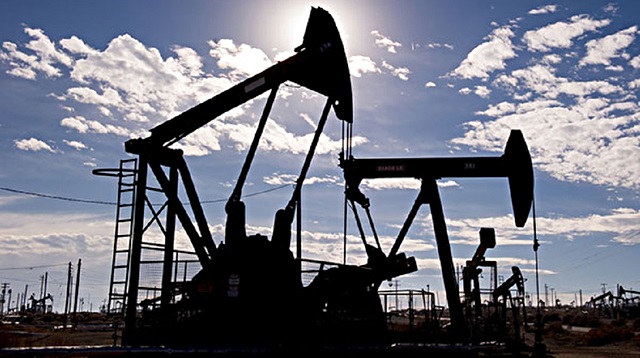
File photo
Turkey's top refiner, Tüpraş, is in talks with U.S. officials to obtain a waiver allowing it to keep buying Iranian oil after Washington reinstates sanctions on the Islamic Republic's energy sector in November, industry sources said.
The United States is preparing to impose the new sanctions on Iran's oil industry after Washington withdrew from a nuclear deal between Tehran and other global powers earlier this year, but is also considering offering waivers to some allies that rely on Iranian supplies.
NATO member Turkey depends heavily on imports to meet its energy needs and neighbouring Iran has been one of its main sources of oil because of its proximity, the quality of its crude, and favourable price differentials.
Turkey has already made efforts to cut its purchases ahead of the U.S. sanctions, but would prefer to keep up some level of Iranian oil imports past November, an industry source familiar with the matter said.
Oil markets look "adequately supplied for now" after a big production increase in the last six months, but the industry is coming under strain, the West's energy watchdog said on Friday.The International Energy Agency said in its monthly report that the world's spare oil production capacity was down to 2 percent of global demand, with further falls likely."This strain could be with us for some time and it will likely be accompanied by higher prices, however much we regret them and their potential negative impact on the global economy," the Paris-based organisation said.Members of the Organization of the Petroleum Exporting Countries (OPEC) and other exporters such as Russia agreed in June to raise output as the market appeared increasingly tight.The price of global benchmark Brent crude has risen from around $45 a barrel in June 2017 and peaked at over $85 this month on bullish bets by speculators.US senator calls for arms sales halt to Saudi ArabiaOPEC, Russia and others such as U.S. shale companies had increased production sharply since May, the IEA said, raising global output by 1.4 million barrels per day (bpd).Overall, OPEC had boosted production by 735,000 bpd since May as Middle East Gulf producers such as Saudi Arabia and the UAE more than compensated for declining output in Venezuela and Iran, which is facing U.S. sanctions from next month.Supply from Iran during September dropped to a two-and-a-half year low, the IEA said, as customers continued to cut back in the run-up to new sanctions, which start on Nov 4.Iranian output fell to 3.45 million bpd, it said, down 180,000 bpd month-on-month. Iranian oil exports in September fell to 1.63 million bpd, down 800,000 bpd from recent 2Q18 peaks, the agency estimated."The decline may deepen significantly ahead of U.S. sanctions - and subsequently as final cargoes are delivered," said the IEA, which advises major oil consumers on energy policy.But, the outlook for world oil consumption is faltering, the IEA said as it cut its forecast of global oil demand growth by 0.11 million bpd for both this year and next to 1.28 million bpd and 1.36 million bpd respectively."This is due to a weaker economic outlook, trade concerns, higher oil prices," it said.OECD commercial stocks rose by 15.7 million barrels in August to 2.854 billion barrels, their highest level since February, on strong refinery output and liquefied petroleum gas restocking, the IEA said.It added that OECD inventories were likely to have risen by 43 million barrels in the third quarter, the largest quarterly increase in stocks since the first quarter of 2016."The increase in net production from key suppliers since May of approximately 1.4 million bpd, led by Saudi Arabia, and the fact that oil stocks built by 0.5 million bpd in 2Q18 and look likely to have done the same in 3Q18, lends weight to the argument that the oil market is adequately supplied for now," the IEA said. 
World oil market 'adequately supplied for now': IEA
"They would like to be able to continue importing 3-4 cargoes a month, like they did during the previous sanctions round. But if the U.S. would tell them to stop, they will oblige and work towards achieving that," the source said.
A Tüpraş spokeswoman was not available for comment. Turkey's Energy Ministry was not immediately available for comment.
Turkey imported around 97,000 barrels per day of Iranian oil in August and 133,000 bpd in September, compared with just over 240,000 bpd in April, tanker tracking and shipping data showed.
And in the first two weeks of October, Turkey has purchased three 1 million barrel-cargoes of Iranian oil - a level that would equate to about 97,000 bpd if it made no other purchases this month.
Turkish interior minister on Thursday welcomed his Iranian counterpart and the delegation accompanying him in the capital Ankara.“The bilateral cooperation and steps we have taken during rough times has not only increased hopes but also encouraged and strengthened us,” said Suleyman Soylu during his meeting with Iran’s Abdolreza Rahmani Fazli.Recalling the historical ties between Iran and Turkey, Soylu said the two countries have taken significant steps in the last two years on cooperation and responsibilities.He further noted that the close cooperation between the two countries has recently become high-level.Iran's Khamenei orders officials to resolve economic crisisFazli, for his part, welcomed the cooperation between Turkey and Iran and said his country is “serious” about further enhancing relations.“Strengthening the relations between the two countries, in all circumstances, is one of Iran’s priorities,” said Fazli.Underscoring the necessity of working together in regional matters, he added: “Regional matters must be resolved by the regional countries. We recognize Turkey as one of the most important and effective countries in our region.”The two ministers, along with the delegation, later continued their meeting with doors closed to the media.
Turkey's interior minister meets Iranian counterpart
CASE-BY-CASE
Asked if Washington was negotiating with Turkey for a waiver, a State Department official said the department was prepared to work with countries that are reducing their imports on a case-by-case basis.
On Monday, Brian Hook, the U.S. special representative on Iran, did not comment directly about any talks on waivers with Turkey. But he told reporters countries seeking sanctions relief must "explain their specific and unique circumstances".
Hook said those conversations were private, but he added the State Department was "trying to advance our national security goals and also taking into account the needs of our allies and partners around the world."
Refiners around the world are under pressure to avoid Iranian oil purchases because they want to maintain their access to the U.S. financial system - something they could lose if they flout the U.S. sanctions.
Tomato paste is not the most obvious economic indicator, but in Iran, where it is a staple that some people have started panic-buying, it says a lot about the impact of renewed U.S. sanctions.While Iran makes its own paste from an abundant crop of locally grown tomatoes, sanctions reimposed by U.S. President Donald Trump since August have played havoc with supply.A 70 percent slide in the rial this year has prompted a scramble for foreign currency that has made exports much more valuable in local terms than selling produce at home.Some shops are limiting purchases of tomato paste, which is used in many Persian dishes, and some lines have sold out as people buy up existing stock.The government has responded by banning tomato exports, one of a raft of interventions to try to limit economic instability that has fuelled public protests and criticism of the government this year.But the tomato policy is not working. An industry representative said tomatoes were being smuggled abroad."We have heard that trucks full of tomatoes are still leaving the country, especially to Iraq," Mohammad Mir-Razavi, head of the Syndicate of Canning Industry, said by telephone."They put boxes of greenhouse tomatoes on top and hide normal tomatoes at the bottom," he said, referring to an exemption for hot-house grown tomatoes that left a loophole.It is one of many ways in which the sanctions are hurting ordinary Iranians while benefiting those with access to hard currency.Washington reintroduced steps against Iran's currency trade, metals and auto sectors in August after the U.S. withdrawal from a deal that lifted sanctions in return for limits on Iran's nuclear programme. Trump said the deal was not strict enough.With U.S. curbs on Iran's oil exports set to come into force next month, some Iranians fear their country is entering an economic slump that may prove worse than the period from 2012 to 2015, when it last faced major sanctions."There is an emerging consensus that the economy will go through a period of austerity similar to that recorded during the Iran-Iraq war," said Mehrdad Emadi, an Iranian economist who heads energy risk analysis at London's Betamatrix consultancy."COMING SOON"Jumps in prices are occurring in a range of goods -- particularly imports such as mobile telephones and other consumer electronics, but also some staples. A bottle of milk, 15,000 rials last year, now sells for 36,000.An 800-gramme (28-ounce) can of tomato paste was selling in Tehran stores for around 60,000 rials in March; it is now 180,000 rials, or $1.24 at the unofficial rate, prompting a scramble by households to stock up. The price of tomatoes has increased more than five-fold compared to last year.Signs on the shelves of some stores limit each customer to two cans. Iranian online shopping site Digikala lists the top nine tomato paste items as out of stock, and the rest as "coming soon". In supermarkets in Najaf in neighbouring Iraq, meanwhile, supplies of Iranian tomato paste are plentiful.Adding to the pressure is a fourfold rise in the price of cans, Mir-Razavi said. Traders importing material to make cans sought to buy dollars at a little-used official rate of 42,000 rials; authorities asked them to use a more expensive rate. The issue has delayed shipments of material to factories.The government is mounting a campaign against price-gouging, periodically ordering shopkeepers to sell at lower prices. But some shopkeepers respond by not selling at all, believing prices will eventually rise again as the sanctions bite.BANKS STABILISEDIran, a big oil producer with a diverse economy, has shown its farming, manufacturing and distribution sectors can ride out long periods of war and sanctions.The Tehran Stock Exchange index has soared 83 percent this year as shares of exporting companies have rocketed. Urban real estate prices have also risen as Iranians plough their savings into property rather than keeping them in depreciating rials.The rial's plunge, which in the unofficial market has taken it to around 145,000 against the dollar from 42,890 at the end of 2017, according to currency tracking website bonbast.com, may even have strengthened the financial system in one way.Banks and pension funds have been struggling with massive debts. Emadi said the rial's slide, to as low as 190,000 in late September, had given the government huge windfall profits on its dollar holdings; authorities appear to have injected some of those profits into insolvent banks to shore them up, he said.But while official data for the last few months has not yet been released, Emadi said he believed the economy was already in a recession that could deepen in coming months.GEOPOLITICSThe International Monetary Fund predicted this week that the economy would shrink 1.5 percent this year and 3.6 percent in 2019, before recovering slowly.That would make the slump less deep than the recession of 2012, when the economy shrank over 7 percent, and not nearly as damaging as the Iran-Iraq war of 1980-1988, when it shrank by about a quarter.The IMF also forecast the average inflation rate would jump to a peak above 34 percent next year, briefly returning to its level in 2013.How much the current recession resembles past periods of economic pain for Iran will depend on the extent to which Washington can use the sanctions to push other countries into cutting oil and non-oil trade with the Islamic Republic.U.S. officials have said the sanctions will be tougher than the steps in 2012-2015. They aim to reduce Iranian oil exports more sharply, and to disrupt exports to Iran from trading hubs such as Dubai more aggressively."I think the return of the sanctions has had a devastating effect on their economy and I think it's going to get worse," Trump's national security adviser John Bolton told Reuters in late August.But Emadi said that if European nations succeeded in creating a special payments system permitting trade with Iran to continue, and if Tehran cracked down on endemic corruption, the economy might start recovering gradually a year from now.In the meantime, many Iranians may continue to struggle with surging prices and an unstable currency.Peyman Mohammadian, 28, an unemployed university graduate in the western city of Andimeshk, said he had tried to protect 5 billion rials in savings by converting them into dollars last month at a rate of 183,000.Since then, the rial has partially rebounded as authorities have sold dollars to support it and threatened currency speculators with arrest. Mohammadian said this left him in a quandary.“On one hand, I want the dollar to rise so I don't lose my money. But on the other hand, I want it to drop below 100,000 -- otherwise inflation will be so high that I won't be able to get married for 10 years.”
Tomato squeeze: US sanctions begin to distort Iran's economy
Indian refiners also cut imports of Iranian oil purchases last month in a sign they are preparing for November.
Washington's plan to impose sanctions on Iranian crude could strain already soured ties between the United States and Turkey - at odds over a host of issues from diverging interests in Syria to Ankara's ambition of buying Russian defence systems.
The release of an American pastor last week who had been in custody in Turkey for two years could signal a thaw in relations between the two NATO allies as Trump said he welcomed an end to the "harsh relationship" the countries had over the summer.
But Turkey has been vocally opposed to the U.S. sanctions on Iran, and has said it will not cut trade ties with Tehran at the behest of other countries.
During 2017, Iran was Turkey's top crude oil source, accounting for 11.5 million tonnes of its total purchases nearing 26 million tonnes, followed by Iraq and Russia.