

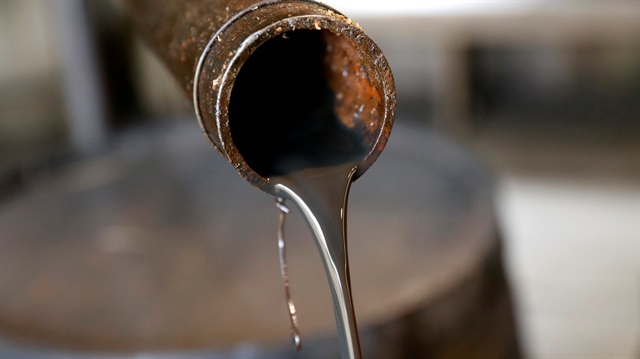
Oil pours out of a spout.
Oil markets look "adequately supplied for now" after a big production increase in the last six months, but the industry is coming under strain, the West's energy watchdog said on Friday.
The International Energy Agency said in its monthly report that the world's spare oil production capacity was down to 2 percent of global demand, with further falls likely.
"This strain could be with us for some time and it will likely be accompanied by higher prices, however much we regret them and their potential negative impact on the global economy," the Paris-based organisation said.
Members of the Organization of the Petroleum Exporting Countries (OPEC) and other exporters such as Russia agreed in June to raise output as the market appeared increasingly tight.
The price of global benchmark Brent crude has risen from around $45 a barrel in June 2017 and peaked at over $85 this month on bullish bets by speculators.
U.S. Kentucky Senator Rand Paul on Wednesday demanded a halt in military support to Saudi Arabia until a Saudi journalist who disappeared in the Consulate in Istanbul was “returned alive”.Jamal Khashoggi has been missing since Oct. 2, when he visited the Saudi Consulate in Istanbul, amid speculation that he was killed by Saudi authorities.In an article in The Atlantic, Paul said that he intended to introduce legislation to “cut all funding, training, advising, and any other coordination” with and to the Kingdom until Khashoggi is confirmed to be alive.“The regime must be held accountable for Jamal Khashoggi,” he said.Slamming the Saudi “oppressive regime”, Paul expressed “deep disappointment” with his fellow senators for not taking measures earlier.“No amount of oil business or arms deals justifies our collusion with a regime that sponsors jihadism around the world,” he said.He also criticized the OPEC nation’s “reckless” actions in the Yemen conflict.Saudi authorities have yet to give a clear explanation on the fate of Khashoggi as several countries -- particularly Turkey, the U.S. and the UK -- press for clarification.According to his fiancée Hatice Cengiz, Khashoggi first arrived at the Saudi Consulate in Istanbul on Sept. 28. After being told his documents would be ready in a week, Khashoggi went to London and returned to Istanbul on Oct. 1.Khashoggi called the consulate and was told "that documents are being prepared" and he could come to the consulate. He went to the diplomatic building on Oct. 2 with Cengiz but was not seen after entering it.On the same day, 15 Saudis, including several officials, arrived in Istanbul on two planes and visited the consulate while Khashoggi was also inside, police sources said.Turkey identifies eight of 15 individuals linked with disappearance of Saudi journalistUS was aware of plan by Saudi officials to capture Khashoggi: Washington PostSaudi officials ask Turkish authorities to defer consulate search for missing journalistUS ready to assist on missing Saudi journalist Khashoggi: Pence
US senator calls for arms sales halt to Saudi Arabia
OPEC, Russia and others such as U.S. shale companies had increased production sharply since May, the IEA said, raising global output by 1.4 million barrels per day (bpd).
Overall, OPEC had boosted production by 735,000 bpd since May as Middle East Gulf producers such as Saudi Arabia and the UAE more than compensated for declining output in Venezuela and Iran, which is facing U.S. sanctions from next month.
Supply from Iran during September dropped to a two-and-a-half year low, the IEA said, as customers continued to cut back in the run-up to new sanctions, which start on Nov 4.
Iranian output fell to 3.45 million bpd, it said, down 180,000 bpd month-on-month. Iranian oil exports in September fell to 1.63 million bpd, down 800,000 bpd from recent 2Q18 peaks, the agency estimated.
"The decline may deepen significantly ahead of U.S. sanctions - and subsequently as final cargoes are delivered," said the IEA, which advises major oil consumers on energy policy.
But, the outlook for world oil consumption is faltering, the IEA said as it cut its forecast of global oil demand growth by 0.11 million bpd for both this year and next to 1.28 million bpd and 1.36 million bpd respectively.
"This is due to a weaker economic outlook, trade concerns, higher oil prices," it said.
OECD commercial stocks rose by 15.7 million barrels in August to 2.854 billion barrels, their highest level since February, on strong refinery output and liquefied petroleum gas restocking, the IEA said.
It added that OECD inventories were likely to have risen by 43 million barrels in the third quarter, the largest quarterly increase in stocks since the first quarter of 2016.
"The increase in net production from key suppliers since May of approximately 1.4 million bpd, led by Saudi Arabia, and the fact that oil stocks built by 0.5 million bpd in 2Q18 and look likely to have done the same in 3Q18, lends weight to the argument that the oil market is adequately supplied for now," the IEA said.