

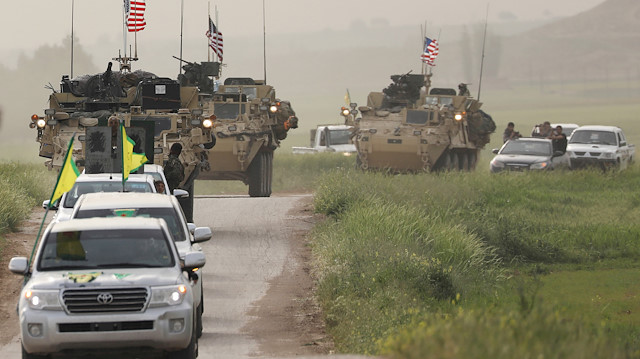
The YPG headd a convoy of U.S military vehicles in the town of Darbasiya next to the Turkish border, Syria April 28, 2017.
Calling the terrorist PYD a legitimate group is "hypocrisy," said the acting chair of Turkey’s ruling party on Thursday.
"It is not understandable for the U.S. to recognize the PYD -- the PKK’s Syrian branch -- as a legitimate organization while the PKK is listed as a terrorist organization by the U.S.,” Numan Kurtulmuş of the ruling Justice and Development (AK) Party told a group of publishers meeting in the capital Ankara.
Discussing the U.S. move this week putting multi-million dollar bounties on three key PKK terrorists, even as it continues to partner with the terrorist PYD, Kurtulmuş said the U.S. knows that there is no difference between the PKK and PYD/YPG.
Turkish and U.S. troops on Thursday conducted their second round of joint patrols in the northern Syrian city of Manbij, as part of a deal to rid the area of the YPG/PKK terrorist group, Turkey's national defense minister announced.Turkish and U.S. troops patrolled around the Saju Stream, which separates the Manbij frontline from the city of Jarabulus, an area falling under Turkey's Operation Euphrates Shield, according to Anadolu Agency reporters on the ground.Turkish and U.S. troops began joints patrols on Nov. 1.Since June 18, the Turkish Armed Forces have carried out 68 unilateral patrols in Manbij.The Manbij deal between Turkey and the U.S. focuses on the withdrawal of YPG/PKK terrorists from the city to stabilize the region, which is in the northeast of northern Syria's Aleppo province.In its more than 30-year terror campaign against Turkey, the PKK -- listed as a terrorist organization by Turkey, the U.S. and the EU -- has been responsible for the death of some 40,000 people, including women and children. The YPG is its Syrian branch.Operation Euphrates Shield, which began in August 2016 and ended in March 2017, aimed to eliminate the terrorist threat along the border in the northern Syrian regions of Jarabulus, Al-Rai, Al-Bab, and Azaz with the use of the Free Syrian Army, backed by Turkish artillery and air cover.
Turkish, US conduct 2nd joint patrols in Manbij, Syria
Turkey has repeatedly objected to U.S. support for the terrorist PKK/PYD as a "reliable ally" in Syria, which has included supplying arms and equipment.
In recent days Turkish officials have stepped up their calls for the U.S. to cut its ties to the terrorist group PYD/YPG.
In its more than 30-year terror campaign against Turkey, the PKK -- listed as a terrorist organization by Turkey, the U.S. and the EU -- has been responsible for the death of some 40,000 people, including women and children. The YPG is its Syrian branch.
The Istanbul Police Department's Counter-Terrorism squads and Intelligence Branch units continue to capture terrorists at “interview rooms” that were formed in 2014 at Atatürk Airport, Sabiha Gökçen Airport and the Grand Istanbul Bus Terminal as part of efforts to prevent people from joining Daesh.Multilingual security personnel, who carry out the interrogations, have been trained on "profiling, risk analysis, monitoring and questioning methods.”According to reports, Turkish counter-terrorism teams have recently started to capture a large number of Kurdistan Workers' Party (PKK) terrorists who seek to escape abroad from Istanbul’s largest bus terminal and airports.On the other hand, the number of Daesh terrorists trying to enter Turkey has decreased.Turkish security forces have been involved in a long-running campaign to thwart Daesh attacks.‘PKK terrorists control 80 pct of drug trade in Europe’More than 300 people have lost their lives in Daesh-claimed attacks in Turkey, where the terror organization has targeted civilians in suicide bomb, rocket and gun attacks.Police have cross-examined more than 3000 foreign suspects in these rooms on suspicion of terrorism in last two years alone.French and British citizens lead the list of foreign suspects who were arrested in connection with terrorism, according to reports.The PKK terrorists who want to escape abroad, mostly head to European countries, particularly Germany and Belgium.The PKK is listed as a terrorist organization by Turkey, the European Union and the United States. The PKK has been conducting armed violence in the southeastern part of Turkey since 1984. More than 40,000 people, mostly civilians, have been killed in the three-decade long conflict.
Airport interview rooms formed for Daesh help nab PKK terrorists in Istanbul
Turkey’s interior minister on Thursday said the PKK terrorist group controls the vast majority of drug trafficking in Europe, earning billions in the process.“Especially in Europe, the PKK controls 80 percent of the drug trade, and it is estimated that the terrorist group earns around $1.5 billion a year,” Süleyman Soylu told a meeting on the war against drugs in the southern Adana province.The terrorist PKK uses its profits from illegal drugs to buy weapons for attacks, he added.On domestic anti-drug efforts, Soylu said Turkey launched 29 percent more operations in the first 10 months of 2018 than the same period last year.Turkey calls on US to end all engagements with PYD/YPGMoreover, in 2017, Turkey launched a total of 70 operations against drug traffickers, versus 68 operations in the first 10 months of 2018, Soylu added.Soylu also accused U.S. support for the terrorist PYD and YPG -- the PKK’s Syrian branches -- of helping to fuel the drug trade."The U.S. giving 5,000, 10,000, 15,000 truckloads of weapons to the PYD” amounts to trying to make Turkey into a transit route for illegal drugs, he said.Calling this terrorism against Turkish civilization, Soylu said the country does not deserve this.Airport interview rooms formed for Daesh help nab PKK terrorists in IstanbulTurkey has repeatedly objected to U.S. support for the terrorist PKK/PYD as a "reliable ally" in Syria, which has included supplying arms and equipment.In recent days Turkish officials have stepped up their calls for the U.S. to cut its ties to the terrorist group PYD/YPG.The PKK is listed as a terrorist organization by Turkey, the U.S. and EU.In its more than 30-year terror campaign against Turkey, it has been responsible for the deaths of some 40,000 people, including women and children. The PYD/YPG are its Syrian branches.
‘PKK terrorists control 80 pct of drug trade in Europe’
Khashoggi and pilgrims
Turning to the killing last month in Istanbul of Saudi journalist Jamal Khashoggi, Kurtulmuş stressed the importance of travelers' safety for the pilgrimage to the Saudi city of Mecca, one of the pillars of Islam.
After entering the Saudi Consulate in Istanbul on Oct. 2, Khashoggi, a Saudi national and columnist for The Washington Post, was strangled and then dismembered, according to the Istanbul Prosecutor’s office.
If someone disappears in the Saudi Consulate, this may give Muslims reason to doubt the safety of pilgrims and isolate Saudi Arabia in the eyes of Muslims, he warned.
So far in 2018, almost 2 million domestic and foreign pilgrims have taken the Hajj pilgrimage.
Even almost 40 days since the killing, pressure on the Saudi government must continue to find out what happened to journalist Jamal Khashoggi, according to an Egyptian journalist and human rights activist.“Actually after more than 40 days it looks like that the international community has forgotten about Jamal Khashoggi’s murder,” Osama Gaweesh told Anadolu Agency on Thursday.Turkey finds traces of acid, chemicals at Saudi consul's residence'Stronger opinion' on Khashoggi case next week: Trump“As we can see, the Jamal news moved from breaking news to daily routine news, and that’s exactly what the Saudis want -- they need time, and this is their bad bet,” he argued.He, added, though, that he believes “we will never ever give up and we have to keep putting pressure on Saudis via media, demonstrations, and demanding answers to three questions:“Where is the body?“Who gave the orders?“Who holds the accountability for this murder?”Khashoggi, a Saudi national and columnist for The Washington Post, disappeared on Oct. 2 after entering the Saudi Consulate in Istanbul to receive paperwork he needed to get married.Once inside, he was immediately strangled and then dismembered, according to the Istanbul Prosecutor’s office.- Khashoggi not forgottenWhile also pressing for answers, Katrin Pribyl, a German journalist, argued to the contrary that “the killing hasn’t been forgotten at all.”Also speaking to Anadolu Agency, Pribyl said: “The world is, rightly so, still shocked by the reported brutality and also the lack of information provided by Saudi Arabia.”“So it’s important and good that there was a review session at the UN this week,” she said.“The questions shouldn’t stop till everyone gets their answers. It seems like Saudi Arabia completely underestimated the worldwide outrage, which the killing of Khashoggi triggered,” she added.Pribyl said the journalistic community had a “very strong reaction to this shocking murder.”Turning to the war in Yemen, just south of Saudi Arabia, Pribyl said the war did not get enough attention before the Khashoggi killing.“It’s good that Saudi Arabia’s role in Yemen came under renewed scrutiny after the Khashoggi murder, as well as any sales links of some Western countries with Saudi Arabia,” she said."Unfortunately many people aren’t aware of the fact that there are lots of investigative or critical journalists all over the world who are persecuted, imprisoned, or killed for doing their job, and their work is systematically hindered," she added.- Journalists' union: 'No impunity'A major journalists’ union in the U.K. earlier this week said governments across the world have a well-stocked toolbox to bring the killers of Khashoggi and the people who ordered it to justice.A National Union of Journalists (NUJ) spokesperson told Anadolu Agency that the union supports the International Federation of Journalists’ call for governments to end their cooperation with the Saudi government until it "tells the truth and arrests the perpetrators."The group reiterated its call on the British government "to ensure there is a full and independent inquiry into the killing" of journalist Khashoggi, the spokesperson said, adding “there must be no impunity.”“All governments can act -- they have economic levers, diplomatic tools, diplomatic tools, and international instruments to seek to bring the killers and those who ordered it to justice,” said an NUJ statement.
'We must keep up pressure on S.Arabia over Khashoggi'
The Turkish investigate team probing the murder of journalist Jamal Khashoggi found traces of hydrofluoric acid and other chemicals inside a well at Saudi Consul General Mohammed al-Otaibi’s house in Istanbul, according to a report by Al Jazeera.Turkey was initially denied permission to search the well at the consul’s residence.A source in the Turkish attorney general’s office conveyed that the killers vaporized the journalist’s dismembered body in acid in one of the rooms at Saudi consul’s residence, the report continued.Mohammad al-Otaibi left Turkey on a commercial flight on Oct .16 before his residence was searched by Turkish police on Oct. 17.Saudi makes $1 bln bid for partnership with S.Africa defence group DenelKhashoggi, a Washington Post columnist and critic of Saudi Arabia's Crown Prince Mohammed bin Salman, was killed inside the Consulate of Saudi Arabia in Istanbul after he went there to obtain documents for his forthcoming marriage.The Saudi government initially insisted Khashoggi had left the consulate, later saying he died in an unplanned "rogue operation". On Oct. 25, the kingdom's public prosecutor Saud Al Mojeb said the attack was premeditated.Istanbul chief prosecutor Irfan Fidan in his turn said that Khashoggi was suffocated as soon as he entered the consulate, and his body then cut up and disposed of. Turkey has demanded cooperation from Saudi officials.Saudis used Israeli spyware to track Khashoggi: Snowden
Turkey finds traces of acid, chemicals at Saudi consul's residence