

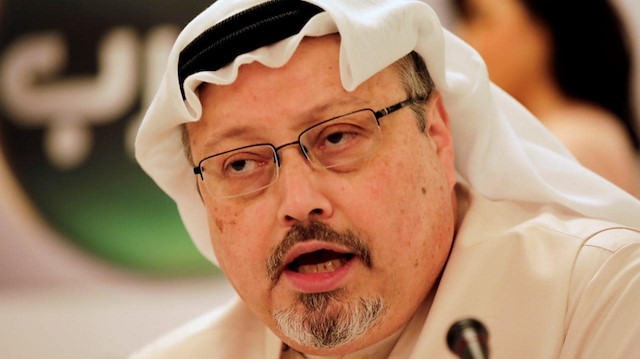
Slain Saudi journalist Jamal Khashoggi
Even almost 40 days since the killing, pressure on the Saudi government must continue to find out what happened to journalist Jamal Khashoggi, according to an Egyptian journalist and human rights activist.
“Actually after more than 40 days it looks like that the international community has forgotten about Jamal Khashoggi’s murder,” Osama Gaweesh told Anadolu Agency on Thursday.
The Turkish investigate team probing the murder of journalist Jamal Khashoggi found traces of hydrofluoric acid and other chemicals inside a well at Saudi Consul General Mohammed al-Otaibi’s house in Istanbul, according to a report by Al Jazeera.Turkey was initially denied permission to search the well at the consul’s residence.A source in the Turkish attorney general’s office conveyed that the killers vaporized the journalist’s dismembered body in acid in one of the rooms at Saudi consul’s residence, the report continued.Mohammad al-Otaibi left Turkey on a commercial flight on Oct .16 before his residence was searched by Turkish police on Oct. 17.Saudi makes $1 bln bid for partnership with S.Africa defence group DenelKhashoggi, a Washington Post columnist and critic of Saudi Arabia's Crown Prince Mohammed bin Salman, was killed inside the Consulate of Saudi Arabia in Istanbul after he went there to obtain documents for his forthcoming marriage.The Saudi government initially insisted Khashoggi had left the consulate, later saying he died in an unplanned "rogue operation". On Oct. 25, the kingdom's public prosecutor Saud Al Mojeb said the attack was premeditated.Istanbul chief prosecutor Irfan Fidan in his turn said that Khashoggi was suffocated as soon as he entered the consulate, and his body then cut up and disposed of. Turkey has demanded cooperation from Saudi officials.Saudis used Israeli spyware to track Khashoggi: Snowden
Turkey finds traces of acid, chemicals at Saudi consul's residence
U.S. President Donald Trump said Wednesday he will have a "stronger opinion" on the killing of journalist Jamal Khashoggi next week.Trump told reporters that the U.S. is working with Turkey and Saudi Arabia to uncover what happened to Khashoggi."I will have a much stronger opinion on that over the next week," Trump said.Khashoggi, a Saudi national and columnist for The Washington Post, was killed Oct. 2 after entering the Saudi Consulate in Istanbul.Khashoggi's legacy should be peace in Yemen: IRCSaudis used Israeli spyware to track Khashoggi: Snowden
'Stronger opinion' on Khashoggi case next week: Trump
“As we can see, the Jamal news moved from breaking news to daily routine news, and that’s exactly what the Saudis want -- they need time, and this is their bad bet,” he argued.
He, added, though, that he believes “we will never ever give up and we have to keep putting pressure on Saudis via media, demonstrations, and demanding answers to three questions:
“Where is the body?
“Who gave the orders?
“Who holds the accountability for this murder?”
Khashoggi, a Saudi national and columnist for The Washington Post, disappeared on Oct. 2 after entering the Saudi Consulate in Istanbul to receive paperwork he needed to get married.
Once inside, he was immediately strangled and then dismembered, according to the Istanbul Prosecutor’s office.
- Khashoggi not forgotten
While also pressing for answers, Katrin Pribyl, a German journalist, argued to the contrary that “the killing hasn’t been forgotten at all.”
Also speaking to Anadolu Agency, Pribyl said: “The world is, rightly so, still shocked by the reported brutality and also the lack of information provided by Saudi Arabia.”
“So it’s important and good that there was a review session at the UN this week,” she said.
“The questions shouldn’t stop till everyone gets their answers. It seems like Saudi Arabia completely underestimated the worldwide outrage, which the killing of Khashoggi triggered,” she added.
Pribyl said the journalistic community had a “very strong reaction to this shocking murder.”
Turning to the war in Yemen, just south of Saudi Arabia, Pribyl said the war did not get enough attention before the Khashoggi killing.
“It’s good that Saudi Arabia’s role in Yemen came under renewed scrutiny after the Khashoggi murder, as well as any sales links of some Western countries with Saudi Arabia,” she said.
"Unfortunately many people aren’t aware of the fact that there are lots of investigative or critical journalists all over the world who are persecuted, imprisoned, or killed for doing their job, and their work is systematically hindered," she added.
- Journalists' union: 'No impunity'
A major journalists’ union in the U.K. earlier this week said governments across the world have a well-stocked toolbox to bring the killers of Khashoggi and the people who ordered it to justice.
A National Union of Journalists (NUJ) spokesperson told Anadolu Agency that the union supports the International Federation of Journalists’ call for governments to end their cooperation with the Saudi government until it "tells the truth and arrests the perpetrators."
The group reiterated its call on the British government "to ensure there is a full and independent inquiry into the killing" of journalist Khashoggi, the spokesperson said, adding “there must be no impunity.”
“All governments can act -- they have economic levers, diplomatic tools, diplomatic tools, and international instruments to seek to bring the killers and those who ordered it to justice,” said an NUJ statement.