

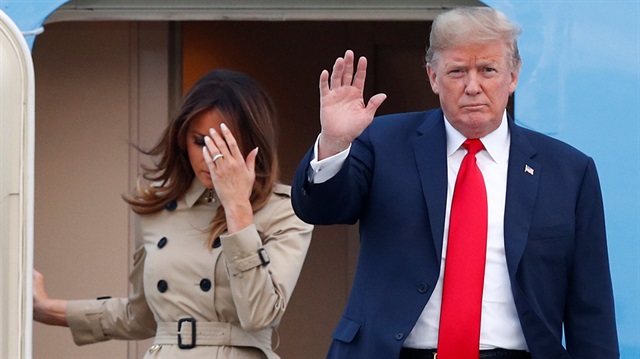
U.S. President Donald Trump and first lady Melania Trump arrive aboard Air Force One ahead of the NATO Summit, at Brussels Military Airport in Melsbroek, Belgium.
President Donald Trump will likely declare U.S. support for NATO’s mutual defense doctrine while pressing for increased spending commitments from NATO allies at a high-stakes summit in Brussels, a senior administration official said on Tuesday.
Trump arrived in Brussels on Tuesday night for what is shaping up to be an unpredictable day of talks on Wednesday with North Atlantic Treaty Organization leaders given his volatile attitude toward allies he believes are not contributing enough to the collective defense.
President Recep Tayyip Erdoğan will attend a meeting of NATO heads of state and government this week in Brussels, the Turkish presidency announced on Tuesday.The summit is set to review steps to adapt NATO to current security threats, as well as exchange views on threats to Euro-Atlantic security, the presidency said in a written statement.A meeting of NATO heads of state and government will be held on Thursday and Friday at the new alliance headquarters in Brussels, Belgium.In a session held with the attendance of Georgia and Ukraine’s heads of state, improving relations between NATO and those countries will be discussed.The alliance is also expected to affirm its support to Afghanistan.The summit is also set to affirm NATO’s “open-door policy” in the Euro-Atlantic region for peace and stability.Erdoğan is expected to held bilateral meetings with his counterparts on the summit's sidelines.
Erdoğan to attend 2-day NATO summit in Brussels
He spent hours on Air Force One on the flight to Brussels debating with aides how to cajole NATO allies into contributing more defense spending to the alliance, the official said.
Shortly before landing, Trump fired off a tweet expressing his frustration.
"Many countries in NATO, which we are expected to defend, are not only short of their current commitment of 2% (which is low), but are also delinquent for many years in payments that have not been made. Will they reimburse the U.S.?" he said in one tweet.
European Council President Donald Tusk told U.S. President Donald Trump on Tuesday to stop berating NATO allies over military investment levels ahead of what is expected to be a fraught alliance summit.Before taking off for Brussels, Trump again chided fellow NATO members for not contributing enough to the alliance while maintaining a trade surplus with the United States, his latest reprimand on issues that are straining transatlantic relations."Dear America, appreciate your allies, after all you don't have that many," Tusk, a former Polish prime minister, said after a signing statement on more cooperation between the European Union and the North Atlantic Treaty Organisation, although he also accepted Europe should spend more on defence.Trump says can't say if Putin is friend or foeMany U.S. presidents have urged European governments to spend more on their militaries. But Trump has intensified the demands to such an extent that allies worry it could damage NATO morale and play into the hands Russian President Vladimir Putin, who they accuse of trying to divide and destabilise the West."Dear President Trump: America does not have, and will not have a better ally than Europe," said Tusk, who chairs summits of EU leaders. "Today, Europeans (collectively) spend on defence many times more than Russia, and as much as China." He said that money went towards both U.S. and European security when the United States regards Russia and China as threats.Trump's tweet on Tuesday echoed earlier posts on Twitter on Monday and his criticism at a rally of supporters in the United States last week, in which he said that Washington was unfairly carrying almost all the cost of defending Europe."Getting ready to leave for Europe. First meeting - NATO. The U.S. is spending many times more than any other country in order to protect them. Not fair to the U.S. taxpayer," Trump said.European officials say while U.S. defence spending makes up 70 percent of combined allied governments' military budgets, just 15 percent of U.S. expenditure is spent in Europe on NATO-related defence. Washington pays about 22 percent of the running cost of NATO, including the headquarters and commonly-funded equipment such as AWACS surveillance planes."On top of that we lose $151 Billion on Trade with the European Union. Charge us big Tariffs (& Barriers)!" Trump also said in the same tweet.EU and U.S. government data put the U.S. trade deficit with the EU at around $100 billion, including services such as finance, where the United States has a surplus. EU officials also say most tariffs on U.S. goods are already low to zero. 
EU's Tusk's riposte to Trump: respect the allies you have
Under a 2014 agreement, each member state is required to boost military spending to 2 percent of its gross domestic product by 2024. But NATO diplomats say only two-thirds of the 28 allies, excluding the United States, have a realistic plan to hit that level by then. The United States spent 3.57 percent of GDP on defense in 2017.
Still, the administration official said, Trump would likely reiterate U.S. support for the NATO treaty's Article 5, a provision that means an attack against one ally is considered an attack against all of them.
Trump alarmed allies during a visit to Brussels last year when he did not specifically mention U.S. backing for Article 5, but aides said later that U.S. support was assumed and did not have to be mentioned.
The official said Trump was going into the NATO summit looking for commitments from allies to increase their defense spending and that his reaction was dependent on “how the morning goes” in his initial meetings with NATO leaders.
"You can expect to hear a lot about that – other countries taking on a bigger role and doing more," the official said.
MEETINGS WITH MAY, PUTIN
After his meeting with NATO leaders, Trump is scheduled to visit London for talks with British Prime Minister Theresa May, days after her Cabinet was hit by two major resignations over the Brexit issue. He will then sit down next Monday in Helsinki for talks with Russian President Vladimir Putin, who U.S. officials believe would like to exploit divisions within NATO.
Donald Trump and Vladimir Putin will sit down in a room together in the Finnish capital on July 16 for their first summit meeting.The U.S. president's spontaneous approach to negotiations, and the inscrutable style of the Kremlin leader, make predicting the outcome of the summit with any accuracy close to impossible.We do however, have a reasonable idea of the issues the two leaders and their aides will have mapped out before the meeting: the areas where they each want something from their counterpart, and the places they are willing to give ground.Below are the issues likely to figure:ARMS RACE RHETORICBoth Trump and Putin have been using bellicose rhetoric about their nuclear arsenals, drawing their countries closer to a new arms race. Trump has said the U.S. nuclear capability needs renewing. He told Reuters last year, "if countries are going to have nukes, we’re going to be at the top of the pack." Putin in March this year unveiled an array of new nuclear weapons, and warned Western governments "now they need to take account of a new reality." An arms race would be dangerous and expensive for both sides. An agreement to scale back the rhetoric would be a win for both Putin and Trump. Progress towards extending the New Start arms treaty, which expires in 2021, would give substance to that agreement.US begins implementing tariffs on ChinaSANCTIONS RELIEFPutin would like Trump to soften sanctions that Washington imposed over the annexation of Ukraine's Crimea region and backing for separatists in eastern Ukraine, involvement in the Syrian civil war and allegations of Russian meddling in the U.S. elections in 2016. While a 2017 law bars Trump from easing many sanctions without Congress’ approval, he can offer some relief without a nod from Congress. The Republican president, who did not want to sign the law and has missed several deadlines for imposing sanctions included in it, could send a signal that the administration does not plan to expand the list of Russian firms and individuals subject to economic and travel restrictions. That would unfreeze much-needed investment and lending from international investors who, at the moment, are reluctant to commit to Russia for fear of the sanctions’ impact. SYRIAN DEALWashington ally Israel is anxious that, with the conflict in Syria entering its end game, Iranian and Iran-backed forces will be left gathered around Israel's borders. At the summit, Trump may ask Putin, the most powerful outside player in Syria since Russia's military intervention there, to use his influence with Tehran to curb Iran's military presence. This would be tough to deliver for Putin: it would risk a rupture with his allies in Tehran, and could leave Russian forces having to do the lion's share of the remaining fighting in Syria, a burden that Moscow does not want to shoulder.Iran to maintain military presence in SyriaDIPLOMATIC TIT-FOR-TATRussia's diplomatic presence in the United States, and the U.S. missions in Russia, are depleted after two rounds of tit-for-tat diplomatic expulsions in the past two years. The first was over alleged Russian meddling in the U.S. election, and the second, this year, was in response to the poisoning in England of former Russian spy Sergei Skripal and his daughter. Putin and Trump could agree in Helsinki to restore the full complement of diplomatic staff. That would not change the substance of the U.S.-Russia relationship, but it would be a symbol of a new start. RUSSIA'S BACKYARDSince Russia's annexation of Crimea in 2014, the NATO alliance has stepped up military exercises in eastern Europe. The aim, according to NATO leaders, is to reassure alliance members who fear a Russian incursion. That has angered Russia. It says NATO is bearing down on its backyard. The Kremlin has likened it to Russia stationing missiles in Mexico. If Trump scaled back the exercises, that would be a big win for Putin. Two senior NATO diplomats told Reuters they are prepared for a worst-case scenario that Trump would announce a freeze on U.S. military exercises or withdraw troops from the Baltics in a gesture to Putin. At the NATO summit in Brussels that precedes Helsinki, NATO states will seek Trump's assurances that he will stand firm on the exercises.Erdoğan to attend NATO meeting in BrusselsUKRAINIAN ALLYWashington has stood by Ukraine's pro-Western leaders in their stand-off with Russia. That has included the United States providing Kiev with hundreds of millions of dollars worth of military aid. Helsinki would be a triumph for Putin if he persuaded Trump to drop that military aid. Ukrainian officials say they have assurances from Trump aides he won't do this, but acknowledge anything can happen when Trump and Putin are in a room together. In return, the Russian leader could make concessions over eastern Ukraine, where pro-Moscow separatists control swathes of territory. Diplomats say there is a deal to be done allowing armed international peacekeepers to patrol the area. However, Putin will not contemplate any concessions over Crimea.
The issues on the table when Trump and Putin meet
"So I have NATO, I have the UK, which is in somewhat turmoil, and I have Putin. Frankly, Putin may be the easiest of them all. Who would think?" Trump told reporters in Washington before departing.
Many members of Congress, including some of Trump's fellow Republicans, have sought to reassure allies nervous about some of Trump's statements, that there is still strong support in Washington for traditional allies like the country's NATO partners.
U.S. Senator Bob Corker of Tennessee, a Republican who chairs the Senate Foreign Relations Committee, said he hoped Trump avoided a repeat of his G7 summit in Quebec City, when his demands on reducing trade surpluses with the United States prompted a bitter debate with allies.
“I hope that the right signals are sent to NATO in advance. I hope that nothing like what happened at G7 occurs,” Corker told Reuters.