

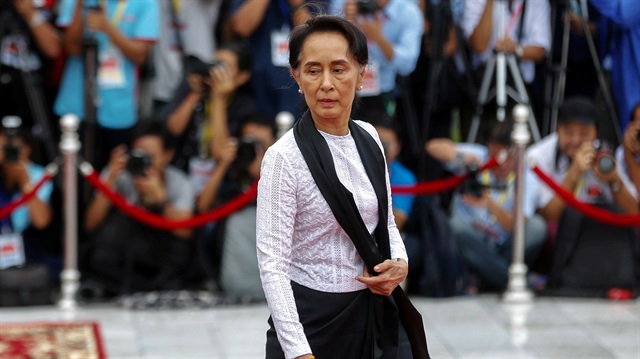
Aung San Suu Kyi
Watching YouTube Myanmar State Counsellor’s 43rd Singapore lecture -- 1-hour lecture including the questions and answers – entitled, “Democratic Transition in Myanmar: Challenges and the Way Forward,” left me deeply disturbed, pained and outraged.
The degree of her delusions, distortions and concoctions made me realize that my fellow Burmese dissident has become nothing more than the most polished mouth piece for her former captors, namely the murderous military regime.
Aung San Suu Kyi wasn’t simply one dissident leader among several potential leaders of significance that I, like millions of other Burmese Buddhists, supported in those long years of vibrant anti-dictatorship opposition after the nationwide uprisings of 1988.
My sentimental ties to Aung San family is more personal and goes far deeper.
One late great uncle of mine was her father’s next-door neighbor, class mate and a friend at Pegu Hall (dormitory) when both were young undergraduates who hailed together from the Buddhist heartland of the then Upper Burma to study Pali, literature, law, etc. at the colonial Rangoon University in the early 1930’s.
It's been one year since the mass fleeing of Rohingya Muslims into Bangladesh. Will they ever go back?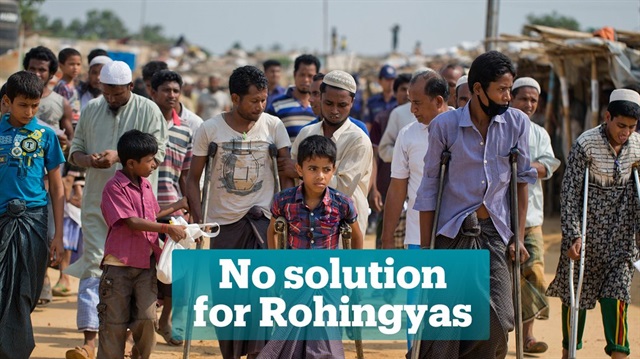
Will the Rohingyas ever go back home?
Through my relative’s first-hand accounts of Aung San, the anti-colonial revolutionary and founder of Burma Independence Army under WWII Japan’s fascist patronage, as well as my own study of the slain national hero’s voluminous speeches and writings, I have developed a lifelong admiration for the man’s strength of character, integrity, Marxist-influenced non-racialism and unwavering sense of service to the oppressed of colonial Burma, not just Buddhists nor the majority Burmans or Bama, but all people who considered Burma their home.
In fact, in my high school days in Mandalay of 1970’s I learned the worthy English phrase “love of truth” from one of his writings wherein he pointedly said as a father he wanted to instill the love of truth in his three children.
While Bangladesh and Myanmar blame each other for a stalled repatriation process, Rohingya Muslim refugees have continued to suffer in tiny makeshift camps in southeastern Bangladesh.It has been one year since the ethnic minority Rohingya faced massacres by the military beginning Aug. 25, 2017, and fled to Bangladesh. But they have been living in poor in refugee camps in Cox's Bazar with little hope returning home.The issue of repatriation has existed in only official statements and official visits between Bangladesh and Myanmar.Video: Will the Rohingyas ever go back home?Dhaka and Yangon inked a deal last year to repatriate hundreds of thousands of Rohingya following the military crackdown in the western Rakhine state of Myanmar.The deal was sharply criticized by the international community, rights groups and Rohingya organizations, but officials from Myanmar and Bangladesh voiced their determination for repatriation.According to the deal signed Nov. 23, 2017, the repatriation would be launched within two months of the agreement.Korean NGOs mark Rohingya Genocide Remembrance DayRohingya mourn first anniversary of Rakhine massacreCanada to host Rohingya genocide remembrance eventsBut there are has been no notable steps from the either side despite a recent visit to Yangon by Bangladeshi Foreign Minister A.H. Mahmood Ali.Dhaka claimed the trip was “fruitful” but experts on the Rohingya issue said Ali returned home empty-handed.Both countries formed a joint working group of 15 officials each to oversee the repatriation process.The first meeting was in Nay Pyi Daw, Myanmar, on Jan. 15-16.Bangladesh authorities repeatedly stressed Rohingya repatriation would be launched in due time. Several meetings were held with not much movement on the fate of what the UN calls the most persecuted people in the world.However, Bangladeshi Finance Minister Abul Maal Abdul Muhit openly voiced clear doubt about the repatriation process. On March 6, Muhit told reporters, “I do not believe the Rohingya can be sent back.”His statement was echoed by Rohingya experts and several advocacy groups across the globe. A total of 23 Rohingya organizations released a statement June 10, voicing criticism of the deal and said it did not address the root causes of the Rohingya crisis, particularly Rohingya citizenship and ethnic identity.“Repatriation is a life and death question for the whole Rohingya people," the groups said, adding they could not trust the Myanmar government and military that have killed, raped and starved its people with hundreds of villages razed, seized land and homes bulldozed.- 'Myanmar delayed repatriation process'Mohammed Abul Kalam Azad, commissioner of the Rohingya Relief and Repatriation Commission (RRRC) told Anadolu Agency on Saturday in Cox’s Bazar that the repatriation process was delayed due to Myanmar government’s reluctance on the issue."Myanmar has built some camps in the Rakhine state for the Rohingya who would return, Azad said. “But Rohingya told us that if they had to stay in camps after their return to Myanmar, they would prefer to stay here in Cox’s Bazar.”Moreover, their safety, basic rights, freedom of movement should be ensured, he added. “It is very unfortunate that a leader like [Aung San] Suu Kyi make falsified statements against Bangladesh to cover-up their own failure and shortage,” said Azad. The Myanmar leader on Tuesday blamed Bangladesh for the delay in repatriations process, stating it was up to Bangladesh to decide how quickly Rohingya refugees would return to Myanmar. "The returnees have to be sent back by Bangladesh. We can only welcome them at the border," Suu Kyi said at an event in Singapore.- Rohingya demands safety and identity Azad, however, thinks it is the Myanmar government who must ensure the safety and dignity of the Rohingya for their return."Both countries had agreed that the repatriation would be permanent, in a safe way and voluntarily," Azad said, highlighting that Bangladesh would not send them forcibly.Pointing to a recent tour of Myanmar by a Bangladesh delegation led by Foreign Minister Ali, Azad said Myanmar promised to renovate some villages for Rohingya without giving a time frame. “During the visit, they told us that they had initially selected 42 villages in which they will build houses for Rohingya. That means they will rebuild those villages. They also shared plans for supporting farmers, as well as providing other benefits. But they did not tell anything about when the implementation process will be started.”Rohingya living in poor conditions in camps said they would stay where they are rather that return to Myanmar "if our life safety and identity is not ensured". "If they do not give us basic rights and identity of Rohingya, we would prefer to die here in Bangladesh camps with limited access to livelihood," said Mohammad Yunus, a 50-year-old father of two daughters. - Persecuted RohingyaSince Aug. 25, 2017, more than 24,000 Rohingya Muslims have been killed by Myanmar’s state forces, according to the Ontario International Development Agency (OIDA).In its recent report, Forced Migration of Rohingya: The Untold Experience, the OIDA increased the estimated number of murdered Rohingya to 23,962 (±881) from an earlier Doctors Without Borders figure of 9,400.More than 34,000 Rohingya were also thrown into fires, while over 114,000 others were beaten, the OIDA report said, adding that 17,718 (±780) Rohingya women and girls were raped by the Myanmar army and police. More than 115,000 Rohingya houses were burned and 113,000 others were vandalized, it added.According to Amnesty International, more than 750,000 Rohingya refugees, mostly children and women, have fled Myanmar and crossed into Bangladesh after Myanmar forces launched a crackdown on the minority Muslim community.The Rohingya, described by the UN as the world's most persecuted people, have faced heightened fears of attack since dozens were killed in communal violence in 2012.The UN documented mass gang rapes, killings -- including of infants and young children -- brutal beatings, and disappearances committed by Myanmar state forces. In its report, UN investigators said such violations may have constituted crimes against humanity. * Mutasim Billah from Cox's Bazar, Bangladesh contributed to story.
Rohingya languish as repatriation process linger
Rohingya refugees in makeshift camps in southeastern Bangladesh are recalling their plight on the first anniversary of Myanmar’s brutal crackdown on the Muslim minority group in the Rakhine state.More than 750,000 refugees, mostly children and women, fled Myanmar and crossed into Bangladesh after military forces launched a crackdown on the minority Muslim community on Aug. 25, 2017.Amena Khatun, 45, told Anadolu Agency of the horrific attack on her family.Video: Will the Rohingyas ever go back home?"They killed my elder son in front of my eyes while they burnt my house and took away our cows," Khatun said. She lost everything but keeps hope for returning home in Myanmar."This is not my country. They give us shelter, food but we want to live on our own land," she said but acknowledged she does not know when repatriations would begin and how the process would continue.She said she did not want to go to refugee camps or concentration camps in Rakhine state under the strict control of Myanmar.Similar fears have gripped hundreds of thousands Rohingya in Bangladesh as the crackdown on Rohingya was underway in Myanmar one year since the horrific attacks begun.The crackdown on Rohingya civilians was launched following a series of attacks allegedly carried out by Arakan Rohingya Salvation Army (ARSA) on 24 police stations and outpost in Muangdaw district in northern Rakhine state.ARSA claimed the attacks were in response to raids, murders and looting by soldiers who were deployed to the area following the deaths of seven villagers in early August.The government continued its brutality despite growing concern and condemnation from across the world.The military operation saw civilians burned alive, murders -- including women and children – and open fire on civilians who tried to flee to border areas.Turkey was amongst the first countries to condemn the attack on civilians and it demanded the UN, the UNSC and international community take action against the “genocide-reminiscent massacres”.Turkish President Recep Tayyip Erdogan was the first head of state to condemn the massacres.He accused that the world of being “blind and deaf” to the situation in Rakhine state.A day later, then-UN High Commissioner for Human Rights Zeid Ra’ad al-Hussein called on Bangladesh to open the border.UN Secretary General Antonio Guterres urged Myanmar to grant access to humanitarian agencies following reports of mass civilian casualties following raids by security forces against Rohingya.Turkish Foreign Minister Mevlut Cavusoglu vowed to support Bangladesh on the Rohingya issue in humanitarian aid aspects and in the international arena.Shortly after Cavusoglu’s declaration, Bangladesh Prime Minister Sheikh Hasina ordered his border open to Rohingya and deployed the military for ensuring safety and order in the Cox’s Bazar area, where Rohingya were placed.Turkish first lady Emine Erdogan visited Rohingya refugees in southern Bangladesh, drawing global attention to the state persecution in Rakhine state and the suffering of refugees in the camps.On the same day, Turkish Cooperation and Coordination Agency (TIKA) managed to get permission from Myanmar to distribute 1,000 tons of aid to Rohingya Muslims in Rakhine state.TIKA was also the first aid agency to distribute aid among Rohingya refugees in Bangladesh’s Cox’s Bazar.However, Myanmar’s military did not stop its brutality but increased attacks by burning hundreds of villages.Human Rights Watch conducted an analysis of satellite imagery, counting at least 200 villages burned in the offensive, with the United Nations calling it “a textbook example of ethnic cleansing.”The local and international community extended helping hands to the refugees as stories of brutality against the Rohingya had been revealing by the newly arriving people from Myanmar.Turkey was in the forefront of Rohingya issue on the ground with its state-sponsored humanitarian aid institutions and nongovernmental charity organization as well as on international level by organizing emergency meeting of the Organization of the Islamic Cooperation (OIC) and advocating for Rohingya at the UN General Assembly.Former Turkish Prime Minister Binali Yildirim visited Rohingya camps in Cox's Bazar, launching a 50-bed field hospital last December.Bangladesh and Myanmar signed a deal last November to facilitate the safe return of Rohingya to Rakhine state despite concern about their safety and basic freedom under current conditions.Although Rohingya repatriation process is not on the horizon, the November 2017 deal was an agreement documenting Myanmar government willing to take its citizen back.More than 24,000 Rohingya Muslims have been killed by Myanmar’s state forces, according to the Ontario International Development Agency (OIDA).In its recent report, Forced Migration of Rohingya: The Untold Experience, the OIDA increased the estimated number of murdered Rohingya to 23,962 (±881) from an earlier Doctors Without Borders figure of 9,400.More than 34,000 Rohingya were also thrown into fires, while over 114,000 others were beaten, the OIDA report said, adding that 17,718 (±780) Rohingya women and girls were raped by the Myanmar army and police. More than 115,000 Rohingya houses were burned and 113,000 others were vandalized, it added.According to Amnesty International, more than 750,000 Rohingya refugees, mostly children and women, have fled Myanmar and crossed into Bangladesh after Myanmar forces launched a crackdown on the minority Muslim community.The Rohingya, described by the UN as the world's most persecuted people, have faced heightened fears of attack since dozens were killed in communal violence in 2012.The UN documented mass gang rapes, killings -- including of infants and young children -- brutal beatings, and disappearances committed by Myanmar state forces. In its report, UN investigators said such violations may have constituted crimes against humanity.
Rohingya mourn first anniversary of Rakhine massacre
So, when I watched Suu Kyi’s speech act performed at the Grand Hyatt in Singapore, available on YouTube, I noted with deep pains and rage that my hero’s world famous, or infamous, daughter packed lie after lie – all verifiable – in her prepared lecture, which she proceeded to deliver with a straight face.
Suu Kyi’s Singapore lecture August 22 was a speech her own martyred father would most definitely feel so ashamed about.
Two years since Suu Kyi’s assumption of her self-declared ‘Above-the-President’ office as State Counsellor with her reportedly autocratic control over all ministries save the security-related ministries such as Home Affairs, Defense and Border Affairs, her leadership is noted only for serial failures.
The commissions she has formed to address the country’s defining problem -- crimes against Rohingyas -- have become a butt of international jokes. As the country’s most revered politician since her father’s murder in 1947, Suu Kyi has been unable to deliver on every one of the party’s official major priorities: “rule of law, peace, development, amendments to the Constitution”.
And yet in the lecture, the NLD leader served up the typically democracy-indifferent and docile Singaporean audience a rose-tinted view of her leadership and governmental performance, which the official hosts on the panel dutifully clapped and heaped praise on.
For someone who grew up under General Ne Win’s “Burmese Way to Socialism” (1962-1988), Suu Kyi’s speech sounded more like a typical party General Secretary’s report to the Socialist Polit Bureau presided over by Chairman (despot) Ne Win in the 1960’s and 1970’s.
The State Counsellor in her own words: “In each of the three panglong (peace) meetings held over the last two years, we made valuable progress. in the First Union Peace Conference, a seven-step roadmap for peace and national reconciliation was achieved. In the Second Conference, 37 principles were adopted. Before the Third Conference, two more ethnic armed groups signed the ceasefire agreement and during the Conference itself, 1``4 more principles were adopted.”
Not only her words are unpersuasive and uncorroborated by the harsh realities of Myanmar ethnic minorities, particularly more than 100,000 Kachin war refugees in the country’s eastern and northern border regions but the world of Myanmar watchers who actually set their foot in these conflict zones offer an assessment radically different from Ms. Suu Kyi’s. Virtually all news reports and field studies about the Burmese military’s internal colonial war of pacification note not only the regression of the country’s peace process under Suu Kyi’s incompetent and failing leadership, typically rich in rhetoric and empty of substance, but also the disappearance of the so-called democratic space even for the ethnically dominant Burman Buddhist public.
That “democratic space” was deliberately allowed by the quasi-democratic regime former General Thein Sein in 2010 designed to tango with the Barack Obama-Hillary Clinton administration as the generals sought to rebalance the military’s overreliance on the increasingly aggressive and invasive China in the Burmese affairs.
The emerging, if belated wisdom in Washington is that the Obama’s Myanmar embracement policy, once held up as one of his signature achievements emboldened, sped up and facilitated the genocidal destruction of Rohingya people.
Under Suu Kyi’s leadership, Myanmar now faces a growing chorus of international calls for the Security Council for the International Criminal Court referral for international crimes in Western Myanmar state of Rakhine, irrespective of whether such calls will bear fruit. Suu Kyi stands accused, with good reasons, of culpability and complicity in the military’s crimes against humanity and even genocide against Rohingya people.
It is matters pertaining to Rohingya persecution -- which my researcher colleague Natalie Brinham and I call “the slow burning genocide,” because of its decades-long nature -- on which Suu Kyi’s speech act morphed from detectable delusions into deliberate distortions.
With no basis in reality, Suu Kyi boasted of having implemented most of the Kofi Annan Commission recommendations, thus: “(t)he recommendations of Dr. Kofi Annan’s Commission, 88 in all, of which we have to date implemented 81, aim at the establishment of lasting peace and stability in Rakhine.”
Kofi Annan is no more to do the fact-checking. But former ambassador Laetitia van den Assum, one of his fellow Rakhine Commission members, is still alive to know the untruths, nah, outright lies of Ms. Suu Kyi. Van den Assum tweeted “The underlying reasons for their (Rohingyas’) flight remain unaddressed”. The tweet, which can be seen at https://twitter.com/lvandenassum/status/1032527791303139328, came on the eve of the one year anniversary of Myanmar’s large scale military attacks on the unarmed and peaceful Rohingyas in more than 300 villages across northern Rakhine region.
As a researcher who has spent the last six years concentrating on my own country’s decades-long, state-directed persecution of Rohingyas, I find it morally repugnant and empirically false Suu Kyi’s disingenuous framing of the largest refugee crisis her military partners in power have created as initially “terror”-related.
She in effect added insult to the collective injury of the nearly 2 million Rohingya survivors, internally displaced inside Myanmar, internationally deported across the border to Bangladesh, or the diaspora, when she said, “the danger of terrorist activities, which was the initial cause of events leading to the humanitarian crisis in Rakhine, remains real and present today. Unless this security challenge is addressed, the risk of inter-communal violence will remain.”
Suu Kyi words echo how Myanmar military has long framed the Rohingyas -- a threat to security -- and justified their institutionalized killings of the latter.
For the first 15 years since the country’s popular uprisings in 1988, I had been one of the most hard-working and effective foot soldiers for Suu Kyi in her international campaigns to ostracize and punish Myanmar military leaders.
I have studied closely Suu Kyi’s leadership and poured over every speech of hers, over the last 30 years since she first parachuted onto the Burmese political stage as “the daughter of General Aung San,” as she put it.
Painfully, I have concluded that the daughter of my nationalist hero is no longer part of Myanmar’s solution. For she has for all intents and purposes morphed into the most polished mouthpiece of the military perpetrators.
Suu Kyi even had the audacity to call three generals in her Cabinet “rather sweet” amidst international calls to haul Myanmar generals to the International Criminal Court.
On Aug. 25, 700,000-plus Rohingya survivors of Myanmar genocide in 35 camps in Kutupalong meet to mourn, memorialize and honor loved ones who were senselessly maimed, mass-raped, slaughtered and burned alive a year ago. The least the world, both grassroots communities and governments, could do is to drop the decades-old policy delusions, globally, that Suu Kyi represents hope, liberty and liberalism.
As a Burmese, a dominant Bama, Buddhist from an extended military family at that, I will say for the record Myanmar’s State Counsellor no longer speaks for me.
Nor does she represent the humanistic values which I learned to embrace through her father’s writings. I know for a fact that there are fellow dissidents inside Myanmar, however small their numbers, who share my categorical rejection of Suu Kyi and her military partners in crimes.
Let’s remember Rohingya victims today. And let’s reject false messiahs of Myanmar, starting with Aung San Suu Kyi.