

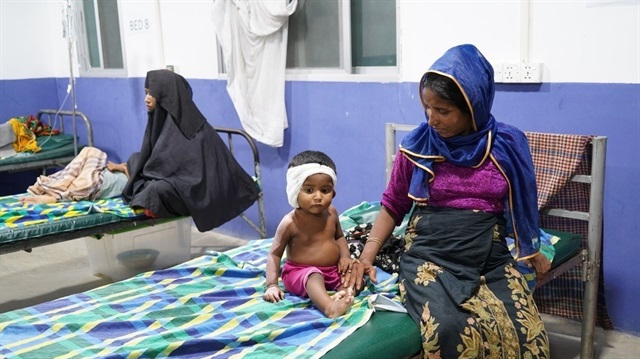
File photo
While Bangladesh and Myanmar blame each other for a stalled repatriation process, Rohingya Muslim refugees have continued to suffer in tiny makeshift camps in southeastern Bangladesh.
It has been one year since the ethnic minority Rohingya faced massacres by the military beginning Aug. 25, 2017, and fled to Bangladesh. But they have been living in poor in refugee camps in Cox's Bazar with little hope returning home.
The issue of repatriation has existed in only official statements and official visits between Bangladesh and Myanmar.
It's been one year since the mass fleeing of Rohingya Muslims into Bangladesh. Will they ever go back?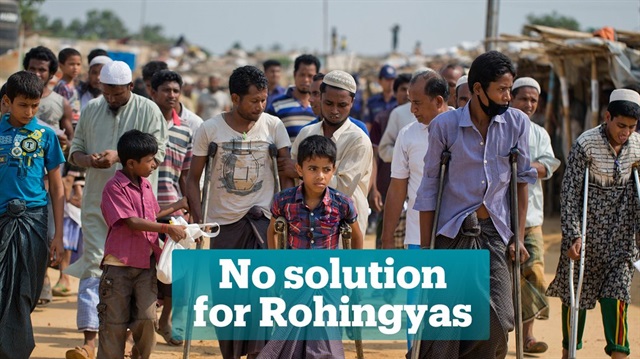
Will the Rohingyas ever go back home?
Dhaka and Yangon inked a deal last year to repatriate hundreds of thousands of Rohingya following the military crackdown in the western Rakhine state of Myanmar.
The deal was sharply criticized by the international community, rights groups and Rohingya organizations, but officials from Myanmar and Bangladesh voiced their determination for repatriation.
According to the deal signed Nov. 23, 2017, the repatriation would be launched within two months of the agreement.
A group of South Korean organizations voiced support for Rohingya refugees Friday by demanding Myanmar guarantee safe return for the world’s most persecuted community who took shelter in neighboring Bangladesh.South Korean activists gathered in front of the Myanmar embassy in Seoul to express solidarity with refugees on Rohingya Genocide Remembrance Day.In a written statement, the Korean Civil Society said it organized the protest “to honor victims killed by Myanmar government last year and to band together with the most persecuted people who have been denied the right to call ‘Rohingya’ themselves.”Video: Will the Rohingyas ever go back home?On Aug. 25, 2017, Myanmar launched a major military crackdown on the Muslim ethnic minority, killing 25,000 civilians and forcing 750,000 others to flee to Bangladesh.The Korean Civil Society, a group of 32 Korean organizations, called attention to “the fact that the Myanmar government has for a long time maintained a broad and systematic way of collective violence, deportation and legal and institutional discrimination against the Rohingya people”.The statement criticized the “organized genocide” and “typical ethnic cleansing” by the government of Aung San Suu Kyi who is a Nobel Peace Prize laureate.Mentioning Rohingya people’s right to return home, the group urged “the Myanmar government to guarantee their voluntary, safe and dignified return”.South Korean NGOs demanded independent investigations into the Rohingya genocide, unrestricted access of international media and human rights group to the area.They also called on Myanmar to acknowledge “Rohingya as indigenous people and give them the citizenship” while demanding the UN Security Council “submit the case of the genocide to the International Criminal Court”.“The Myanmar government should ensure voluntary, safe and dignified return of all the refugees, and ensure active participation in the repatriation discussion,” according to the statement and the group urged its own government to extend a helping hand to Rohingya refugees.- Persecuted RohingyaSince Aug. 25, 2017, more than 24,000 Rohingya Muslims have been killed by Myanmar’s state forces, according to the Ontario International Development Agency (OIDA).In its recent report, Forced Migration of Rohingya: The Untold Experience, the OIDA increased the estimated number of murdered Rohingya to 23,962 (±881) from an earlier Doctors Without Borders figure of 9,400.More than 34,000 Rohingya were also thrown into fires, while over 114,000 others were beaten, the OIDA report said, adding that 17,718 (±780) Rohingya women and girls were raped by the Myanmar army and police. More than 115,000 Rohingya houses were burned and 113,000 others were vandalized, it added.According to Amnesty International, more than 750,000 Rohingya refugees, mostly children and women, have fled Myanmar and crossed into Bangladesh after Myanmar forces launched a crackdown on the minority Muslim community.The Rohingya, described by the UN as the world's most persecuted people, have faced heightened fears of attack since dozens were killed in communal violence in 2012.The UN documented mass gang rapes, killings -- including of infants and young children -- brutal beatings, and disappearances committed by Myanmar state forces. In its report, UN investigators said such violations may have constituted crimes against humanity.
Korean NGOs mark Rohingya Genocide Remembrance Day
Rohingya refugees in makeshift camps in southeastern Bangladesh are recalling their plight on the first anniversary of Myanmar’s brutal crackdown on the Muslim minority group in the Rakhine state.More than 750,000 refugees, mostly children and women, fled Myanmar and crossed into Bangladesh after military forces launched a crackdown on the minority Muslim community on Aug. 25, 2017.Amena Khatun, 45, told Anadolu Agency of the horrific attack on her family.Video: Will the Rohingyas ever go back home?"They killed my elder son in front of my eyes while they burnt my house and took away our cows," Khatun said. She lost everything but keeps hope for returning home in Myanmar."This is not my country. They give us shelter, food but we want to live on our own land," she said but acknowledged she does not know when repatriations would begin and how the process would continue.She said she did not want to go to refugee camps or concentration camps in Rakhine state under the strict control of Myanmar.Similar fears have gripped hundreds of thousands Rohingya in Bangladesh as the crackdown on Rohingya was underway in Myanmar one year since the horrific attacks begun.The crackdown on Rohingya civilians was launched following a series of attacks allegedly carried out by Arakan Rohingya Salvation Army (ARSA) on 24 police stations and outpost in Muangdaw district in northern Rakhine state.ARSA claimed the attacks were in response to raids, murders and looting by soldiers who were deployed to the area following the deaths of seven villagers in early August.The government continued its brutality despite growing concern and condemnation from across the world.The military operation saw civilians burned alive, murders -- including women and children – and open fire on civilians who tried to flee to border areas.Turkey was amongst the first countries to condemn the attack on civilians and it demanded the UN, the UNSC and international community take action against the “genocide-reminiscent massacres”.Turkish President Recep Tayyip Erdogan was the first head of state to condemn the massacres.He accused that the world of being “blind and deaf” to the situation in Rakhine state.A day later, then-UN High Commissioner for Human Rights Zeid Ra’ad al-Hussein called on Bangladesh to open the border.UN Secretary General Antonio Guterres urged Myanmar to grant access to humanitarian agencies following reports of mass civilian casualties following raids by security forces against Rohingya.Turkish Foreign Minister Mevlut Cavusoglu vowed to support Bangladesh on the Rohingya issue in humanitarian aid aspects and in the international arena.Shortly after Cavusoglu’s declaration, Bangladesh Prime Minister Sheikh Hasina ordered his border open to Rohingya and deployed the military for ensuring safety and order in the Cox’s Bazar area, where Rohingya were placed.Turkish first lady Emine Erdogan visited Rohingya refugees in southern Bangladesh, drawing global attention to the state persecution in Rakhine state and the suffering of refugees in the camps.On the same day, Turkish Cooperation and Coordination Agency (TIKA) managed to get permission from Myanmar to distribute 1,000 tons of aid to Rohingya Muslims in Rakhine state.TIKA was also the first aid agency to distribute aid among Rohingya refugees in Bangladesh’s Cox’s Bazar.However, Myanmar’s military did not stop its brutality but increased attacks by burning hundreds of villages.Human Rights Watch conducted an analysis of satellite imagery, counting at least 200 villages burned in the offensive, with the United Nations calling it “a textbook example of ethnic cleansing.”The local and international community extended helping hands to the refugees as stories of brutality against the Rohingya had been revealing by the newly arriving people from Myanmar.Turkey was in the forefront of Rohingya issue on the ground with its state-sponsored humanitarian aid institutions and nongovernmental charity organization as well as on international level by organizing emergency meeting of the Organization of the Islamic Cooperation (OIC) and advocating for Rohingya at the UN General Assembly.Former Turkish Prime Minister Binali Yildirim visited Rohingya camps in Cox's Bazar, launching a 50-bed field hospital last December.Bangladesh and Myanmar signed a deal last November to facilitate the safe return of Rohingya to Rakhine state despite concern about their safety and basic freedom under current conditions.Although Rohingya repatriation process is not on the horizon, the November 2017 deal was an agreement documenting Myanmar government willing to take its citizen back.More than 24,000 Rohingya Muslims have been killed by Myanmar’s state forces, according to the Ontario International Development Agency (OIDA).In its recent report, Forced Migration of Rohingya: The Untold Experience, the OIDA increased the estimated number of murdered Rohingya to 23,962 (±881) from an earlier Doctors Without Borders figure of 9,400.More than 34,000 Rohingya were also thrown into fires, while over 114,000 others were beaten, the OIDA report said, adding that 17,718 (±780) Rohingya women and girls were raped by the Myanmar army and police. More than 115,000 Rohingya houses were burned and 113,000 others were vandalized, it added.According to Amnesty International, more than 750,000 Rohingya refugees, mostly children and women, have fled Myanmar and crossed into Bangladesh after Myanmar forces launched a crackdown on the minority Muslim community.The Rohingya, described by the UN as the world's most persecuted people, have faced heightened fears of attack since dozens were killed in communal violence in 2012.The UN documented mass gang rapes, killings -- including of infants and young children -- brutal beatings, and disappearances committed by Myanmar state forces. In its report, UN investigators said such violations may have constituted crimes against humanity.
Rohingya mourn first anniversary of Rakhine massacre
Canadians and much of the world will stand in solidarity Saturday with “the world’s most persecuted minority” while marking the first global Rohingya Genocide Remembrance Day.It was Aug. 25, 2017 when the Myanmar military, aided and abetted by the majority Buddhist population, systematically began what the United Nations and others have termed “ethnic cleansing” of the minority Muslim Rohingya. The violence against the Rohingya has been going on for decades, but Aug. 25 marked a new and more bloody chapter in atrocities in Myanmar's Rakhine state.According to Amnesty International, more than 750,000 Rohingya refugees, mostly children and women, have fled Myanmar and crossed into Bangladesh after Myanmar forces launched a crackdown on the minority Muslim community.Villages were burned and women and children killed and raped.Today, there are an estimated one million living in squalid conditions in temporary camps in Bangladesh.While many countries have expressed outrage, global pressure on Myanmar, formerly named Burma, has failed to stop the atrocities. Canada has pledged CAN$300 million in aid but it will take more than money to stop the slaughter.“The Canadian government has taken extensive action in support of the Rohingya people and we are greatly appreciative of their efforts,” Ahmed Ramadan said Friday. He is acting director of the Burma Task Force (BFM), one of the prime organizations behind the observance of the remembrance day in Canada.“However, the 40-year genocide and suffering in Burma continues to progress. Success will only truly be achieved when the Rohingya have their citizenship, peace and freedom restored and the perpetrators of such heinous crimes are held accountable.”Hasan Siddiqui of the BFM told Anadolu Agency that through the events the organizers want to bring attention to the plight of the Rohingya.“What we are hoping from this day is to remind everyone that Canadians have not forgotten about the Rohingya people who have been facing a genocide,” he said. “The world community should ensure that the Rohingya genocide is brought to a halt, that their rights are restored, their dignity returned to them and that they can safely live in their native land.”In North America, it is hoped hundreds of thousands will attend events that are open to everyone in a bid to demonstrate solidarity with the Rohingya. The events will feature guest speakers, along with photo-exhibits, mock refugee tents and pretend checkpoints.Along with the Burma Task Force, the Canadian Rohingya Development Initiative helped organize events in Canada.Siddiqui said the UN needs to act immediately to end the Rohingya suffering.“The UN should recognize what is happening in Myanmar as genocide and work towards establishing a UN-protected safe zone in their native land wherein Rohingya lives and rights will be safeguarded and their long-term security can be ensured.”Events are planned across the country, including in Toronto, Halifax, Ottawa, Winnipeg and Vancouver.In the U.S. similar rallies are set for Chicago, New York City and Washington, D.C. and European cities are participating, too.- Persecuted RohingyaSince Aug. 25, 2017, more than 24,000 Rohingya Muslims have been killed by Myanmar’s state forces, according to the Ontario International Development Agency (OIDA).In its recent report, Forced Migration of Rohingya: The Untold Experience, the OIDA increased the estimated number of murdered Rohingya to 23,962 (±881) from an earlier Doctors Without Borders figure of 9,400.More than 34,000 Rohingya were also thrown into fires, while over 114,000 others were beaten, the OIDA report said, adding that 17,718 (±780) Rohingya women and girls were raped by the Myanmar army and police. More than 115,000 Rohingya houses were burned and 113,000 others were vandalized, it added.The Rohingya, described by the UN as the world's most persecuted people, have faced heightened fears of attack since dozens were killed in communal violence in 2012.The UN documented mass gang rapes, killings -- including of infants and young children -- brutal beatings, and disappearances committed by Myanmar state forces. In its report, UN investigators said such violations may have constituted crimes against humanity.
Canada to host Rohingya genocide remembrance events
But there are has been no notable steps from the either side despite a recent visit to Yangon by Bangladeshi Foreign Minister A.H. Mahmood Ali.
Dhaka claimed the trip was “fruitful” but experts on the Rohingya issue said Ali returned home empty-handed.
Both countries formed a joint working group of 15 officials each to oversee the repatriation process.
The first meeting was in Nay Pyi Daw, Myanmar, on Jan. 15-16.
Bangladesh authorities repeatedly stressed Rohingya repatriation would be launched in due time.
Several meetings were held with not much movement on the fate of what the UN calls the most persecuted people in the world.
However, Bangladeshi Finance Minister Abul Maal Abdul Muhit openly voiced clear doubt about the repatriation process.
On March 6, Muhit told reporters, “I do not believe the Rohingya can be sent back.”
His statement was echoed by Rohingya experts and several advocacy groups across the globe.
A total of 23 Rohingya organizations released a statement June 10, voicing criticism of the deal and said it did not address the root causes of the Rohingya crisis, particularly Rohingya citizenship and ethnic identity.
“Repatriation is a life and death question for the whole Rohingya people," the groups said, adding they could not trust the Myanmar government and military that have killed, raped and starved its people with hundreds of villages razed, seized land and homes bulldozed.
- 'Myanmar delayed repatriation process'
Mohammed Abul Kalam Azad, commissioner of the Rohingya Relief and Repatriation Commission (RRRC) told Anadolu Agency on Saturday in Cox’s Bazar that the repatriation process was delayed due to Myanmar government’s reluctance on the issue.
"Myanmar has built some camps in the Rakhine state for the Rohingya who would return, Azad said. “But Rohingya told us that if they had to stay in camps after their return to Myanmar, they would prefer to stay here in Cox’s Bazar.”
Moreover, their safety, basic rights, freedom of movement should be ensured, he added.
“It is very unfortunate that a leader like [Aung San] Suu Kyi make falsified statements against Bangladesh to cover-up their own failure and shortage,” said Azad.
The Myanmar leader on Tuesday blamed Bangladesh for the delay in repatriations process, stating it was up to Bangladesh to decide how quickly Rohingya refugees would return to Myanmar.
"The returnees have to be sent back by Bangladesh. We can only welcome them at the border," Suu Kyi said at an event in Singapore.
- Rohingya demands safety and identity
Azad, however, thinks it is the Myanmar government who must ensure the safety and dignity of the Rohingya for their return.
"Both countries had agreed that the repatriation would be permanent, in a safe way and voluntarily," Azad said, highlighting that Bangladesh would not send them forcibly.
Pointing to a recent tour of Myanmar by a Bangladesh delegation led by Foreign Minister Ali, Azad said Myanmar promised to renovate some villages for Rohingya without giving a time frame.
“During the visit, they told us that they had initially selected 42 villages in which they will build houses for Rohingya. That means they will rebuild those villages. They also shared plans for supporting farmers, as well as providing other benefits. But they did not tell anything about when the implementation process will be started.”
Rohingya living in poor conditions in camps said they would stay where they are rather that return to Myanmar "if our life safety and identity is not ensured".
"If they do not give us basic rights and identity of Rohingya, we would prefer to die here in Bangladesh camps with limited access to livelihood," said Mohammad Yunus, a 50-year-old father of two daughters.
- Persecuted Rohingya
Since Aug. 25, 2017, more than 24,000 Rohingya Muslims have been killed by Myanmar’s state forces, according to the Ontario International Development Agency (OIDA).
In its recent report, Forced Migration of Rohingya: The Untold Experience, the OIDA increased the estimated number of murdered Rohingya to 23,962 (±881) from an earlier Doctors Without Borders figure of 9,400.
More than 34,000 Rohingya were also thrown into fires, while over 114,000 others were beaten, the OIDA report said, adding that 17,718 (±780) Rohingya women and girls were raped by the Myanmar army and police. More than 115,000 Rohingya houses were burned and 113,000 others were vandalized, it added.
According to Amnesty International, more than 750,000 Rohingya refugees, mostly children and women, have fled Myanmar and crossed into Bangladesh after Myanmar forces launched a crackdown on the minority Muslim community.
The Rohingya, described by the UN as the world's most persecuted people, have faced heightened fears of attack since dozens were killed in communal violence in 2012.
The UN documented mass gang rapes, killings -- including of infants and young children -- brutal beatings, and disappearances committed by Myanmar state forces. In its report, UN investigators said such violations may have constituted crimes against humanity.
* Mutasim Billah from Cox's Bazar, Bangladesh contributed to story.