

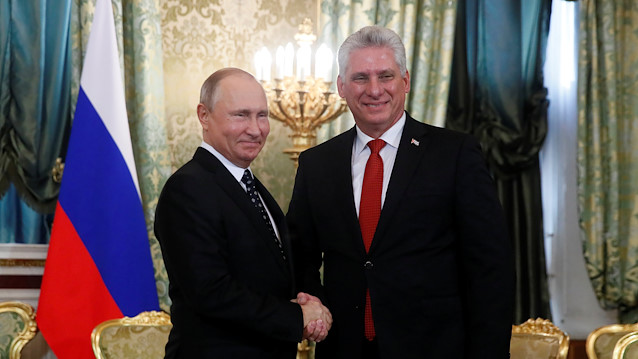
Russian President Vladimir Putin welcomes Cuban President Miguel Diaz-Canel
Russia and Cuba on Friday called on the United States to reconsider its intention to withdraw from a Cold War-era nuclear arms treaty, saying the move would have extremely negative consequences for international security.
Washington has said it wants to quit the Intermediate-Range Nuclear Forces arms treaty and has accused Russia of violating it, something Moscow denies.
Russia and Cuba made their call for the United States to think again in a joint statement issued after talks in Moscow between President Vladimir Putin and Cuban President Miguel Diaz-Canel.
A group of Republican senators asked U.S. President Donald Trump on Wednesday to suspend civilian nuclear talks with Saudi Arabia after the murder of Saudi journalist Jamal Khashoggi and Saudi actions in Yemen and Lebanon.The five U.S. lawmakers, led by Senator Marco Rubio, said they would use the Atomic Energy Act to block any U.S.-Saudi nuclear agreements if Trump did not cut off talks."The ongoing revelations about the murder of Saudi journalist Jamal Khashoggi, as well as certain Saudi actions related to Yemen and Lebanon, have raised further serious concerns about the transparency, accountability, and judgment of current decision makers in Saudi Arabia," the senators wrote.Saudi prosecutor completes inspections in Turkey, heads to airport"We therefore request that you suspend any related negotiations for a U.S.-Saudi civil nuclear agreement for the foreseeable future," said the lawmakers, who included senators Cory Gardner, Rand Paul, Dean Heller and Todd Young.Representatives for the White House did not immediately respond to a request for comment on the letter, which was first reported by NBC News.Khashoggi, a leading critic of Saudi Arabia's de facto ruler, Crown Prince Mohammed bin Salman, disappeared after visiting the Saudi consulate in Istanbul on Oct. 2. The death of the Washington Post columnist, a U.S. resident who had American children, sparked global outrage and pitched the world's top oil exporter into crisis.French foreign minister says sanctions against Saudi Arabia possibleThe United States has called for transparency in the investigation of Khashoggi's death and revoked the U.S. visas of some Saudis over the incident. Trump has said Prince Mohammed bore ultimate responsibility for what happened to Khashoggi but has also cited Riyadh as a strong ally.U.S. Secretary of State Mike Pompeo and Defense Secretary James Mattis on Tuesday called for a cessation of hostilities in Yemen and urged the start of U.N.-led negotiations to end the civil war next month.Saudi Arabia's official comments on Khashoggi's death have shifted from initially denying any involvement to saying the killing was premeditated. Both Saudi Arabia and Turkey are investigating Khashoggi's death. Saudi prosecutor discusses Khashoggi case with Turkish intelligenceUN calls for impartial probe into Khashoggi’s killing
Republican senators urge Trump to suspend nuclear talks with Saudi Arabia
Japan's resurgent nuclear industry will miss a government target of providing at least a fifth of the country's electricity by 2030, a Reuters analysis shows.With eight reactors running and one more set to come online in November, nuclear has this year overtaken non-hydro renewables in power output for the first time since the 2011 catastrophe, when all of the country's nuclear plants were idled.Yet operators can expect as few as six units to restart in the next five years, and fewer than 20 by 2030, the analysis shows. That is far short of the 30 needed to meet the government target reiterated this year.Based on the analysis, the world's third-largest economy may get about 15 percent of its power from nuclear in 2030, compared with a government target of 20-22 percent."It's impossible to meet the target, that's pretty much confirmed," said Takeo Kikkawa, an energy studies professor at Tokyo University of Science, who sat on an official panel that reviewed Japan's energy policy this year.He said he did not expect another round of restarts before 2020.One major trading house predicts nuclear will account for 14 percent of power production in 2030, according to a presentation given at a private seminar this year and shown to Reuters.Nuclear remains an unpopular energy option in Japan and the country will reboot only a fraction of the 54 reactors it had before the disaster.Six reactors at Fukushima Daiichi are being dismantled in a decades-long exercise that is fraught with technological challenges and radioactive waste. Operators have decided to decommission another 10 units across the country since Fukushima.The Nuclear Regulation Authority created new safety standards from scratch after the disaster highlighted failings in the industry and its overseers. All reactors must be relicensed before restarting.Yet Japan's nuclear industry, which before Fukushima operated the world's third-largest number of reactors and provided about 30 percent of the country's electricity, has staged a significant recovery.The turnaround has exceeded expectations of analysts and the utilities themselves. Kansai Electric Power and Kyushu Electric Power, for instance, have won approval to restart or are on course to win approval for all the reactors they applied to relicense.Those units are far from Tokyo and are pressurised water reactors (PWR), unlike the boiling water reactor (BWR) designs favoured in eastern Japan, including those that melted down at Fukushima.Many court cases are pending for reactors in the east of the country. Local political support varies, and the regulator is locked in disputes with operators over earthquake risk assessment.The older BWR technology used in many of the reactors under review is also an issue because the stigma of Fukushima hangs over them."When you come to the BWRs, the issue becomes very politicized," said Nobuo Tanaka, the chairman of the Sasakawa Peace Foundation who was the head of the International Energy Agency between 2007 and 2011 after a stint in Japan's industry ministry.The reputation of Tepco, which operates two nuclear plants that have been damaged in natural disasters, also looms large, Tanaka said."Tepco does not have any support as a nuclear operator," he said. The utility has to be removed from the equation before progress on BWR reactors can be made, he said.Tepco has reached the first stage of approval, but faces strong opposition from local residents. But Japan's utility lobby group said progress was being made."The safety reviews of PWR plants took time but they have been progressing steadily and there have been some developments in the BWR category as well," Satoru Katsuno, the chairman of Japan's federation of electric utilities and president of Chubu Electric, said of the outlook for restart approvals.Chubu Electric has been locked in a dispute for years with the regulator over disaster resilience measures at its Hamaoka plant, which uses BWR reactors.The analysis suggests that Japan will rely on fossil fuels, particularly liquefied natural gas and coal, as the pace of renewables expansion slows. That will make it harder to meet its emissions targets under international agreement.The government estimates costs for replacement fuel – mostly liquefied natural gas - to compensate for idled reactors totalled 14.6 trillion yen ($130 billion) across the industry in the six years through March.The lack of realistic energy targets makes it harder for the industry to plan for investment, utility officials say. And the issue of disaster resilience is not going away: a big earthquake struck the northern island of Hokkaido in September and left a nuclear plant reliant on backup generators.
Japan's nuclear industry growing, but slower than government hoped
Russia's deployment of new nuclear-capable missiles in Europe is jeopardising a key arms control treaty that helped end the Cold War, NATO Secretary General Jens Stoltenberg told a news conference in Norway on Tuesday.President Donald Trump said on Oct. 20 that Washington planned to quit the Intermediate-Range Nuclear Forces (INF) treaty, signed in 1987, amid what he sees as Russian violations of the agreement."The problem is the deployment of new Russian missiles. There are no new U.S. missiles in Europe, but there are more Russian missiles capable of carrying nuclear warheads, and those missiles put the INF treaty in jeopardy," Stoltenberg said."Therefore we call on Russia to ensure that they are in full and transparent compliance with the INF treaty," he added.Video: NATO chief calls on Russia to comply with INF nuclear treatyRussia-Turkey forum to be held in AntalyaPutin wants to discuss US exit from nuclear pact with Trump in Paris
NATO's Stoltenberg calls on Russia to comply with INF nuclear treaty