

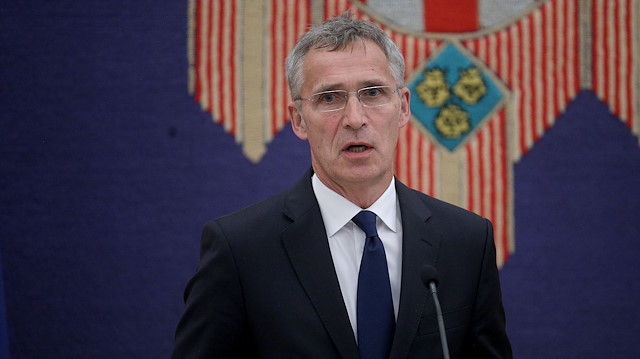
NATO Secretary General Jens Stoltenberg
Russia's deployment of new nuclear-capable missiles in Europe is jeopardising a key arms control treaty that helped end the Cold War, NATO Secretary General Jens Stoltenberg told a news conference in Norway on Tuesday.
President Donald Trump said on Oct. 20 that Washington planned to quit the Intermediate-Range Nuclear Forces (INF) treaty, signed in 1987, amid what he sees as Russian violations of the agreement.
"The problem is the deployment of new Russian missiles. There are no new U.S. missiles in Europe, but there are more Russian missiles capable of carrying nuclear warheads, and those missiles put the INF treaty in jeopardy," Stoltenberg said.
"Therefore we call on Russia to ensure that they are in full and transparent compliance with the INF treaty," he added.
Russia's deployment of new nuclear-capable missiles in Europe is jeopardising a key arms control treaty that helped end the Cold War, NATO Secretary General Jens Stoltenberg told a news conference in Norway on Tuesday (October 30).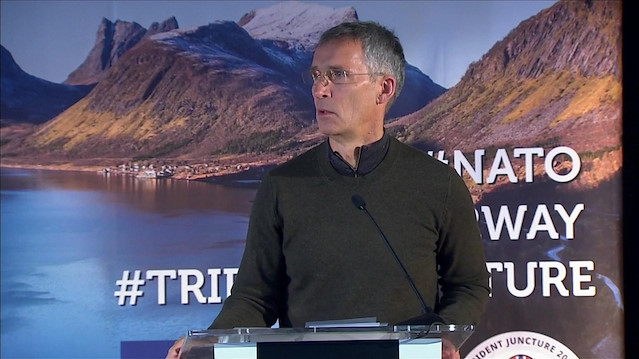
NATO chief calls on Russia to comply with INF nuclear treaty
The Russian-Turkish Public Forum will be held between Nov. 1-4 in Turkey's Mediterranean resort city Antalya, secretary-general of the group said Tuesday. Sergey Markov said that during the session Russian and Turkish experts would discuss underlying problems and offer possible solutions."First question on the agenda is the visa issue. There is now a serious disparity in this area. And this is one of the key issues the Turkish side constantly raises," he said.He offered to move to e-visa and visa issuance at airports in the first stage and then to remove visa requirement for Turkish citizens.Turkey says Idlib deal going as planned, no issue in implementationThe next question on the agenda is a perceptual problem, Markov said."There is a phenomenon, known as the Russian-Turkish information paradox. The Russian media write about Turkey based on what they read on western media, and the same is true with Turkish media. We seem to look to each other through the lens of western media and this reflection is often distorted," he said.This paradox can be resolved easily, Markov said, by opening doors for correspondents from both countries."For now, Anadolu Agency is the only major Turkish media group which has an office in Moscow," he said.Another factor is related to experts who run think-tanks generally financed by western institutes which may manipulate public opinion, Markov added.Teaching shared history will also be discussed at the forum."Russian-Turkish relations have a long and complicated history. The problem here is that the emphasis is on conflict periods. I would suggest that we develop a balanced position on the conflict periods for their teaching in schools, so that it is true, but it does not provoke negative feelings among the representatives of the two nations. And at the same time to highlight the periods of positive development," Markov said.The forum was created by Russian President Vladimir Putin and Turkish President Recep Tayyip Erdoğan in 2013. Its main task is to expand and to deepen Russian-Turkish relations. The results of the forum sessions are reported directly to the two leaders.
Russia-Turkey forum to be held in Antalya
Russian President Vladimir Putin wants to discuss U.S. plans to exit the Intermediate-Range Nuclear Forces (INF) arms treaty with Donald Trump when the two meet in Paris on Nov. 11, the Kremlin said on Monday.Trump and Putin plan to hold a bilateral meeting in Paris on the sidelines of events to commemorate the centenary of the end of World War One."There are still a lot of questions concerning strategic stability, even more so in the context of the stated U.S. intention to leave the INF. All of this will of course be on the agenda," Kremlin spokesman Dmitry Peskov told reporters on a conference call. 
Putin wants to discuss US exit from nuclear pact with Trump in Paris