

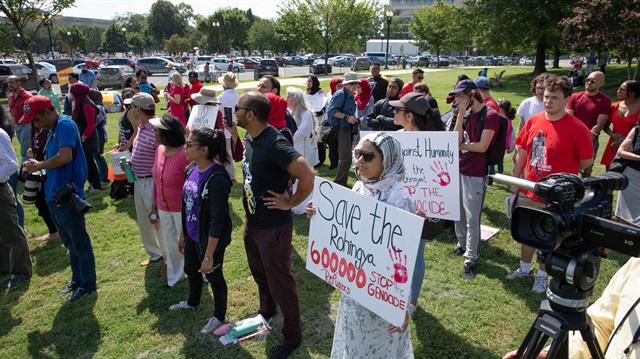
Protest in Washington in solidarity with Rohingya Muslims
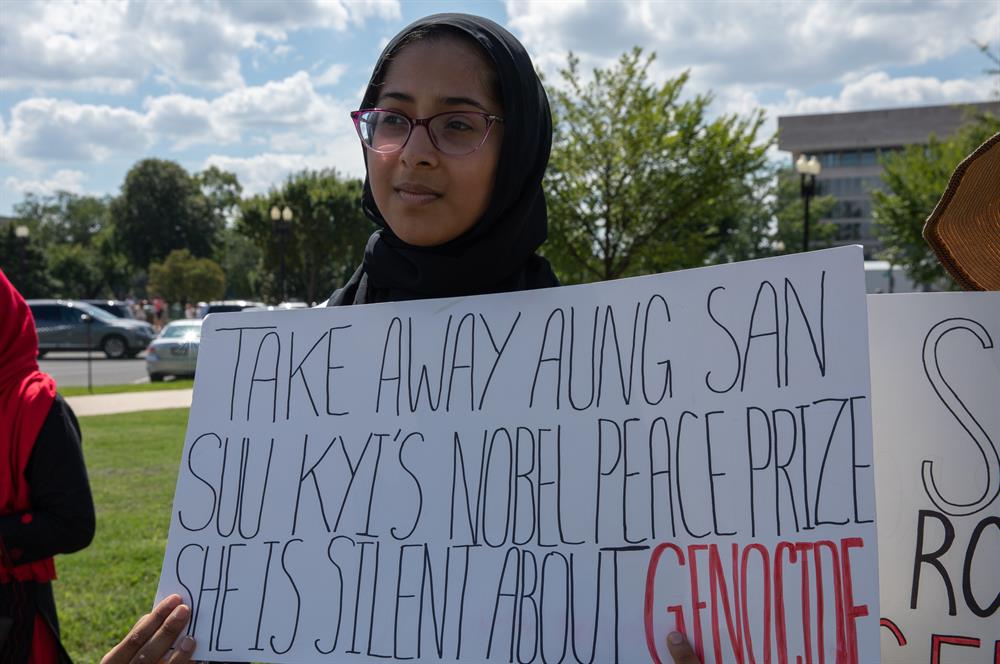
A group of Rohingya Muslims gathered in front of U.S. Capitol building Saturday to mark the first anniversary of violence against their community by the Myanmar army in Rakhine state and their exodus to Bangladesh.
The demonstration was coordinated by multiple Muslim and Rohingya organizations, including the Council on American-Islamic Relations (CAIR), Dar Al-Hijrah Islamic Center, the International Campaign for the Rohingya and the Burma Task Force.
"We want these massacres to be accepted as genocide by the U.S. and international community," Burmese Task Force Director Hena Zuberi told Anadolu Agency.
More than 750,000 Rohingyas fled Myanmar last August and crossed into Bangladesh, fleeing violence and massacres initiated by the Myanmar army.
Zuberi mentioned the Rohingya community thought that the exodus would be a temporary solution and soon the Rohingya would return to their homes, however, one year later, they remain in refugee camps.
"We thought it would be a temporary stay. But it has been a year, and nothing has changed. The needle is stuck, and we want this needle to move," Zuberi added.
"It is a call of the Rohingya people, they have called for this day to be marked all over the world. So we can support them, so we can stand in solidarity with them, so we can educate people about the genocide," Zuberi said, noting that the U.S. administration should take initiative.
Persecuted Rohingya
Since Aug. 25, 2017, more than 24,000 Rohingya Muslims have been killed by Myanmar’s state forces, according to the Ontario International Development Agency (OIDA).
In its recent report, Forced Migration of Rohingya: The Untold Experience, the OIDA increased the estimated number of murdered Rohingya to 23,962 (±881) from an earlier Doctors Without Borders figure of 9,400.
More than 34,000 Rohingya were also thrown into fires, while over 114,000 others were beaten, the OIDA report said, adding that 17,718 (±780) Rohingya women and girls were raped by the Myanmar army and police. More than 115,000 Rohingya houses were burned and 113,000 others were vandalized, it added.
The Rohingya, described by the UN as the world's most persecuted people, have faced heightened fears of attack since dozens were killed in communal violence in 2012.
The UN documented mass gang rapes, killings -- including of infants and young children -- brutal beatings, and disappearances committed by Myanmar state forces. In its report, UN investigators said such violations may have constituted crimes against humanity.
Almost one million Rohingya people have led their lives on the brink in the Cox’s Bazar refugee camp in Bangladesh since Aug. 25, 2017, when forces in neighboring Myanmar launched a crackdown on the minority Muslim community.Conditions for the Rohingya refugees have worsened dramatically since the early days of the influx one year ago, when thousands of people were crossing the border each day, sleeping exposed under open skies, with many in desperate need of medical help and on the brink of starvation.Hafizur Rahman, 34, has memorized the Quran. He used to teach at a religious school at Mangdu, Myanmar called Tahfizul Quran. Now he is teaching at a religious school in the camp called Furkania. He fled Myanmar persecution and took shelter in Kutupalong Rohingya camp.Video: Will the Rohingyas ever go back home?Rahman told Anadolu Agency that he has three children but right now he is not thinking about their future. He is satisfied with the tiny shelter he was given in Bangladesh, saying that it is better than things in Myanmar. From experience he says he doubts Myanmar will give the Rohingya citizenship status. For the time being he is satisfied with his life at the camp.About the future, he says he prays to Allah and does not want to think about anything further.All refugees at the camp have access to shelter, food, and medical care, including from a Turkish-run clinic. But malnutrition, health problems, and food insecurity are at crisis levels, and overcrowding is a major problem that limits access and mobility, thereby increasing safety risks.Asked about his life at Kutupalong Refugee camp in Bangladesh, Md Anis, a former Bypchan primary school teacher in Myanmar, says they sell some of the supplies given to them by aid groups to fulfill their other needs. He told Anadolu Agency that their main needs are a gas stove and cash.Suu Kyi is most polished mouthpiece of Myanmar militaryRohingya languish as repatriation process lingerAnis, 54, had a job for 10 years before deciding to flee Myanmar last September, after seeing his neighbors being brutally tortured by Myanmar’s army.Like other Rohingya, he warns of dire consequences if their basic rights are not met.“If the world doesn’t see us and our basic rights aren’t met, and doesn’t put pressure [on Myanmar] to take us back, then we shall commit suicide if necessary. We don’t want to be victims of the Myanmar military again.”He says if the world fails to give them back their rights they should be given permission to fight for themselves.According to humanitarian community’s 2018 Joint Response Plan (JRP), an estimated 16 percent of the Rohingya are single mothers. Many lost their husbands to violence in Myanmar or to migration in search of livelihoods for survival. A majority of the population are women and children (52 percent are women and girls; 55 percent are children under 18).Arefa Begum, 45, came from Mongdu, Myanmar. She has 10 children, eight of whom are with her in Bangladesh, with her sons Md Alam (20) and Robi Alam (19) still in Myanmar.On the problems women face in camp, Arefa says they don’t find work to earn money. Their small room has little ventilation and it’s hot all the time. They don’t get enough firewood for cooking. The garbage scattered around their room often makes their children sick.The burden of all these problems make Arefa look like an old woman. She says she has six daughters, all unmarried, the eldest 18. They have neither education nor work, and she doesn’t know how to marry them off. She can hardly think of the type of future awaiting them.-Threat of environmental disasterAs of last October, approximately 2,500 acres of forest had been cut for firewood and building shelters. Of this, at least 1,500 acres was cut from social forestry projects, impacting local Bangladeshi communities. The demand for firewood from forests is likely higher than the environment can supply. This could also exacerbate the effects of flooding and cyclones, as low-lying, degraded land will become more exposed.The camps and settlements are also encroaching on Asian elephant territory, which poses a risk to both people (12 Rohingya people have been killed in elephant incursions) and the elephants, whose habitat is being compromised. The endangered Indian elephant, along with deer and two species of Indian civet, is a flagship species in the area that is vulnerable. Out of the total 1,156 wildlife species that inhabit this threatened forest -- including fish, amphibians, reptiles, birds and mammals -- 65 are critically endangered, 94 are endangered, and 56 are vulnerable.In the refugee camps and settlements, with weak shelters and little infrastructure in place, the settlements are particularly vulnerable to this environmental impact. So there is an urgent need to upgrade shelters and to pre-position shelter materials and essential household items for emergency response.-Lack of educationThe refugees are not permitted to enroll in formal education facilities and even when allowed informal access to education, they are denied certification.In particular, recently arrived refugees lack access to safe and protective learning facilities in new campsites and makeshift settlement areas. This gap is partly due to limited space in these areas as well as the time needed to set up educational activities. Cox’s Bazar is among the lowest-performing districts in the country in terms of education access, retention and achievement.UNICEF is providing education in learning centers for 92,000 Rohingya children aged 4-14, teaching them basic literacy, numeracy and life-saving messages in English and Burmese. However, over 50 percent of children in the refugee camps are currently out of reach of education services.UNICEF operates 150 Child-Friendly Spaces where children are enabled to heal following their traumatic exodus from Myanmar. Children receive psycho-social support and case management from trained social workers. Children are encouraged to participate in recreational activities such as games, art, music, and drama. They also learn critical life skills to equip them to understand and deal with the real risks they face in their daily lives, including child labor, child marriage, and human trafficking.Absence of ID documents and recognized legal status impedes refugees’ freedom of movement, as well as access to justice, legal opportunities, accredited education, and other public services.Children also face serious risks such as psychosocial distress, neglect, abuse, separation from caregivers, child marriage, child labor, and trafficking.And conditions in the camps are far from ideal. Many refugee families live on the edge of dangerous hills, with little protection from heavy monsoon rains. The upcoming cyclone season could potentially be devastating for the refugee camps.Children living in the refugee camps face increased risk of waterborne diseases such as acute watery diarrhea.One year on from the start of this crisis, the situation of the Rohingya remains extremely perilous.- A persecuted peopleMore than 24,000 Rohingya Muslims have been killed by Myanmar’s state forces, according to the Ontario International Development Agency (OIDA).In its recent report, Forced Migration of Rohingya: The Untold Experience, the OIDA increased the estimated number of murdered Rohingya to 23,962 (±881) from an earlier Doctors Without Borders figure of 9,400.More than 34,000 Rohingya were also thrown into fires, while over 114,000 others were beaten, the OIDA report said, adding that 17,718 (±780) Rohingya women and girls were raped by the Myanmar army and police. More than 115,000 Rohingya houses were burned and 113,000 others were vandalized, it added.According to Amnesty International, more than 750,000 Rohingya refugees, mostly children and women, have fled Myanmar and crossed into Bangladesh after Myanmar forces launched a crackdown on the minority Muslim community.The Rohingya, described by the UN as the world's most persecuted people, have faced heightened fears of attack since dozens were killed in communal violence in 2012.The UN documented mass gang rapes, killings -- including of infants and young children -- brutal beatings, and disappearances committed by Myanmar state forces. In its report, UN investigators said such violations may have constituted crimes against humanity.
One year since exodus, Rohingya in Bangladesh on the edge
While Bangladesh and Myanmar blame each other for a stalled repatriation process, Rohingya Muslim refugees have continued to suffer in tiny makeshift camps in southeastern Bangladesh.It has been one year since the ethnic minority Rohingya faced massacres by the military beginning Aug. 25, 2017, and fled to Bangladesh. But they have been living in poor in refugee camps in Cox's Bazar with little hope returning home.The issue of repatriation has existed in only official statements and official visits between Bangladesh and Myanmar.Video: Will the Rohingyas ever go back home?Dhaka and Yangon inked a deal last year to repatriate hundreds of thousands of Rohingya following the military crackdown in the western Rakhine state of Myanmar.The deal was sharply criticized by the international community, rights groups and Rohingya organizations, but officials from Myanmar and Bangladesh voiced their determination for repatriation.According to the deal signed Nov. 23, 2017, the repatriation would be launched within two months of the agreement.Korean NGOs mark Rohingya Genocide Remembrance DayRohingya mourn first anniversary of Rakhine massacreCanada to host Rohingya genocide remembrance eventsBut there are has been no notable steps from the either side despite a recent visit to Yangon by Bangladeshi Foreign Minister A.H. Mahmood Ali.Dhaka claimed the trip was “fruitful” but experts on the Rohingya issue said Ali returned home empty-handed.Both countries formed a joint working group of 15 officials each to oversee the repatriation process.The first meeting was in Nay Pyi Daw, Myanmar, on Jan. 15-16.Bangladesh authorities repeatedly stressed Rohingya repatriation would be launched in due time. Several meetings were held with not much movement on the fate of what the UN calls the most persecuted people in the world.However, Bangladeshi Finance Minister Abul Maal Abdul Muhit openly voiced clear doubt about the repatriation process. On March 6, Muhit told reporters, “I do not believe the Rohingya can be sent back.”His statement was echoed by Rohingya experts and several advocacy groups across the globe. A total of 23 Rohingya organizations released a statement June 10, voicing criticism of the deal and said it did not address the root causes of the Rohingya crisis, particularly Rohingya citizenship and ethnic identity.“Repatriation is a life and death question for the whole Rohingya people," the groups said, adding they could not trust the Myanmar government and military that have killed, raped and starved its people with hundreds of villages razed, seized land and homes bulldozed.- 'Myanmar delayed repatriation process'Mohammed Abul Kalam Azad, commissioner of the Rohingya Relief and Repatriation Commission (RRRC) told Anadolu Agency on Saturday in Cox’s Bazar that the repatriation process was delayed due to Myanmar government’s reluctance on the issue."Myanmar has built some camps in the Rakhine state for the Rohingya who would return, Azad said. “But Rohingya told us that if they had to stay in camps after their return to Myanmar, they would prefer to stay here in Cox’s Bazar.”Moreover, their safety, basic rights, freedom of movement should be ensured, he added. “It is very unfortunate that a leader like [Aung San] Suu Kyi make falsified statements against Bangladesh to cover-up their own failure and shortage,” said Azad. The Myanmar leader on Tuesday blamed Bangladesh for the delay in repatriations process, stating it was up to Bangladesh to decide how quickly Rohingya refugees would return to Myanmar. "The returnees have to be sent back by Bangladesh. We can only welcome them at the border," Suu Kyi said at an event in Singapore.- Rohingya demands safety and identity Azad, however, thinks it is the Myanmar government who must ensure the safety and dignity of the Rohingya for their return."Both countries had agreed that the repatriation would be permanent, in a safe way and voluntarily," Azad said, highlighting that Bangladesh would not send them forcibly.Pointing to a recent tour of Myanmar by a Bangladesh delegation led by Foreign Minister Ali, Azad said Myanmar promised to renovate some villages for Rohingya without giving a time frame. “During the visit, they told us that they had initially selected 42 villages in which they will build houses for Rohingya. That means they will rebuild those villages. They also shared plans for supporting farmers, as well as providing other benefits. But they did not tell anything about when the implementation process will be started.”Rohingya living in poor conditions in camps said they would stay where they are rather that return to Myanmar "if our life safety and identity is not ensured". "If they do not give us basic rights and identity of Rohingya, we would prefer to die here in Bangladesh camps with limited access to livelihood," said Mohammad Yunus, a 50-year-old father of two daughters. - Persecuted RohingyaSince Aug. 25, 2017, more than 24,000 Rohingya Muslims have been killed by Myanmar’s state forces, according to the Ontario International Development Agency (OIDA).In its recent report, Forced Migration of Rohingya: The Untold Experience, the OIDA increased the estimated number of murdered Rohingya to 23,962 (±881) from an earlier Doctors Without Borders figure of 9,400.More than 34,000 Rohingya were also thrown into fires, while over 114,000 others were beaten, the OIDA report said, adding that 17,718 (±780) Rohingya women and girls were raped by the Myanmar army and police. More than 115,000 Rohingya houses were burned and 113,000 others were vandalized, it added.According to Amnesty International, more than 750,000 Rohingya refugees, mostly children and women, have fled Myanmar and crossed into Bangladesh after Myanmar forces launched a crackdown on the minority Muslim community.The Rohingya, described by the UN as the world's most persecuted people, have faced heightened fears of attack since dozens were killed in communal violence in 2012.The UN documented mass gang rapes, killings -- including of infants and young children -- brutal beatings, and disappearances committed by Myanmar state forces. In its report, UN investigators said such violations may have constituted crimes against humanity. * Mutasim Billah from Cox's Bazar, Bangladesh contributed to story.
Rohingya languish as repatriation process linger